Dying in Times of Biopower and the Politics of Grief
Updated: Jan 2
Written by Sophie Reyer, Author
Sophie Anna Reyer is an Austrian author of multiple theater pieces and publications. She was born in Vienna, Austria. Reyer discovered her various profound talents in the arts at a young age as a child prodigy.

I still remember, "What is under the stone?" I asked. Back then, as a child. At the cemetery. A body, they said. And why the candles? For the dead. Oh, I see. I nodded, buried my hands in my jacket pockets, and hid my nose beneath the collar of my turtleneck. I didn't understand. Not then, and honestly, I still don’t know. I also wonder whether this crack can ever truly be comprehended. Someone is there, and then suddenly, this someone is no longer there. Suddenly lying beneath the earth as a crumbling remnant, hollowed out by worms. Falling apart into dust and ash. Whenever I think of the dead, I am always a child in front of a stone at the All Saints’ cemetery. And my father’s hand holds mine, clasped onto my left hand.
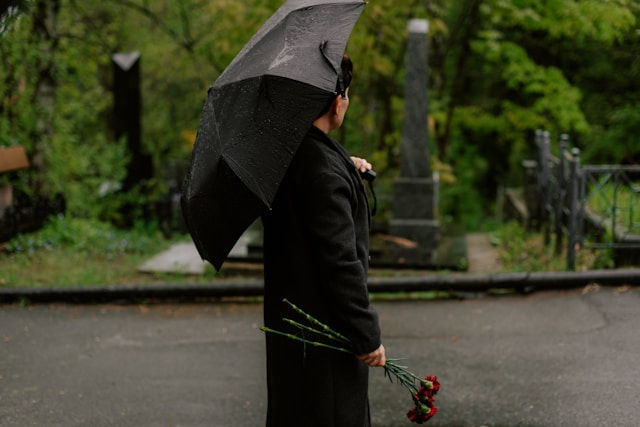
And my mother lights a match. The tiny sparks of the burning wicks drift in the cold November air. The cemetery is a sea of black, sluggish stone masses, their surfaces flickering with soft light. Breath can be exhaled as smoke from the mouth. In the center of the graveyard stands a cross, to which a body is affixed.
Jesus, they say. Why he has thorns on his crown, I also don’t quite understand. So what. They told me he’s not real. I nodded.
Only the crack inside me that’s real. It remained after my grandmother died. And then my aunt, from cancer. I drew an angel for her, with wings in thick luminous marker colors. The shaky drawing was burned along with her body. I didn’t understand that either. The aunt, now just a collection of smoke clouds. That such things happen. Back then, I didn’t quite know how to stand there and stare.
And today? When the pain of loss resurfaces, I ask myself once again whether I know more now. The answer I must give myself is: No. But I do know that mourning the dead is important to cope with the crack that opens inside when someone is no longer there, band to make space for something that has no language, which has always eluded my imagination. The dark patch of death as a trauma, which, like all traumas, is defined by lying beyond verbal grasp. Yes, I think, as I continue to ask myself: You have no words for it. You can dance, scream, laugh, or cry; you won’t be able to dance it out of yourself, scream it out, or laugh or cry it out.
In Mexico, a friend told me, there’s a celebration called Día de los Muertos, where small skulls are painted in bright colors. How cute they look, she said. The Day of the Dead is a vibrant folk festival against the Western-influenced values that the state tries to propagate. It is, in essence, a last remnant preserved from pre-Hispanic indigenous societies. A quite fascinating alternative to the imported Halloween craze, which children in Europe also now celebrate without really knowing why. About a year ago, around All Saints’ Day, a neighbor boy knocked on my door. Mumbled with a twisted face: “Trick or treat,” and at first, I didn’t understand. Only when he repeated his phrase the third time could I connect it in my mind with the American cry “Trick or Treat,” which I had memorized as a child for English class. Unfortunately, I had gobbled up all my chocolate for lunch, so I handed him a little cocoa powder instead, just to prevent him from crying and to let him tell the next day in school that he had enjoyed Halloween too. Did I save the little neighbor boy’s celebration? I wonder.
From mourning the dead to spooning dry cocoa powder a long way. That spooning, or gathering candies, is more pleasant than recognizing losses, I am aware. And surely, both are necessary, both belong to life. I only wonder why our society emphasizes the “fun factor” so much. Where is the space for silence, in which pain can burst forth? And why is entertainment medicine constantly poured into the cracks we carry with us, through talk shows, loud music, and mindless American customs filling the void? Is the fear of the bottomless trauma of loss so great? Is it because mourning, governed by its own laws and rhythms, produces such intense fear within us?
"Grief is anarchistic."
Yes. Grief is subversive. Grief is anarchistic. Grief has explosive power. And: grief is a political act. This is also the opinion of Judith Butler, the American philosopher and literary scholar. As Butler stated in an interview, the shame of many AIDS survivors was so great that they could not allow themselves a public mourning that would have societal and political relevance. For me, the message of Derek Jarman’s film Blue carries an even deeper significance. In it, he poetically documents his own decline and eventual blindness due to HIV. The meticulous portrayal of his suffering, caused by a virus created by humans in a laboratory, forces us to look, even when all we can see is a blue screen, a perspective inspired by Jarman’s own blindness.
But returning to Judith Butler, she describes the process of framing how certain forms of life are perceived as mournable while others are excluded. This technique, she explains, is heavily used by the American media. The life of an American soldier killed in Afghanistan is mourned, but the countless Afghan civilians who also lost their lives are absent from the public mourning registers. Life that isn’t recognized as mournable effectively ceases to exist. Conversely, life that can’t be mourned fades away as if it had never been.
On one hand, the Western world claims universal moral and political standards think of how the US government so vehemently tries to impose Western ideals of equality onto what they call the “backward” East, even as gender equality and women’s rights in the West remain problematic. Chauvinistic ideas and traditional gender roles thrive like never before. On the other hand, these claims evaporate when it comes to the mourning of groups that don’t fit into the frame. Mourning publicly means giving someone a voice in doing so, it becomes a profoundly political act.
But since the bubble of grief carries its own universe, governed by laws different from our busy, stressed daily life, rituals and religious forms of processing can only serve as crutches, a means to bring the unintegrable, the unspeakable, into some kind of articulation.
I think, for example, of the reenactment of death during a funeral when the coffin is shovelled full of earth, like in theater, where the curtain falls to signal that the play is over, filling the coffin with small shovelfuls of earth becomes a performative act that helps us grasp the concept of loss. The crack remains, a scar in the topography of the soul; it reminds us of what was valuable and is now gone.
Today is a foggy autumn day. I am practicing mourning. I admit it to myself. I mourn all those who have no names, who are not registered in the measurable grid of reality. The politically persecuted women behind veils, just as much as women under daily pressure to objectify their bodies, victims of a war fought under the hollow pretext of bringing “modernity” to a country, costing countless lives.
I mourn, and to do so, I listen to Antony’s song The Spirit Was Gone. I gaze out of the window, yes, I mourn, I don’t need religion, ideology, or fixed rituals for that. I softly sing along with the CD: “The spirit has gone from her body. Forever. It has always been inside. And now it’s disentwined. It’s hard to understand.”
Read more from Sophie Reyer
Sophie Reyer, Author
Sophie Anna Reyer is an Austrian author of multiple theater pieces and publications. She was born in Vienna, Austria. Reyer discovered her various profound talents in the arts at a young age as a child prodigy. She is a writer of theater pieces (S. Fischer) and novels (Emons) and was shortlisted for the Austrian Book Award in 2019 and 2021.