Why Most Training Doesn’t Work and What Actually Drives People Development
Fabienne helps women leaders to expand their influence and impact authentically, resulting in more balance and financial success. She is the founder of TalentMakers®, the creator of Start-To-Lead®, and the author of "The She Leader”, published in 2022.

Despite decades of innovation in corporate learning, most training still fails to create lasting transformation. Why? Because organizations keep clinging to outdated beliefs about how people grow. After 30+ years in the field, I’ve seen these myths up close, and I’m here to debunk them once and for all. If you’re ready to stop checking boxes and start igniting real change, read on.
Why people development still isn’t working
I’ve been working in people development, what I personally prefer to call it, instead of the impersonal “talent development” for over 30 years. And in that time, I’ve seen every trend, theory, and “revolutionary” method come and go. But despite all the innovation, organizations are still facing the same frustrating challenge: training that doesn’t lead to true transformation.
Why?
Because far too many companies are still building learning strategies on outdated assumptions. Let’s expose the most common myths and then replace them with the truths that actually move people and organizations forward.
Myth 1: People learn by listening
This outdated model still drives far too many learning initiatives. The idea that people retain knowledge just by hearing it is not only flawed, it’s counterproductive.
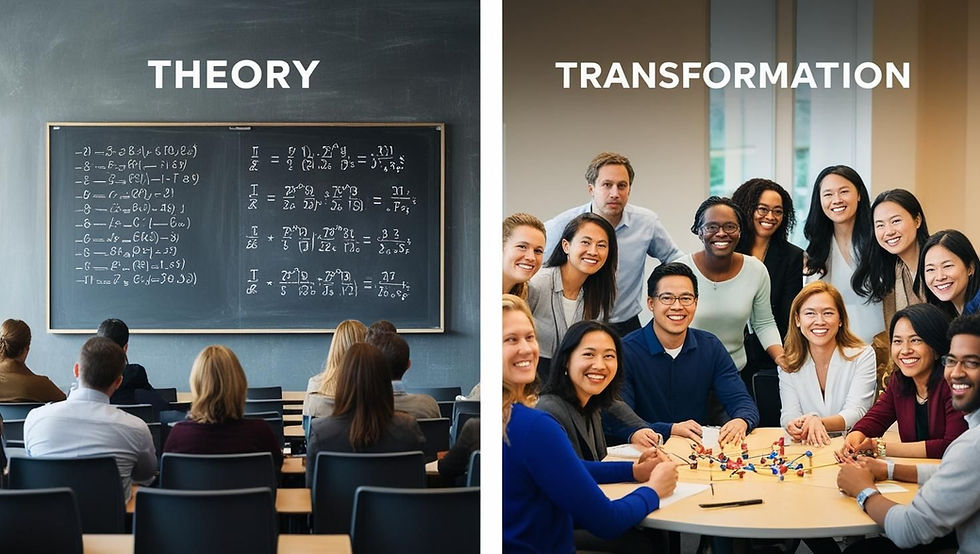
The truth: People don’t learn by listening. They learn by doing.
Think back to your last training session. You might have taken notes, nodded in agreement… and forgotten most of it a week later. Passive consumption doesn’t lead to transformation.
What actually works? Experiential learning. When people are actively involved in testing ideas, making decisions, navigating failure, and reflecting, they embed new insights and behaviors more deeply.
Insight: The best people development programs don’t just teach theory; they simulate reality. They invite leaders into hands-on situations that challenge their thinking and stretch their abilities in real-time.
Myth 2: More Information Equals More Learning
Many organizations still believe that cramming more content into a training equals more value. But content overload leads to mental fatigue, not mastery.
Let’s be honest: Information doesn’t transform people. Experiences do.
Effective people development focuses on depth, not volume. It’s about helping people engage deeply with one idea, one challenge, one shift in mindset or behavior at a time.
Real example: Instead of a two-hour slide show on feedback theory, offer a 45-minute coaching session where participants navigate difficult feedback conversations in real time. That’s how skills are internalized.
Myth 3: Traditional training formats are enough
A one-day workshop might tick a box, but it doesn’t transform behavior.
People don’t grow in conference rooms. They grow in the flow of their actual work when they’re challenged, supported, and encouraged to reflect on real-life situations.
Modern people development needs to move from being event-based to being embedded into the daily rhythm of leadership. It should show up in the way people lead meetings, give feedback, navigate ambiguity, and manage change.
Perspective shift: People development isn’t a “learning moment.” It’s a leadership journey.
Myth 4: Senior leaders don’t need to be involved
This is one of the biggest reasons people development efforts fall flat. Leadership cannot be outsourced to L&D or HR.
When top leaders don’t model learning, neither will anyone else.
Programs only succeed when senior leaders show up not just as sponsors, but as participants. When they share their growth journey, attend sessions, and role-model learning, it signals to the organization that development is part of the business strategy, not a side project.
Key question: Do your leaders talk about what they’re learning? Or just about what others should be doing?
So, what actually works in people development today?
To drive true transformation, organizations need to shift their entire approach to how they support growth. That means focusing on:
Designing experience-first learning: Because people learn best when they’re active participants, not passive observers.
Emphasizing transformation over information: Because real learning changes how people think, behave, and lead.
Embedding learning into the flow of work: So development happens not outside the job, but inside it.
Engaging senior leaders as role models and champions: Because when leaders prioritize growth, the entire culture follows.
Final thought: Stop teaching, start transforming
People development isn’t just about content delivery. It’s about creating growth environments that inspire, challenge, and support human potential.
In a world where change is constant, developing people isn’t a “nice to have.” It’s a strategic imperative.
So here’s my challenge to you:
Stop settling for outdated learning models.
Start designing people development experiences that stick.
Because transformation doesn’t happen by talking, it happens by doing.
Let’s talk about what’s next
If your organization is ready to move beyond old-school training and build a people development culture that actually works, I’d love to explore ideas with you.
Feel free to reach out through my website or connect with me on LinkedIn.
Read more from Fabienne Renders
Fabienne Renders, Women’s Leadership Mentor | L&D Expert
Fabienne is the leadership mentor to female leaders who want to improve their careers and life. She is passionate about helping them expand their influence and impact while enjoying being true to themselves.
She is the founder of TalentMakers® and the creator of Start-To-Lead®. She has been in the corporate world for over 30 years and has helped thousands of employees of renowned companies learn and develop.
Her mission: Better Leadership for a Better World.