From Hollywood Dreams To Healing Hearts: Dennaé Dumas - Sex Therapist And Coach- Exclusive Interview
Brainz Magazine Exclusive Interview
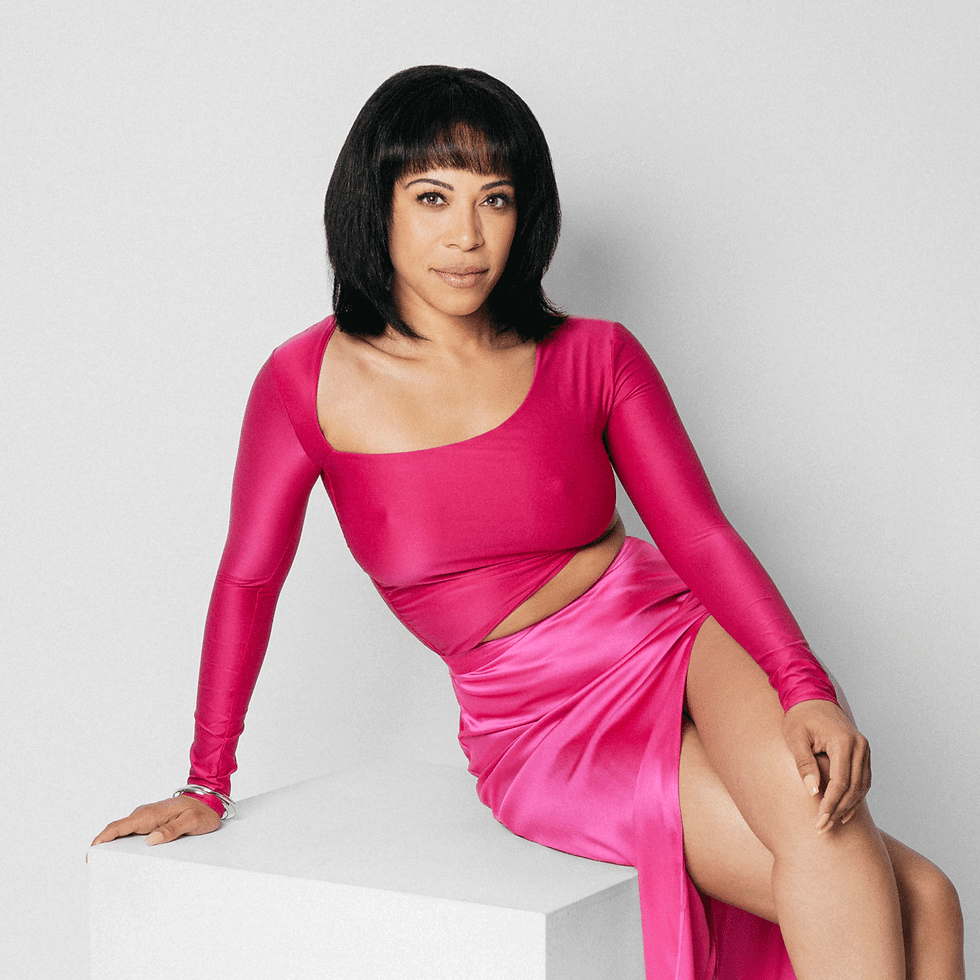
Dennaé Dumas was born and raised in Los Angeles, California. In her adolescence, her family briefly moved to the suburbs of Philadelphia but eventually ended up in Raleigh, North Carolina. This is where she finished an undergraduate degree at the University of North Carolina at Greensboro in Communication Studies with a Minor in Business. As an undergrad, Dennaé spent a year in Lyon, France. She learned the French language and got an opportunity to fulfill her desire to travel the world. After college and missing Southern California significantly, Dennaé moved back to Los Angeles to become an actress.
Dennaé spent many years pursuing her Hollywood dreams. One day, she realized that although she loved the entertainment industry, her true passion was to help others. She started a life coaching practice assisting clients in living their “best life.” Due to how much she loved it, a friend recommended getting a master’s in social work to work with more people. Dennaé graduated from Columbia University with both an MSW and an MBA. She credits her parents for inspiring her love of helping others. Currently, Dennaé Dumas works as a sex therapist and a sex, intimacy, and relationship coach.
What led you to become a sex therapist and intimacy/relationship coach, can you tell us about your journey and the experiences that influenced your career choice?
I always enjoyed working with others. I was pursuing an entertainment career in Los Angeles when I started a life coaching practice. At the time, I did not think it would necessarily be my new career. But when people came to me for support, I immediately recognized that I needed training in psychology and psychotherapy. So, I went to Columbia University, where I graduated with an MSW and an MBA. While there, I met a fantastic friend in a human sexuality class who told me she thought I would be a great sex therapist. I laugh about it now because it´s like, how do you know if someone would be a great sex therapist?
Nonetheless, I guess she saw something I didn’t see in myself. We were taking the class with this fantastic professor, and the course blew my mind away. The class focused on the intersection of sex, culture, race, and socioeconomics. I was so fascinated by what I was learning. I began to see the world and myself through a new lens. This is one of the best, most unexpected journeys of my life. However, I would not have had it any other way. Additionally, I can use my past coaching skills and my skills as a performer to strengthen my work as a sex therapist. It is the perfect integration of all my life experiences.
What key areas do you specialize in as a sex therapist and intimacy/relationship coach?
How do you help individuals and couples navigate these areas effectively?
My work as a sex therapist can involve addressing any emotional or mental barriers to sexual function, which can include lack of desire, lack of arousal, difficulty having an orgasm (anorgasmia), performance issues, pain during sex (dyspareunia), ED (erectile dysfunction), and ejaculation issues. I do not treat physical or medical conditions but can collaborate with medical providers. In addition, I can also help with challenges with sex education or miseducation, communication between partners, hypersexual disorders, sexual trauma, gender identity or sexual orientation, polyamory, or multi-partner relationships, navigating ethical nonmonogamy, relationship ruptures, compulsive behaviors, cultural and religious, and societal messaging around sex. A sex therapist uses therapeutic modalities to treat various conditions. Sex, intimacy, and relationship coaching differ from therapy because it is more aspirational. It can center around helping people redefine their erotic template, improve the quality of their sex lives by exploring passion, develop skills to enhance their pleasure during sex, discover and realize their sexual fantasies, learn how to negotiate their boundaries in the bedroom, and help people actualize their sexual goals.
Sex, intimacy, and relationship coaching are essential in that it helps people navigate some of these areas effectively. It begins by honoring where people are currently in their journey and supports how they come to relate to themselves as sexual beings—allowing people the opportunity to examine their sexuality and recognize that sex is a holistic part of the human experience. Sex, intimacy, and relationship coaching meets clients where they are and establishes clear, actionable steps to improve their sexual experience.
How do you create a safe and non-judgmental environment for your clients to discuss
sensitive and intimate topics?
This is an excellent question! I see the concept of safety as integral to establishing a climate where pleasure, play, and exploration can exist during sex. While nothing is 100% safe, the ability to discuss expectations, reinforce communication, and acknowledge autonomy helps people feel more empowered to make decisions that align with them. The goal is to give people enough information and tools so that they can cultivate the experience that is right for them. It is not about creating a sexual experience deemed suitable for everyone; it is about honoring differences in culture, worldview, and identity that are the cornerstone of who we are. Respecting these differences allows people to be validated, seen, and affirmed, leading to a better relationship with sex, partnership, and themselves.
Can you share a specific case or client success story showcasing your work & its positive impact as a sex therapist and intimacy/relationship coach?
While out of respect for my clients, I won´t share a specific case or client story, as I want to honor the privacy of the people I work with, what I will say is that when people are allowed to show up holistically, sex is then emphasized as a part of that experience. Growth seems to happen by leaps and bounds when people are better able to cultivate a life of pleasure. They begin to see their sex lives as a continuous investment that grows over the lifespan versus something that just is. The marker for true success is what clients set for themselves. More importantly, it´s about honoring the journey one takes as a sexual being regardless of what that means individually and the idea that you can be an ever-growing person within this space. It allows the understanding that you can change over time, and the space within human sexuality becomes more expansive.
What common challenges or misconceptions do people face regarding their sexual and
intimate lives and how do you address these challenges in your practice?
I think some of the common challenges people face involve self-worth, self-love, and body image. If you don't have a good relationship with your body or self, it can prohibit sexual desire or the experience of pleasure in a way that sometimes people don´t truly understand. Also, in relationships, people underestimate the importance of communication in improving one’s sex life. Sometimes cultural messages can be a challenge. Within the session, people can challenge those cultural norms or beliefs and define some things for themselves. There are a lot of cultural messages about what it means to have sex or what sex is supposed to look like in a partnership. But every partnership is different. It is about the shared agreement with the people in the relationship and whether everyone is happy.
One of the ways that these challenges are addressed in my practice is by exploring a person and it´s history with sex. How did they learn about it? What message did they receive about it from their family, school, community, and culture? How do those messages currently show up in the way they view sex? A common misconception people face regarding their sexual and intimate lives is that everyone should have the same type of sex. Or if you are sex-positive, then you are automatically promiscuous. Diving deeper into who you are as a sexual being does not equate or place a value on how often, what type, or whom you have sex with. It is about developing a greater understanding of who you are so that you can have a relationship with sex that is specific to you.
What techniques or methodologies do you employ to help individuals and couples
improve their communication, emotional connection, and overall satisfaction in their
relationships?
I like to use different theoretical frameworks, influencing the modalities I use in sessions. They may include the Gottman method, The Couples Developmental Model, Dialectal Behavioral Therapy, Emotion Focus Therapy (EFT), and Imago. Some exercises incorporate Internal Family Systems (IFS), Inner Child Work, Narrative Therapy, or CBT. Attachment theory is a huge one for understanding relationships. When we use attachment styles as a framework, clients then begin to see how those styles show up in the way that they partner in a relationship or influence their sex lives.
How do you approach cultural and individual diversity as a sex therapist and
intimacy/relationship coach? How do you ensure inclusivity and sensitivity towards
different backgrounds and belief systems?
I love this question about cultural and individual diversity because this is the crux of the type of work I want to do and how I engage with the human sexuality field. My work is grounded in the fact that people have diverse identities, and their experiences in the world influence how people relate to themselves as sexual beings. I always want to honor people’s lived experiences appropriately. It´s essential to investigate what a client values regarding their sex life. Whether you´re an individual, a couple, or a multi-partner group, it´s about understanding the person & their values, their identity, and how those things relate to the concept of sex in a way that supports their goals and personal desires.
How are you updated with the latest research, developments, and best practices in sex
therapy, intimacy, and relationship coaching?
I must stay at the forefront of my industry to provide the best care for my clients. I do so by seeing myself as a continuous student. I was taught that you can never truly master something, as there is always something new to learn in any industry. One of the ways that I stay engaged is by being an active part of the community. I truly believe in collaboration as a way to strengthen relationships. I want to work with people pushing this field´s limits and boundaries so that more and more experiences are represented. I am excited to state that I am getting my Ph.D. as a clinical sexologist at Weiner University. Human sexuality is so expansive. I will always be learning, growing, and improving in this field. It makes for an unpredictable and exciting journey.
Can you discuss the importance of self-care and personal boundaries for professionals in sex therapy and intimacy/relationship coaching? How do you prioritize your well-being while supporting others in their journeys?
Any work with people, whether you're a clinician, a teacher, or a doctor, requires one to prioritize self-care. People-centered professions can be very stressful. Self-care helps me manage stress and anxiety while increasing my energy and mood to show up for clients. Showing up for others helps me hold space for someone else´s experience. Regarding boundaries, I always say that boundaries are a form of love. Boundaries help everyone be on the same page. They minimize misunderstandings and help create clear guidelines for how I would like to be treated. When I express my boundaries, it is a way to model boundary setting for my clients. They let clients know what acceptable behaviors are and what are not. Boundaries help to honor our needs and cultivate respect and safety so that we can have the freedom to play.