Why Every Hospital Must Adopt Memory Care Training – A Call to Protect Our Patients and Our Staff
Written by Clifford Cartagena, CEO & Founder
Clifford Cartagena, RN, BSN, is a psychiatric nurse, safety trainer, and founder of Gentleway Systems LLC. Co-founder of Arizona Care Horizon Institute, he is completing his PMHNP degree at Walden University. Author of The Gentle Art of Crisis, he advances trauma-informed, dignified approaches to workplace safety.

Dementia care is no longer confined to memory care units. It is present in every hospital department, and too often, staff are left without the practical training needed to communicate, de-escalate, and protect both patients and themselves. This article is a call to transform hospital culture by making memory care training a standard of excellence, not a specialty add-on.
A gap we can no longer ignore
Despite years of nursing education, countless in service sessions, and mandatory continuing education, I have discovered that many nurses and hospital staff are not truly prepared to care for patients living with dementia or Alzheimer’s disease. Textbooks and lectures teach the disease process, but not how to connect, calm, and communicate with someone who no longer processes the world as we do. This missing piece leads to frustration, unnecessary agitation, and even workplace violence incidents in hospital settings. It is not a matter of competence. It is a matter of training the heart and the hands together.
Why this matters for every hospital
Dementia is not a diagnosis isolated to memory care homes. It is everywhere, in emergency departments, telemetry units, ICUs, psychiatric hospitals, and rehab facilities. In fact, research shows that up to 25 percent of hospitalized adults over age 65 show signs of dementia, often undiagnosed upon admission. When staff are unprepared, common behaviors such as wandering, confusion, or agitation are misinterpreted as noncompliance or psychiatric illness. This can lead to restraint, sedation, or confrontation, actions that harm dignity, escalate fear, and compromise safety.
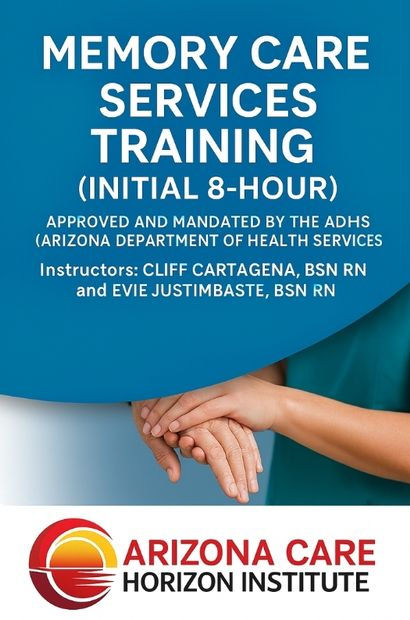
The Arizona Department of Health Services (ADHS) took a bold step by mandating Memory Care Services (MCS) Training for assisted living and memory care facilities beginning July 1, 2025. But the truth is, hospitals need this training too.
How my practice changed
After completing the ADHS authorized Memory Care Services Training, my understanding of dementia transformed. I began to see not just the symptoms, but the person behind them. I learned communication techniques that reduce agitation, body positioning that promotes safety, and empathy driven strategies that restore connection. The results were immediate. My patients were calmer, more trusting, and safer. As an authorized ADHS instructor, I now train caregivers, managers, and providers across Arizona, empowering them to care with compassion and confidence.
What hospital leaders must know
Every hospital already trains for code blues, fire safety, and infection control, because lives depend on it. The same must now be true for memory care competency.
Here is what adopting MCS training can do for your facility:
Reduce patient aggression and staff injuries.
Lower use of restraints and unnecessary medications.
Improve HCAHPS and family satisfaction scores.
Strengthen compliance with CMS and Joint Commission safety goals.
Elevate staff morale by giving them confidence, not fear, in caring for cognitively impaired patients.
This is more than compliance. It is culture change.
A new model for training, blended, accessible, transformative
Through the Arizona Care Horizon Institute (ACHI), we have successfully delivered the ADHS approved eight hour initial, four hour manager level, and four hour annual refresher trainings across Arizona. Now, with the support of Gentleway Systems LLC, we are developing an eight hour blended learning format, six hours online and two hours live skills training, to make it even easier for hospital systems to adopt.
Our team is also exploring virtual reality integration to create immersive dementia care simulations. This is a new frontier in education, and we want hospitals to be the first to benefit.
A call to my fellow nurses and healthcare leaders
Every time a patient with dementia enters a hospital, we are entrusted with their safety, comfort, and dignity. That responsibility cannot be left to chance or improvisation.
We need a system-wide shift, one that treats dementia care not as a specialty, but as a standard of excellence for all who touch patients’ lives.
Hospitals are where crises unfold, but they can also be where change begins. Let’s lead it.
Read more from Clifford Cartagena
Clifford Cartagena, CEO & Founder
Clifford Cartagena, RN, BSN, is a psychiatric and medical-surgical nurse, hospice provider, safety trainer, and founder of Gentleway Systems LLC. He is also the co-founder of the Arizona Care Horizon Institute. He was authorized by the ADHS (Arizona Department of Health Services) to deliver the Memory Care Services Training in Arizona. Cliff is currently completing his Psychiatric Mental Health Nurse Practitioner (PMHNP) degree at Walden University. He is the author of The Gentle Art of Crisis. With more than 20 years of nursing and leadership experience, he developed the Gentleway System, a trauma-informed approach to preventing and managing assaultive behaviors across healthcare and beyond. Learn more here.