A Quiet Bar, a Loud Topic, and the Beauty of Changing Your Mind
Written by DDL Smith, Author
DDL Smith is a British novelist known for ‘Detective Dion’ and the eco-horror novel ‘Decay’. His independently published novels have attained global reach with his ‘think like a publisher’ mentality.

A few weeks ago, I found myself escaping the winter air in a quiet bar. A customer ordered a steak well-done, only to be persuaded away from culinary arson by the bartender. Pleased with herself, the bartender skipped back to me to continue our conversation.
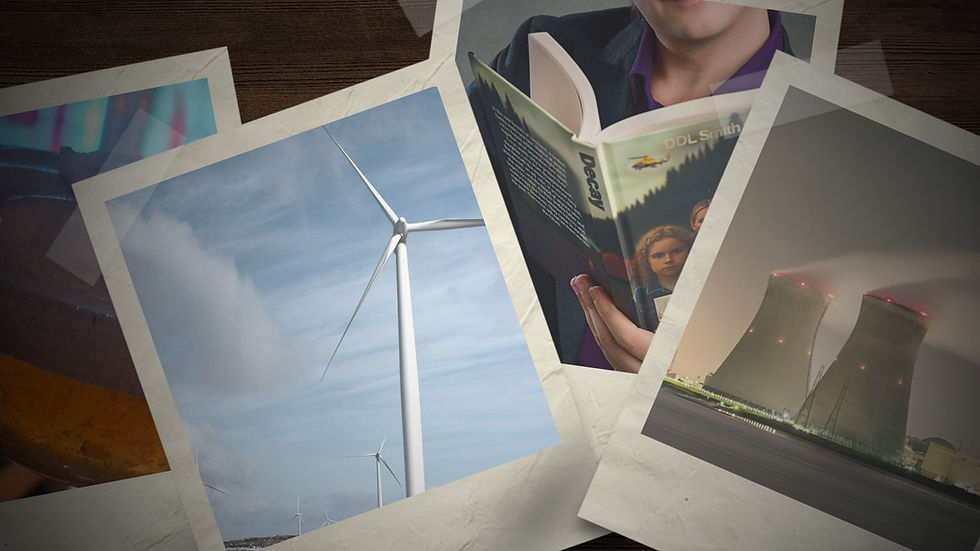
We danced through a handful of topics, from tequila to Pokémon cards to the Polaroid of me hung up on the wall from last year. One of our conversations involved debating which was better, nuclear or wind power.
They weren't too keen on nuclear, whereas I'm all for it. But the conversation got me thinking. In a world of authors, entrepreneurs, and business owners, our mentors have always emphasized the importance of being an authority figure in our fields. But what should happen when our views are challenged, more complex than thought, or even flat-out wrong? Even as experts in our fields, the world isn't divided into right and wrong answers. We should still hear other views because, who knows, we might just learn even more.
Let's look at our two views about which is better, nuclear or wind.
The debate
Wind power feels natural. Unthreatening. There will still be wind long after our civilization is gone. There's wind on other planets, unlike the refined materials used for nuclear power. It's fast to deploy and increasingly inexpensive. One turbine can power a village without the need for huge concrete factories to build reactors. Clean, scalable, and free of historical fear.
For nuclear, there's an upfront cost. But nuclear is dependable, with its facilities lasting far longer than any turbine would before breaking. Nuclear provides a large amount of reliable power without taking up as much space as turbines would, space that can be used for farmland or to protect habitats.
A difference in perspective is the main driver behind our views. This conversation took place in a city of 60,000 people. Beyond the city are tiny villages, sparsely dotted among a seemingly endless Swedish wilderness. There's space for turbines that would provide enough power. A short walk from my front door and up a viewing deck, you're suddenly looking over central London. You'd see the population of Sweden before the horizon. Beyond that, endless towns, cities, and farms. There's not enough space in London to power it with wind turbines.
We both had the right mindset for what works in our communities, yet our solutions were wrong for each other's.
The numbers
When I got home, I looked over the numbers to see who was right, hoping to be right and laugh maniacally in my office. I knew nuclear would produce more CO₂ during construction than a field of wind turbines. However, the emissions did not scale as I thought.
To produce the same power output from turbines as a modern-day nuclear reactor, you'd need around 265 turbines, several times that number if you're comparing real delivered output over 80 years with a nuclear reactor. When you factor in the construction costs for both, they average out. Wind averages around 7–12 g CO₂/kWh. Nuclear sits between 3.7–12 g CO₂/kWh, depending on enrichment methods and plant lifespan.
Neither one is cleaner than the other. We were both wrong on that front. But each has its own environment where one makes more sense over the other. Seeing the facts more clearly helps us, individually, make the right decisions and adapt. When we want to be seen as the expert in the room in our fields, it's very easy to double down on the narrative rather than be open to refinement.
When certainty becomes a habit of the mind
To me, doubling down on our views to be seen as an expert is no clearer in our example than in the UK's Green Party manifesto on nuclear energy. In their manifesto, they argue that nuclear is "unsafe and much more expensive than renewables." Scottish Greens call nuclear "no solution to the climate crisis." We've discussed the climate crisis solution above and the matter of safety in a previous article. So, let's take their remaining point, cost.
Sizewell C, a planned nuclear plant in the UK, is projected to cost £40bn. Offshore turbines to match the capacity would be around £8bn. On the surface, they have a point. But from a different perspective, wind turbines would last around 20 to 25 years before being replaced. A modern UK plant can last up to 80 years. Lifecycle costs look much closer in cost now, £40bn upfront versus £32bn over the same lifecycle. When factoring in the extra space required in the UK for onshore turbines, the taking of farmland or development areas, and the lower economic stimulus, the costs seem negligible.
Yet we see political leaders choosing a clear side when, in reality, both are viable solutions. This "doubling down" doesn't show leadership or expertise, it signals avoidance.
We can carry this lesson into our work and home lives too. It's okay for our minds to change and evolve our ideas, that's innovation, not weakness. Changing our minds or not knowing doesn't stop us from being experts in our respective fields, it gives us space to be even better. I take pride in my novels for breaking down complicated concepts from whatever fixation or new hobby I have while writing. Having my views changed, or not knowing how to write something, is part of why I love writing.
Scientists are experts in their field. But if a new discovery proves them wrong, understanding the data at hand and forming a more robust theory makes them more credible. Doubling down on their opinion does not.
Conclusion
Our conversation back at the bar moved on from the energy debate peacefully, with both of us gaining a wider understanding. We spoke about the best ice hockey team, with no debate needed, then threw obscure facts like trivia-obsessed gremlins. One new thing we learned is that the tequila brand José Cuervo has its own train.
At the end of the night, my phone sat charging on a single USB-C cable. I found myself remembering an era when we had dozens of proprietary cables. Every company argued that theirs was the best, yet in reality, it meant we never had the correct cable with us when we needed it. Agreeing and using the best of everything gave us a solution that quietly makes our lives a little easier.
It seems strange for two Europeans to spend an evening comparing the merits of different green energy technologies while other parts of the world choke from coal emissions. However, conversations like ours are something policymakers struggle with. Progress is born from listening. Becoming an expert is born from learning. Little by little. One friendly debate at a time. We become a little more connected and a little more hopeful. Once we continue to refine our views, we'll be seen as experts in the future, helping to understand and lead a far nicer world.
Read more from DDL Smith
DDL Smith, Author
DDL Smith is a London-based novelist whose cross-genre, contemporary fiction reflects issues and fears in modern society. His creative roots started from a young age with theatre and scriptwriting for online content. When transitioning to novels, his goal was to use marketing techniques to ‘think like a publisher’ while staying independent. A tactic that has his books available in book chains across the globe.