When Dementia is Mistaken for Psychosis and the Clinical Error That Escalates Care
Updated: Mar 19
Written by Clifford Cartagena, CEO & Founder
Clifford Cartagena, RN, BSN, is a psychiatric nurse, safety trainer, and founder of Gentleway Systems LLC. Co-founder of Arizona Care Horizon Institute, he is completing his PMHNP degree at Walden University. Author of The Gentle Art of Crisis, he advances trauma-informed, dignified approaches to workplace safety.

Every year, thousands of patients are mislabeled. A confused older adult is called “combative.” A hallucinating patient is labeled “psychotic.” A wandering resident is considered “noncompliant.” But what if the behavior is neither defiance nor primary psychiatric illness? What if it is dementia being misunderstood?
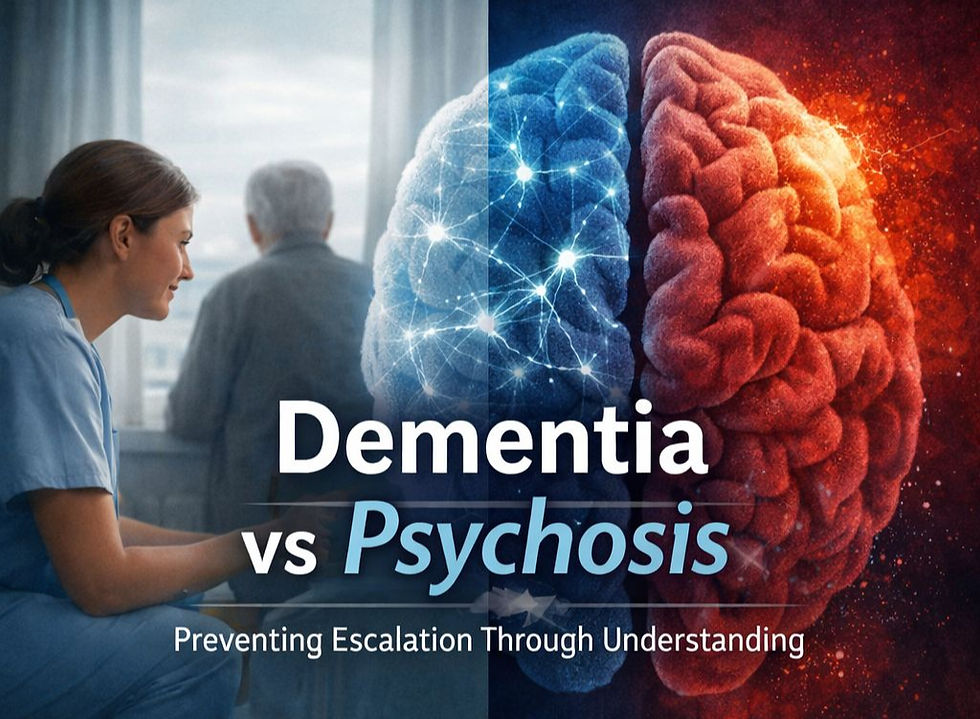
The clinical distinction between dementia-related behavioral symptoms and primary psychosis is not academic. It is a safety issue. And when professionals get it wrong, escalation follows.
The high cost of misinterpretation
Dementia affects cognition, memory, perception, and executive functioning. As the disease progresses, individuals may experience:
Visual hallucinations
Paranoia
Agitation
Disorganized speech
Emotional lability
These symptoms can resemble schizophrenia or acute psychosis. However, the neurological origins, progression patterns, and response to intervention are fundamentally different.
When staff assume “psychiatric aggression” instead of “neurological confusion,” they often respond with:
Verbal confrontation
Physical restriction
Overmedication
Law enforcement activation
Involuntary holds
Each of these increases trauma risk for both the patient and the staff. Escalation rarely begins with violence. It starts with a misunderstanding.
Why de-escalation fails in dementia cases
Traditional de-escalation models are built around restoring logic and reason. They rely on:
Reality orientation
Rational discussion
Behavioral contracts
Directive communication
These approaches can work in primary psychosis once acute symptoms stabilize. They often fail in advanced dementia. Why? Because you cannot reason with a brain that no longer typically processes time, context, or identity.
If a patient with dementia believes they are 25 years old and need to go to work, telling them they are 84 and retired is not grounding, it is threatening. The nervous system responds accordingly.
Neurology vs. psychiatry: A practical distinction
Primary psychosis typically presents with:
Organized delusional systems
Auditory hallucinations
Gradual symptom development
Insight fluctuations
Dementia-related behavioral disturbances are more commonly present with:
Visual hallucinations
Sundowning patterns
Rapid environmental sensitivity
Cognitive decline over time
Executive dysfunction
Understanding the pattern changes the intervention. Instead of correction, you use redirection. Instead of confrontation, you validate emotion. Instead of control, you adjust the environment. The intervention is neurological, not disciplinary.
The escalation chain
Here is what often happens in facilities:
Staff misinterpret behavior.
Staff apply incorrect de-escalation method.
Patient becomes more fearful.
Physical resistance increases.
Emergency measures are used.
Trauma is reinforced.
Documentation labels patient “aggressive.”
The cycle repeats. Breaking this cycle requires training that differentiates behavioral health crisis from neurocognitive disorder response.
The public health implications
The aging population is increasing. Hospitals, assisted living facilities, memory care units, behavioral health centers, and emergency departments are encountering more mixed presentations dementia layered with depression, trauma, or delirium.
Without structured education, escalation becomes the default. With proper training, escalation can be prevented.
What professionals must learn
Practical prevention training must include:
Rapid bedside differentiation between dementia and primary psychosis
Trauma-informed response models
Environmental modification strategies
Non-restriction positioning techniques
Language shifts that reduce defensive reactions
Family communication methods
Clear decision trees for when psychiatric transfer is appropriate
When teams understand the neurological root, physical restraint rates decrease. Medication reliance decreases. Staff injury decreases. Patient dignity increases.
March is Brain Awareness Month, a time to correct the narrative
We talk about Alzheimer's awareness. We talk about behavioral health reform. We talk about crisis response models. But we rarely talk about the intersection where misdiagnosis creates preventable escalation.
If we genuinely care about patient safety, we must move beyond generic de-escalation and into diagnosis-informed response. That shift alone can change outcomes.
If your team is encountering escalating behaviors that may be rooted in misinterpretation rather than aggression, structured training on dementia versus psychosis differentiation may significantly reduce risk. A live educational program developed for healthcare professionals is currently available and open to enrollment. Learn more here.
Read more from Clifford Cartagena
Clifford Cartagena, CEO & Founder
Clifford Cartagena, RN, BSN, is a psychiatric and medical-surgical nurse, hospice provider, safety trainer, and founder of Gentleway Systems LLC. He is also the co-founder of the Arizona Care Horizon Institute. He was authorized by the ADHS (Arizona Department of Health Services) to deliver the Memory Care Services Training in Arizona. Cliff is currently completing his Psychiatric Mental Health Nurse Practitioner (PMHNP) degree at Walden University. He is the author of The Gentle Art of Crisis. With more than 20 years of nursing and leadership experience, he developed the Gentleway System, a trauma-informed approach to preventing and managing assaultive behaviors across healthcare and beyond.