What We Can Learn About Collaboration From Nature
Written by: Julia Felton, Executive Contributor
Executive Contributors at Brainz Magazine are handpicked and invited to contribute because of their knowledge and valuable insight within their area of expertise.

Increasingly business leaders are realizing that if they are to thrive in today's volatile, uncertain, chaotic, and volatile (VUCA) economy they need to fully embrace the power of collaboration. The old models of command and control leadership fuelled by competition are simply not sustainable business models in a world where uncertainty dominates everything we do.
So what exactly is collaboration and what can we learn from nature to help us apply this to our business?

What is Collaboration?
The Cambridge Dictionary defines collaboration as “to work with someone else for a special purpose”. And it typically involves two or more people, teams, or organizations combining their resources to achieve the goal. It is a win-win situation where the sum of the parts ends up being more than the whole. One party contributes something that is built on and then leveraged by the other party. The end result is something much better than any of the parties could have achieved individually.
However, in my experience, many people think collaboration means one person or entity has to relinquish something to make the collaboration work. This would be an example of a win-lose relationship and that is not what we are striving for here.
Collaborative Examples In Nature
Nature understands how collaboration works and there are many examples that we can see around us. A few include:
Ants and bees working in collaboration and in collective ways to establish their hives and colonies
Sea anemones and clownfish cultivate cooperative relationships with each other to provide protection and nutrients
Water buffalo have a symbiotic, collaborative relationship with egrets. The egrets pick parasites out of the water buffalo's skin, which in turn provide a source of nourishment for them. They also provide a warning system of any impending danger for the water buffalo
One of the reasons why nature values collaboration is because it understands and appreciates the inter-dependence and inter-connectedness of everything. Nothing happens in isolation in nature. Everything has an impact on something else, which is a principle that many of us have not yet grasped. Because the reality of the situation is that everything that I do ultimately impacts and influences you in some way. You might not see the direct impact right now, but trust me it will. This is because everything in the world is comprised of energy and so each of us creates an impact ripple that expands either positively or negatively.
Collaborative Leadership
Collaborative principles can be applied to all areas of business including leadership. Long gone are the days when anyone leader can know everything there is to know. That is simply not possible in this Information Age where leaders are inundated with information. We are literally drowning it in.
A New York Times Weekly edition contains more information than the average person in the seventeenth century would have come across in their entire lifetime. In 2008 we consumed three times as much information as in 1960, and by 2020 it is estimated that we generated 44 times more data than we produced in 2015. This is why smart leaders are now embracing the concept of collaboration in leadership through a process called Shared Leadership.
Shared Leadership occurs when two or more people decide to work collaboratively together to lead the team or project. The benefit of this approach is that the “best” leader can step up and lead at the most appropriate time. For example, some leaders provide the best ideas when a project is just starting out; other leaders are better at setting and maintaining the direction; others are great at rallying the team and getting others on board; whilst other leaders are better at implementing and getting things done; finally others are better at refining and improving the product or service. Imagine how much more effective the leadership could be in your business if multiple people collaborated in the shared leadership process.
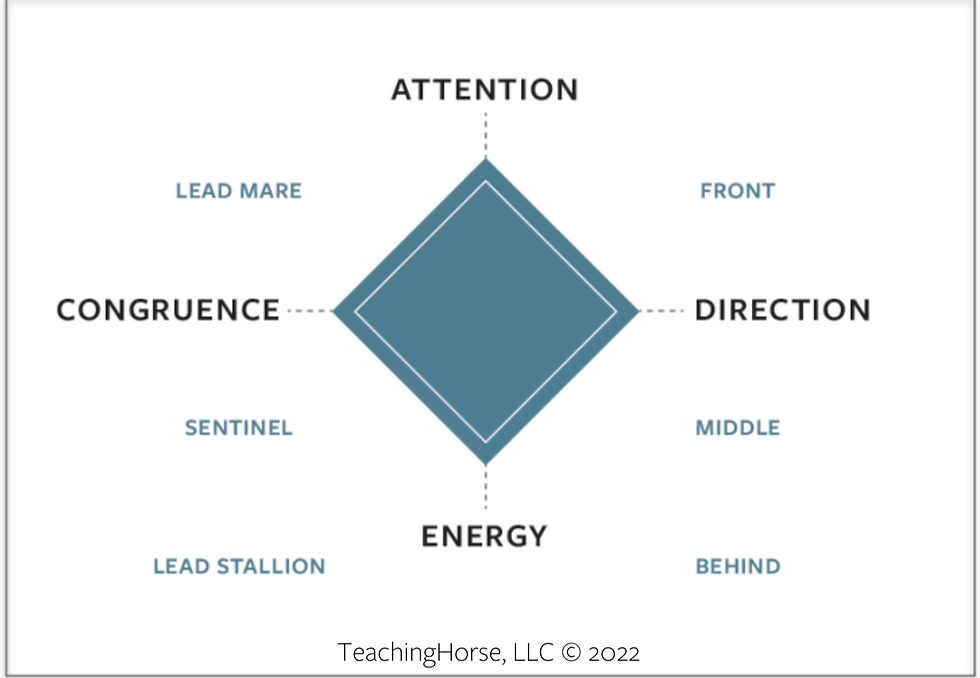
A fabulous model of how to embrace Shared Leadership exists in nature and specifically in herds of wild horses. They utilize the Diamond Model of Leadership as a way to collaborate and share leadership, using three different leadership positions.
Leading from the front
Leading from the back
Leading from the middle
The lead mare sets the direction and pace of the herd from the front of the diamond formation. She pays attention to what is happening in the environment and then makes a decision on where to go next. The lead stallion keeps the herd together and protects it from predators and is positioned at the back of the diamond. He influences the energy at which the herd moves. The rest of the herd, the sentinels, cover the other two points of the diamond, and lead from the middle, covering the outer sides of the diamond. Their role is to align the herd in the direction that has been set and detect potential threats coming from the side In addition to responding to threats, the sentinels are often the ambassadors of the herd and are the first to welcome new members.
The ever-present goal of herd leadership is health, harmony, and unity. With the unpredictability that nature ensures, herd leaders are often presented with challenges that require them to either reposition themselves to respond to changes in the environment or possibly even change roles to leverage their strengths differently. For example, when a threat emerges, like the new presence of a stranger or predator, the sentinel will often move from the center of the herd to the front where the threat appears. The sentinel will often redirect the herd away from danger. Once the lead mare senses the direction to safety, she will emerge back in front of the herd to set the new course. Once safe movement begins, the sentinel will return to the centre position.
Collaborative leadership has enabled horse herds to exist for over 50 million years as they have learnt to adapt and evolve to thrive in the uncertain environments they have experienced.
I’d love to hear from you about other collaborative relationships you’ve seen in nature and how you can apply these to your business.
Follow me on LinkedIn, Facebook and visit my website for more on leadership and reinventing business. I also invite you to download my free eBook on Leading Teams Through Uncertainty and check out my latest book – Unbridled Business – on Amazon.
Julia Felton, Executive Contributor Brainz Magazine
Julia Felton (aka The Business Wrangler) is the founder of Business HorsePower, a leadership and team engagement company. She is passionate about disrupting the status quo and discovering new ways to run and lead businesses so they are fit for purpose in the 21st century. She believes that a model on how to reinvent business exists in nature and herds of horses that embrace the principles of connection, collaboration, and community to work effectively together. By aligning purpose with actions the team achieves exponential results because everyone starts pulling in the same direction and feels inspired to show up for work every day knowing they are making a difference in the world. Julia is a leading authority on Unbridled Leadership. The author of two books Unbridled Business: Unlocking Nature’s Wisdom To Reinvent Leadership & Unbridled Success: How The Secret Lives of Horses Can Impact Leadership, Teamwork & Communication. She is the host of IMPACTFUL: The Podcast and a C-Suite and CEO Mentor, consultant, trainer, and speaker.