What Modern Therapy Forgot, and What My Ancestors Never Stopped Knowing
Christopher Sanchez-Lascurain is a Licensed Clinical Social Worker, somatic therapist, and founder of Healthemindset, specializing in nervous system healing, ancestral wisdom, and trauma recovery for empaths, HSPs, and BIPOC and LGBTQ+ communities.

Every piece of work I have shared in this series has been pointing toward something. Toward a way of understanding healing that is larger than symptom reduction. Toward a clinical practice that honors the nervous system and the ancestor, the research paper and the ceremony, the individual in the room and the community that shaped them. Toward a vision of mental health care that does not ask people to become smaller or more palatable or more Western in order to receive it. This final piece is where I want to bring all of that together, not as a theoretical framework, but as a living practice.
Two rivers, one current
I hold two distinct lineages in my work. The first is clinical. AEDP, trained under Dr. Diana Fosha's direct lineage. Somatic therapy. Polyvagal theory. Attachment science. An evidence-based understanding of how the nervous system stores and processes experience, how the therapeutic relationship creates the conditions for healing, and how emotion, fully felt and fully moved through, transforms rather than simply discharges.
The second is ancestral. My Choctaw and Chickasaw heritage. Curanderismo, the healing tradition rooted in Indigenous and mestizo wisdom that understands illness and healing as occurring across body, spirit, community, and lineage simultaneously. The practices, the orientations, the ways of knowing that my ancestors carried through some of the most devastating historical trauma any people have survived, and that came to me through fragments, through instinct, through the particular quality of recognition you feel when you encounter something that was always already yours. These two rivers do not run in conflict. They run parallel. In the work, they merge.
What ancestral healing is
Ancestral healing, as I practice and understand it, is rooted in premises that are simultaneously ancient and scientifically supported. We are not only individuals. We are the living expression of a lineage, carrying in our nervous systems, our epigenome, our relational patterns, and our deepest beliefs, the accumulated experiences of the people who came before us. Not metaphorically. Biologically.
The research on intergenerational trauma transmission is detailed enough now that this is no longer a spiritual claim in search of scientific validation. It is a scientific finding in search of a healing response.
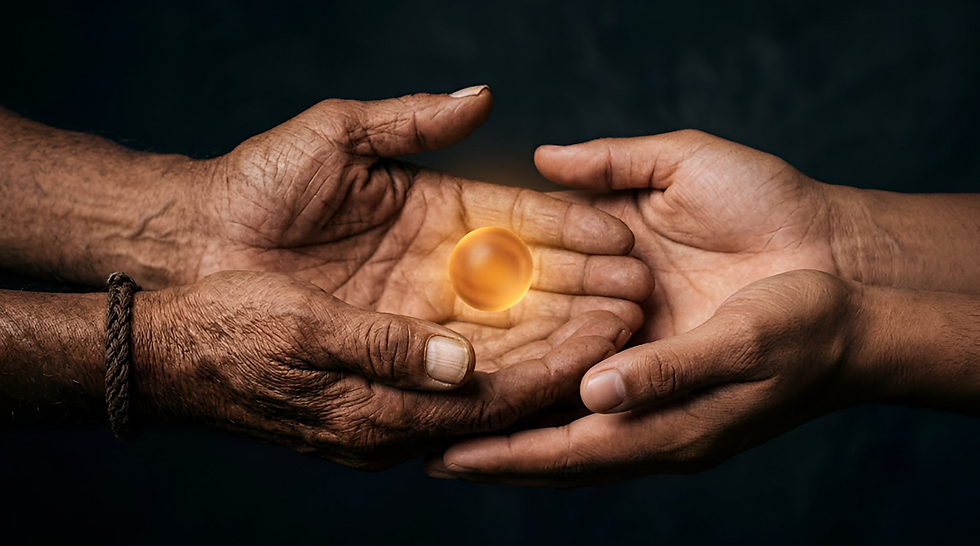
What was wounded across generations can be healed across generations. The transmission of trauma is not a one-way street. If the experiences of our ancestors shaped our nervous systems, then the healing we do in our own lives ripples backward and forward, touching the lineage in both directions.
Our ancestors are a resource, not only a wound. Alongside every line of transmitted trauma runs a line of transmitted wisdom, survival strategies, spiritual intelligence, relational knowledge, and ways of being in relationship with the body and the earth that sustained communities through unimaginable pressure.
How it works
It looks like beginning every therapeutic relationship with genuine curiosity about the client's full context, not just their presenting symptoms and their childhood history, but their cultural background, their community, their spiritual life if they have one, and their relationship to their own ancestry. Not because these are nice-to-know additions to the clinical picture, but because they are the clinical picture.
It looks like taking seriously what clients bring from their own healing traditions. When a client who practices Ifa tells me that they recently received guidance from a divination that speaks to exactly what we are working on in session, I do not file that under "cultural belief to be respected." I engage with it as clinical data.
It looks like being willing to incorporate ceremony, in its broadest sense, into the therapeutic container when it is appropriate and invited. Intentional ritual, meaningful objects, the marking of significant transitions, and the invocation of protective relationships, whether those are understood as spiritual, relational, or ancestral. These are technologies of healing that predate the DSM by millennia.
It looks like naming intergenerational patterns not only as psychological inheritance but as ancestral material, asking not just "how did your parents relate to their emotions?" but "what do you know about what your grandparents survived? What did their survival require of them? What did they pass on that served you, and what did they pass on that cost you?"
The integration that took years
I want to be honest about something, learning to hold all of this with integrity has been the work of a career, not a training. There were years when I kept these worlds more separate than they needed to be, the clinical framework in one room, the ancestral knowing in another. Partly because I was trained in a system that did not know how to hold Indigenous wisdom as legitimate clinical knowledge. Partly because I was still doing my own work of reclaiming what colonization had interrupted in my own lineage.
The moment I stopped keeping them separate was not dramatic. It was a quiet decision made in the middle of an ordinary workday that I was done apologizing, professionally or otherwise, for the fullness of what I carry.
What I have learned is that the integration does not require choosing. The somatic approach and the ancestral approach are not in competition. They are, at their deepest level, saying the same thing. That healing is not only cognitive. It involves the whole person, body, emotion, relationship, lineage, and spirit.
AEDP gives me a map of how the nervous system moves through healing. My ancestors give me a map of what that healing is for, what it connects us back to, what it makes possible for the generations that follow, and what it restores in us that should never have been taken. I use both maps. Always.
What Healthemindset means
I founded Healthemindset because I needed a container large enough to hold all of this, the clinical rigor and the ancestral wisdom, the evidence base and the ceremony, the individual nervous system and the lineage it carries.
I work with empaths and highly sensitive people because I am one. I work with BIPOC and LGBTQ+ communities because these communities have historically received mental health care that has ranged from inadequate to actively harmful. I work with professionals in demanding fields because the most sustainable impact comes from people who are regulated, resourced, and genuinely rooted in themselves. You can explore more about personal development and nervous system health across the full Brainz platform.
All of it connects. The empath is learning to work with their sensitivity rather than against it. The queer client is building a felt sense of permission to exist fully in their body. The BIPOC client whose hypervigilance finally has a name and a healing path. The professional who discovers that slowing down enough to feel does not end their effectiveness, but deepens it. The person who begins to ask questions about their ancestry and finds, waiting there, not only wounds but wisdom. This is what ancestral healing in practice looks like.
A final word
If you have read any part of what I have shared across these pages, something brought you here. Maybe it was recognition, seeing your own experience named in a way that finally made sense. Maybe it was professional curiosity. Maybe it was the particular kind of hunger that arrives when you have done enough healing to know that more is possible, but you have not yet found the door.
Whatever brought you, I want you to know this, the healing you are looking for is not outside of you. It is not waiting for a technique or a diagnosis or a framework. It is already moving in you, the way the drive to heal always moves, toward wholeness, toward safety, toward the particular aliveness that is your birthright.
Your nervous system knows. Your body knows. Your ancestors knew. The work is creating enough safety, enough relationship, and enough honest and reverent attention that all of that knowing finally gets to come home.
Begin here
If something in these pages has resonated, I would be honored to do this work with you. Healthemindset offers an integrated practice of somatic therapy, AEDP, and ancestral healing for clients across California through telehealth. Visit here to learn more and take your first step.
Read more from Christopher Sanchez-Lascurain
Christopher Sanchez-Lascurain, Psychotherapist & Ancestral Healer, LCSW
Christopher Sanchez-Lascurain, LCSW, is a somatic therapist, AEDP-trained clinician, and founder of Healthemindset. Drawing on polyvagal theory, Curanderismo, and his Choctaw and Chickasaw ancestral healing traditions, Christopher offers a deeply integrative approach to trauma recovery and nervous system regulation. He specializes in supporting empaths, highly sensitive people, and members of BIPOC and LGBTQ+ communities navigating the intersection of identity, culture, and healing. His work bridges clinical rigor with cultural reclamation, creating space for clients to reconnect with their bodies, their lineages, and their wholeness. Christopher is based in Los Angeles, California, and works with clients remotely all over California.