How To Prepare Your Family for a Stress-Less Summer Holiday
Dr. Victoria A. Elasic is the founder of Oak & River and a coach specialising in whole-system recalibration for high-capacity women navigating demanding careers, complex family systems, and competitive educational environments.

Yay, a family holiday! Why am I not excited? The car is finally packed (all by you, so it’s done properly). Someone can't find their shoes (did they even have them on when they got in the car?). One child is already asking how much longer. Another is upset because they wanted to sit on the other side. The snacks have already been opened. You've travelled less than ten minutes. Someone smells. Suddenly, you find yourself wondering, "We haven't even left yet. How has it already gone wrong?"
The truth is, nothing has gone wrong. Your family has simply entered a brand new environment. Every new environment asks something different of every nervous system inside it. We spend weeks planning where we're going. We compare hotels, pack the suitcases, book activities, and check the weather obsessively. Yet almost no one prepares for the environment their family is about to enter.
Then we wonder why the arguments begin on day one. Are you really looking forward to the holiday, or are you quietly dreading it because of holidays of yore? That’s your nervous system remembering how overwhelmed you were during your (oh yes, it is mum’s holiday too, isn’t it?!?) holiday with the little ones last time. The one where the lovely, glimmery moments were overshadowed by tantrums and grumpy responses from children aged 0 to 99 years old.
What if you changed your typical approach? What if you paused and prepared everyone with the important invisible things to pack too?
Holidays aren't just destinations, they're temporary environments, and every environment shapes behaviour. Most people prepare for holidays by packing clothes. At Oak & River, we prepare people.
Why travel matters
I’ve heard many parents confess that they’ve avoided travel and outings altogether because of experiences such as the one I described. However, from an Oak & River perspective, this deprives your family of an opportunity for growth.
A family holiday is much more than a break from everyday life, it is a temporary redesign of your child's environment. The routines change. The sensory experiences change. The expectations change. Children are invited to explore, notice, ask questions, solve problems, and connect with people and places in ways that daily life rarely allows.
Research suggests these experiences strengthen emotional intelligence, executive functioning, adaptability, curiosity, and confidence because children's brains are actively making sense of novel environments. In other words, travel isn't simply something children enjoy, it is something that helps them grow.
The irony is that while travel offers extraordinary opportunities for growth, it also temporarily removes the very environments that help our children function at their best. Understanding both sides of this equation is what allows families to create holidays that are not only memorable but genuinely restorative for everyone.
In a recent Forbes article, The Psychology Behind Why Travel Is Good for Your Kids, travel journalist Rebecca Ann Hughes interviewed educational psychologist Dr. Patricia Britto, who describes travel as "a powerful developmental tool when approached intentionally." Britto explains that experiences in new environments help children develop emotional intelligence, adaptability, confidence, curiosity, and interpersonal skills. These are qualities that are becoming increasingly important in today's world. She also notes that unfamiliar environments activate attention, memory, language, observation, and executive functioning in ways that are difficult to replicate in a traditional classroom.
These are incredible skills, so how do we make these experiences happen without breaking our parents' souls?
Holidays don't remove stress, they change it
Many of us begin our summer holidays hoping there'll be a chance to relax. We imagine slower mornings, happy family memories, and a break from the pressures of everyday life. However, for our brains, holidays are rarely restful from the moment they begin. Instead, they introduce an entirely new environment.
Think about everything that changes at once:
A different place.
Different beds.
Different food.
Different routines.
Different expectations.
Different sounds and smells.
More people.
More choices.
Longer days.
More excitement.
More waiting.
More transitions.
Hotter weather.
Poorer sleep.
In addition, for many children, they're still recovering from one of the biggest annual transitions of all, the sudden shift from the predictable rhythm of school to the freedom and unpredictability of the summer holidays.
For adults, summer often feels like a welcome release, but for children, it can feel like the ground has shifted beneath their feet. The routines that quietly supported them for months have disappeared overnight. Even children who are excited about the holidays are often working much harder than we realise to adapt to this new environment.
None of these things are "bad." In fact, many of them are wonderful, but each one quietly asks a little more of the brain. When enough of those demands build up, even small disappointments and challenges can suddenly feel enormous.
At Oak & River, we begin with a simple belief: behaviour doesn't happen in isolation. It emerges from the interaction between a person and their environment. Rather than asking, "Why is my child behaving like this?" we begin to ask, "What is this environment asking of my child's brain and body today?" That single question changes everything because once we start looking beyond behaviour, we begin to notice the story unfolding long before anyone raises their voice.
Our bodies whisper before they shout
One of the most valuable skills families can develop is learning to recognise the whispers before the shouting begins. Long before a child refuses to join the next activity, they may begin rubbing their eyes, walking more slowly, becoming unusually silly, arguing over something tiny, making repetitive noises, needing more reassurance, or becoming unusually quiet.
Adults have whispers too. We become shorter in our responses, more impatient, more controlling, more likely to rush, and we stop laughing.
All of this is information. These are messages from our nervous systems, quietly telling us that the environment is becoming harder to manage. I explain this to my clients as a cumulative load. One drop never causes an overflow. It's the compiled excitement, heat, walking, hunger, waiting, noise, tiredness, and decision-making that slowly fill it. Once you become aware of this, you can create opportunities for the bucket to empty throughout the day.
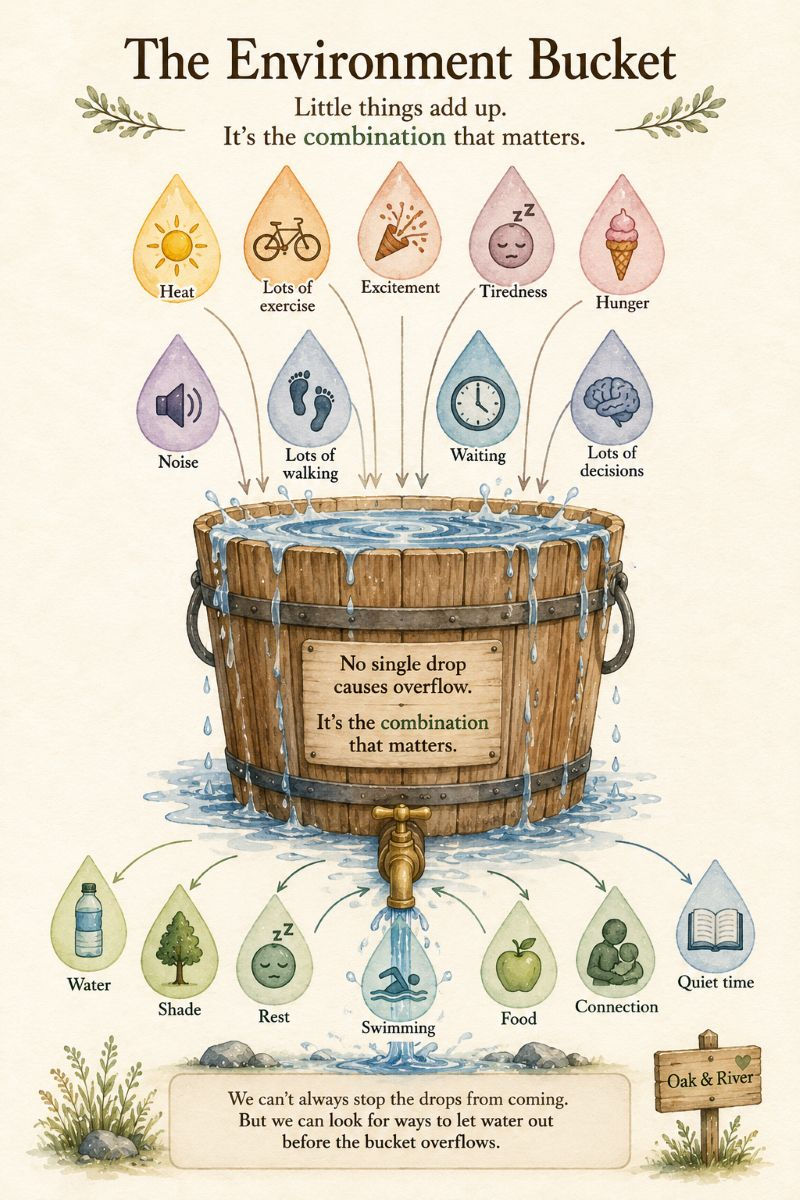
Oak Leaf reminder: Before the body shouts, it whispers. The earlier we notice the whispers, the less often we need to fight the fires.
Instead of becoming firefighters who rush in once the bucket has overflowed, we can become detectives. Detectives notice the whispers. They recognise the patterns. They understand that behaviour is often the final chapter of a story that began much earlier.
The more we learn to notice those early clues, the more opportunities we have to redesign the environment before anyone reaches their limit. The goal isn't to stop the overflow. It's to notice the first drops.
Design the holiday before you leave home
Most of us spend weeks planning the logistics of a holiday. We compare accommodation, check the weather forecast, pack the suitcases, and book activities. Yet very few families spend time preparing for the people who are actually going on the trip.
One of the most valuable conversations you can have before you leave home doesn't involve maps or packing lists. It begins with curiosity.
Gather together over dinner or during the journey and invite every family member, including the adults, to answer a few simple questions:
What makes holidays wonderful for you?
What usually feels difficult?
What helps you feel calm again when you've had enough?
How will we know when you need a break?
What do you want everyone to remember about you this week?
These conversations aren't about avoiding challenges. Rather, they're about understanding one another well enough to respond with empathy when challenges arise. They also help families recognise that everyone experiences holidays differently.
One child may love filling every day with adventure, while another may quietly need an hour with a book after lunch. One adult may feel energised by spontaneity, while another may feel calmer knowing the plan before leaving the lodge. None of these preferences are right or wrong. They're simply different, and once they're visible, they become much easier to honour.
Design around energy, not just activities
One of the most common mistakes families make is assuming that if one fun activity is good, five must be even better. However, our brains do not experience holidays as a list of activities. They experience them as cumulative demands.
Imagine a day that includes an early start, cycling to breakfast, swimming, mini golf, lunch in a busy café, an afternoon activity, ice cream, a family meal, and an evening show.
Every one of those experiences might be enjoyable. Together, however, they ask an enormous amount of our brains and bodies. Sometimes, the most successful holiday is not the one that fits in the most activities. It is the one that protects enough energy to enjoy the activities you have chosen.
At Oak & River, I often encourage families to think less about planning every hour and more about protecting everyone's capacity to enjoy the day. That might mean choosing two meaningful adventures instead of five. It might mean deliberately scheduling an hour back at the lodge or having an early dinner before everyone becomes overtired. Rest is not what happens after the fun. It is often what makes the fun possible.
Waiting is part of the adventure too
If you have ever visited a theme park, you will know that the longest part of many attractions is not the ride. It is the queue. Adults find waiting difficult. Imagine how it feels for a young child who has only a limited understanding of time and whose excitement has already been building all morning!
Years ago, as I prepared for my first visit to Disney World with my nearly three-year-old daughter, an experienced school director shared a piece of advice that I have never forgotten. She suggested stopping at a discount shop beforehand, such as Poundland in the UK or Dollar Tree in the US, buying a selection of inexpensive surprises, and wrapping them individually. Do not get carried away. Regular paper is fine!
These surprises might include sticker books, bubbles, colouring or water painting books, reusable stickers, felt shapes, magnetic travel games, masking tape for creative play, small puzzles, or a sketchbook and a pen with multiple colours.
Wrap each item individually and keep them in your bag. Backpacks are the best for this, by the way. When you find yourself facing a particularly long queue, invite your child to choose just one.
Suddenly, the wait becomes part of the adventure. There is the anticipation of choosing, the excitement of unwrapping, the novelty of a new activity, and, hopefully, something engaging enough to make the queue feel shorter!
Notice that nothing about the queue has changed. The environment has, and sometimes, that is all it takes!
Oak Leaf reminder: The goal is not to fill every minute. It is to create enough space for everyone to enjoy the moments that matter.
Understanding before correction
One of the biggest shifts we can make as parents is to stop seeing behaviour as the beginning of the story. Most of the time, it is the end.
Imagine watching a river after heavy rain. You do not suddenly blame the river for overflowing. You naturally begin asking what happened upstream. Did it rain all night? Did smaller streams feed into it? Was the ground already saturated? Behaviour works in much the same way.
A child who suddenly refuses to walk, argues over something small, or bursts into tears is often responding to everything that has happened before that moment. Perhaps it has been hot all day. Perhaps there have been too many decisions. Perhaps they are hungry, tired, overwhelmed by noise, or simply trying to keep up with the excitement around them.
The behaviour is visible, yet the causes are often hidden. Before correcting what we can see, it helps to become curious about what we cannot.
I often encourage families to pause and ask three simple questions. First, what did I notice? What happened without judgement? Second, what might be happening underneath? What need, feeling, or environmental factor could be contributing? Third, what could I try first? What response would create safety and understanding before correction?
For example, I might say, “I noticed my son suddenly refused to join the next activity. I wonder if his brain has been working hard all morning and his ‘environment bucket’ is already close to overflowing. I could try offering a quiet break, a drink of water, or two simple choices before insisting that we continue.”
This does not mean we stop having boundaries. It means we recognise that understanding often makes boundaries far easier to hear.
I notice | I wonder if | I could try |
My child suddenly became silly or noisy. | Their brain may be overwhelmed, even if they don't realise it yet. | Offer a drink, a snack, or a quiet reset before correcting the behaviour. |
My child refuses to join the next activity. | Their "environment bucket" may already be full. | Offer two simple choices or suggest a short break before deciding. |
My child snaps at a sibling. | Hunger, tiredness, heat, or excitement may have reduced their capacity. | Address the underlying need before focusing on the conflict. |
My partner becomes impatient. | They may be carrying the mental load of keeping everyone safe, organised, or on schedule. | Acknowledge their effort and offer to share the load. |
I notice I'm becoming frustrated. | My own bucket may be fuller than I realised. | Pause, breathe, ask for help, or take five minutes to reset. |
Someone becomes unusually quiet. | They may need space, reassurance, or time to process. | Check in gently without demanding they talk. |
Someone is arguing over something small. | The disagreement may not actually be about the issue itself. | Look for the hidden need before trying to solve the argument. |
Plans suddenly feel impossible. | The environment may need adjusting, not the people in it. | Change the pace, reduce stimulation, or simplify the plan. |
Oak Leaf reminder: Curiosity creates connection. Correction is most effective after someone feels understood.
The Oak & River pause: When behaviour catches you by surprise, pause and notice what you are seeing right now. Wonder what might be happening beneath the surface. Then respond by asking what would help this person feel understood before you try to solve the problem.
Build recovery into every day
Families are usually very good at planning activities. However, very few plan for recovery. Yet recovery is often what makes the rest of the day possible.
As you plan your holiday, think about intentionally scheduling moments that allow everyone's bucket to empty again. This might include spending time in the shade, having regular snacks and drinks, enjoying a cooling swim, reading quietly, taking a one-to-one walk, having a slow morning, or making time to reconnect.
The important thing to remember is that recovery looks different for everyone. One child may need quiet and space, while another may need movement or playful connection. One parent may recharge by reading for twenty minutes, while another feels restored after a walk or a meaningful conversation.
Be curious rather than certain. One of the greatest gifts we can give our families is asking, “What helps you feel like yourself again?” rather than assuming we already know the answer.
I have worked with many families who were surprised to discover that what they believed was helping their child recover was actually making things harder. Sometimes, the most supportive thing we can do is simply observe, listen, and allow each family member to become an expert on their own needs.
Perhaps most importantly, model this for your children. Instead of pushing through exhaustion, narrate what you are noticing: “I’m feeling a bit overwhelmed after all that excitement. I’m going to sit quietly with a cup of tea for ten minutes so I can enjoy the rest of our afternoon with you.” Children learn that recovery is not a sign that something has gone wrong. It is a healthy part of living well.
Oak Leaf reminder: Recovery is not what happens after the holiday. It is what helps the holiday continue well.
The park is practice
When families tell me they are worried about travelling this summer, they often imagine holidays in terms of airports, long journeys, or expensive attractions. However, some of the most important learning happens much closer to home.
The trip to the local park, the drive to football, an afternoon at the beach, or lunch with grandparents can all provide valuable experiences. These everyday outings are not simply things to get through and “survive.” There are opportunities to practise.
Dr. Maria Montessori believed that children are driven towards independence and that this develops through real experiences rather than simply being taught about them. As Michael Dorer explains in Montessori Life, independence grows as children are given opportunities to make choices, solve problems, and participate meaningfully in everyday life.
That changes how we think about family outings. Instead of asking, “Can my child cope with this?” we might ask, “What skills will this outing help my child practise?”
Every trip offers opportunities to build confidence in waiting, adapting to changes in plans, recovering after disappointment, asking for help, noticing when we need a break, communicating our needs, solving unexpected problems, and reconnecting after difficult moments.
These are not distractions from childhood. They are childhood. The goal is to make every outing supportive enough that children can experience challenge without becoming overwhelmed. That is why I encourage families to think less about managing behaviour and more about designing environments.
Sometimes, that means bringing snacks or slowing the pace. Sometimes, it simply means recognising that today’s trip to the park is preparing your child for tomorrow’s bigger adventures.
Independence increases confidence: Dorer writes that when children are trusted to make choices, they develop confidence, become more willing to take risks, and seek out further experiences. Children become more confident travellers by travelling.
Independence develops through experience: One of my favourite passages says that adults should avoid doing for children what they can do for themselves because the independence gained through the experience is more valuable than completing the task efficiently. That immediately made me think of holidays. Instead of carrying every backpack, ordering every meal, solving every disagreement, and planning every step, we can gradually invite children into the process. They can help with packing, reading maps, choosing snacks, navigating, or finding the picnic table. These are opportunities to grow!
Freedom and responsibility belong together: The article reminds us that Montessori's three freedoms, choice, repetition, and movement, are inseparable from responsibility. That ties in beautifully with the Environment Redesign philosophy. Instead of unlimited freedom, offer meaningful choices. For example, ask, “Would you like to walk to the lake first or have our picnic first?” rather than “What do you want to do?” That is an excellent real-world example of designing for autonomy without creating decision overload.
Focus on process, not perfect outcomes: Dorer explains that an emphasis on process encourages problem solving, exploration, and creativity, whereas focusing only on outcomes can reduce children's willingness to take independent risks. Instead of asking, “Did we have the perfect holiday?” ask, “What did we practise together?” A successful outing is not one without tears, wrong turns, or changed plans. It is one where children discover that they can experience challenge, recover, and continue the adventure. Every trip to the park, every family picnic, and every car journey gives them another opportunity to practise those skills because, one day, those small outings become long journeys. The confidence they carry with them will not have been packed into a suitcase. It will have been built, one ordinary adventure at a time.
The holidays our children remember most will not necessarily be the ones with the biggest adventures. They will remember how they felt. They will remember whether they felt understood, safe, included, and able to recover when things became hard.
The best family holidays are not perfect. They are thoughtfully designed. Reflect on your goals for the holiday and, where relevant, the goals you share with your partner. Is the goal to relax, have adventures, or bond as a family? Try to manage your expectations and zoom out to maintain the bigger picture.
Try not to compare your experience to a Jet2holidays commercial. Instead, focus on the invisible elements of the time together that are worth celebrating. Think of your core values and the moments you will carry with you as your children grow up.
This summer, I hope your family laughs until your sides hurt. I hope someone falls asleep in the car. I hope somebody changes their mind. I hope somebody gets overwhelmed and discovers that they can recover.
I hope plans change. I hope someone apologises. I hope someone feels deeply understood. Those are the moments children remember, not because their behaviour was perfect, but because they learned what it feels like to belong in a family that finds its way back to one another.
The holidays will eventually end. The environments we create and the ways they teach us to love, adapt, and recover can shape our families for a lifetime.
Read more from Dr. Victoria A. Elasic
Dr. Victoria A. Elasic, Founder of Oak & River
Dr. Victoria A. Elasic is the founder of Oak & River, where she works with high-capacity women seeking greater clarity, steadiness, and margin in complex professional and family systems. Drawing on her background in Montessori education, leadership, and coaching, she guides clients in recalibrating how they carry responsibility across work, home, and school environments. Victoria’s work focuses on reducing hidden friction in daily systems so capable women can experience greater lightness, clearer decision-making, and more sustainable leadership. She works privately with a small number of clients and leads curated small-group intensives.