Do You Constantly Question Your Relationship? It Could Be ROCD
Eliana Bonaguro, LMHC, specializes in OCD and anxiety disorders. She blends evidence-based therapy with visual storytelling through her illustrated self-help guides to make complex mental health concepts more approachable, engaging, and easier to understand.

Andrew loved his girlfriend. They had built a life together over several years. They shared a cosy apartment in Brooklyn, supported each other through difficult moments, and often talked about a future that included marriage and children. From the outside, the relationship looked healthy, stable, and loving.

As their relationship became more serious, Andrew started to feel overwhelmed by his own thoughts. The more conversations they had about marriage and commitment, the more emotionally consumed he became. Some days, he felt deeply connected to her and could easily picture spending his life with her. Other days, he became trapped in relentless doubt and emotional confusion.
His feelings ran the gamut from love, guilt, resentment, and fear to the persistent thought that perhaps someone “better” might still be out there waiting for him. At times, he worried he was wasting her time. Other times, he feared he was sabotaging a healthy relationship simply because he could not tolerate uncertainty.
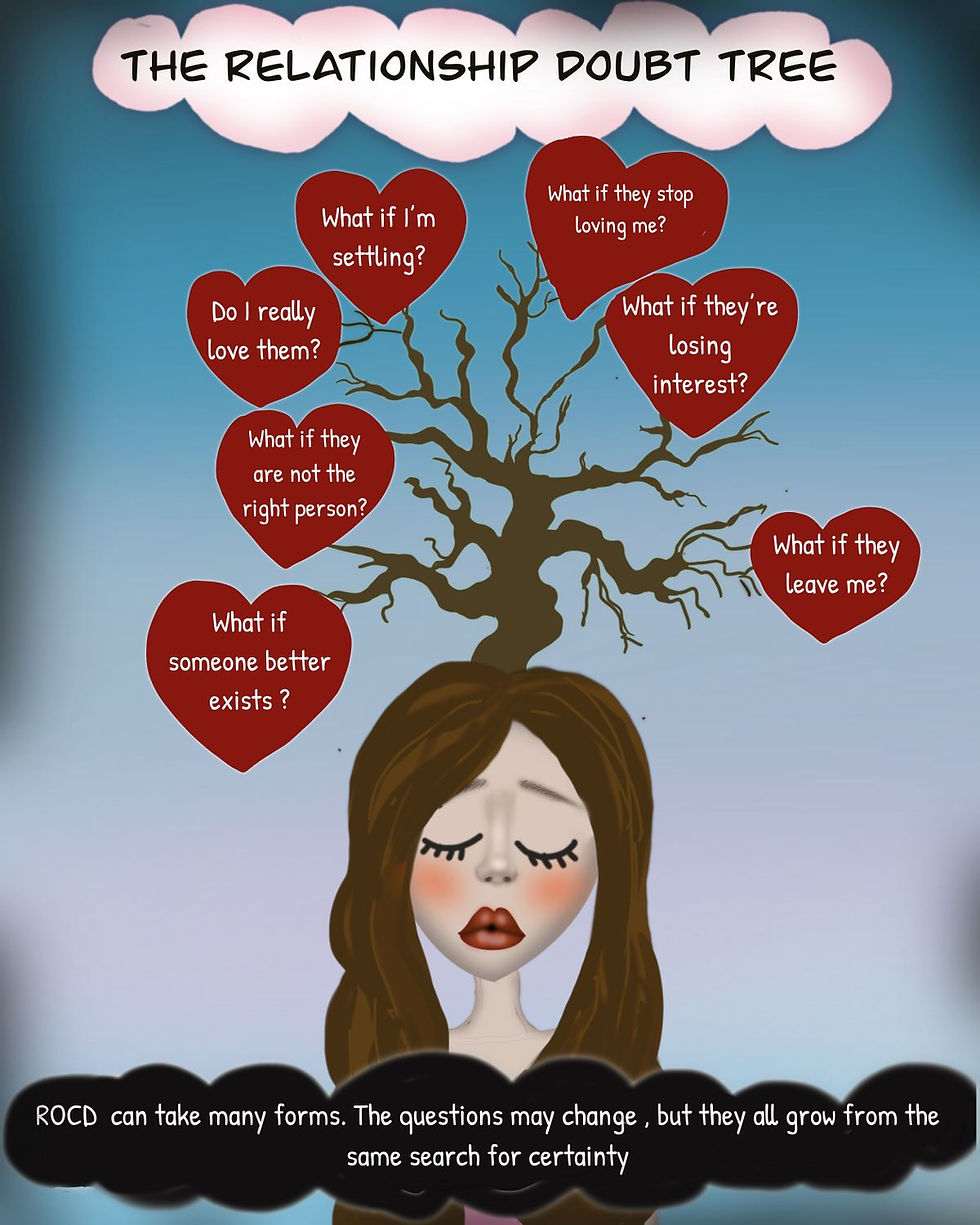
He started looking for flaws in the relationship, analysing his feelings, and comparing their connection to other couples. He also questioned whether his anxiety meant something was truly wrong. Over time, these intrusive thoughts became hard to ignore. What if I do not truly love her enough? What if I am making the wrong decision? What if my anxiety is trying to warn me? What if I commit and later regret it? What if I am wasting her time?
The more Andrew tried to find certainty in his relationship, the more overwhelmed and disconnected he felt. For many thoughtful and introspective people, this kind of mental loop can appear in their romantic lives. Sometimes, these experiences are more than just normal relationship doubts. They can be signs of Relationship OCD, or ROCD.
What is Relationship OCD?
Relationship OCD is a subtype of Obsessive Compulsive Disorder that centres around intrusive fears, doubts, and uncertainty related to romantic relationships.
While it is not uncommon for people to experience occasional, passing doubts in relationships, ROCD involves repetitive obsessions and compulsive behaviours that become emotionally exhausting, time-consuming, and hard to disengage from.
Individuals experiencing ROCD often find themselves preoccupied with repetitive questions. They may wonder whether they truly love their partner, whether their partner is “the right person,” whether they feel attracted enough, whether the relationship feels “right” enough, whether they are making a mistake by staying, or whether uncertainty itself means something is fundamentally wrong.
These fears often intensify during periods of increased commitment, such as moving in together, discussing marriage, having children, or imagining a long-term future. Because relationships naturally involve vulnerability, emotional fluidity, and inherent uncertainty, OCD often latches onto them powerfully.
Why ROCD feels so convincing
One of the hardest parts of Relationship OCD is that the doubts feel very real. Many individuals assume that if anxiety feels this strong, there must be a genuine problem within the relationship. They begin treating every shifting emotion, intrusive thought, or temporary fluctuation in attraction as critical evidence that must be analysed and solved.
As a therapist specialising in OCD and anxiety disorders, I often see analytical, intelligent individuals become trapped in endless attempts to logically solve emotional uncertainty. Unfortunately, the more someone tries to force absolute certainty, the more tangled and emotionally reactive the thoughts become.
Many people with ROCD are highly introspective and emotionally aware. They are not careless about relationships. In fact, they care deeply and place enormous pressure on themselves to make the “perfect” decision.
OCD tends to weaponise this deep sense of responsibility. Normal human experiences, such as temporary emotional distance, stress, irritation, boredom, or fluctuating attraction, can suddenly feel threatening and catastrophic. Thoughts that might briefly pass through someone else’s mind become sticky, repetitive, and emotionally charged.
Over time, people with Relationship OCD may begin monitoring themselves constantly. They may ask, “Do I feel enough right now?” “Am I attracted enough in this exact moment?” “Why did that couple seem happier than we do?” or “What if my anxiety means I should leave?”
Ultimately, this constant internal checking takes its toll on the relationship, which becomes devoid of its natural spontaneity. The connection begins to feel emotionally tense, not because the relationship itself is unhealthy, but because OCD has turned love into a problem that constantly needs solving.
Why you keep doubting your relationship
When people think about OCD, they often imagine visible compulsions such as constant handwashing or repeatedly checking locks. However, Relationship OCD frequently operates through invisible mental rituals and reassurance-seeking behaviors.
Common ROCD compulsions include mental review, where a person replays conversations or memories repeatedly to search for “evidence” of compatibility or incompatibility. It may also include compulsive comparison, where the relationship is constantly measured against other couples, movies, or past relationships.
Other common compulsions include excessive research, such as Googling relationship advice, taking compatibility quizzes, or scanning online forums for answers. Reassurance seeking may also become frequent, with individuals repeatedly asking friends, family, therapists, or even their partner for validation that everything is okay.
Some people experience confession loops, where they feel an overwhelming urge to repeatedly tell their partner about their doubts or passing thoughts. Others become caught in hypervigilant feeling-checking, constantly monitoring their internal feelings of love or attraction toward their partner.
These compulsions might lower anxiety for a short time, but they make the OCD cycle stronger. The brain starts to believe that uncertainty is dangerous and must be fixed right away. This leads to tiring cycles of obsession, overthinking, brief relief, and more doubt.
Why reassurance usually makes ROCD worse
People with ROCD often look for reassurance, hoping it will calm their anxiety. Reassurance helps for a moment, but the relief does not last.
Soon, the doubts return with a new angle. What if I missed something? What if my feelings are not genuine? What if I realise years later that this was a mistake?
Over time, reassurance itself becomes part of the OCD cycle. The more someone relies on external validation to feel calm, the harder it becomes to tolerate uncertainty independently.
Reclaiming your mental freedom requires a shift in strategy. Effective OCD treatment does not focus on helping people achieve perfect certainty about their relationships. Instead, it focuses on changing how individuals respond to intrusive thoughts, anxiety, and uncertainty itself.
How ERP treats Relationship OCD
Exposure and Response Prevention, or ERP, a specialised form of Cognitive Behavioural Therapy, or CBT, is considered the gold standard treatment for OCD.
ERP helps individuals gradually learn how to tolerate uncertainty while reducing compulsive behaviours and mental rituals. This therapeutic process is not just about preserving a relationship. It is about reducing cognitive fatigue and reclaiming peace of mind.
Successful treatment for Relationship OCD often involves becoming aware of and reducing compulsive rumination, disengaging from emotional and physical feeling checking loops, and drastically reducing reassurance seeking and compulsive comparison patterns. It also involves learning to allow uncertainty to exist without trying to solve it immediately and shifting focus away from compulsive fear and back toward personal values.
The goal of treatment is not to force a decision or generate artificial certainty about a partner. Instead, therapy helps individuals develop a healthier relationship with uncertainty itself. Over time, the mind learns that thoughts and emotions do not always require immediate analysis, answers, or resolution.
Breaking free from Relationship OCD
All relationships involve a degree of uncertainty, vulnerability, and periods of natural ebb and flow. However, when relationship fears become obsessive, repetitive, and emotionally consuming, it is worth exploring whether OCD may be the culprit.
Relationship OCD can leave people feeling trapped between fear, guilt, confusion, and overwhelming pressure. Many suffer in silence because they fear their thoughts mean something terrible about their character or their capacity to love.
Yet intrusive thoughts are not reflections of truth, intuition, or hidden desires. Sometimes, they are simply symptoms of anxiety and OCD attaching themselves to what matters most deeply to you.
With appropriate treatment, support, and patience, it is possible to break free from the exhaustion of overanalysis, learn to tolerate the unknown, and move toward a more grounded and meaningful life.
Read more from Eliana Bonaguro
Eliana Bonaguro, Licensed Mental Health Counselor
Eliana Bonaguro, LMHC, is a licensed mental health counselor specializing in OCD, anxiety disorders, panic disorder, agoraphobia, and Exposure and Response Prevention (ERP) therapy. She is also the author and illustrator of several mental health guides that blend evidence-based psychology with visual storytelling to make complex mental health concepts more approachable and easier to understand. Her insights and contributions have been featured in Forbes, Healthline, Newsweek, and RTOR.