

Bottles of Hope and the Premise Behind the Kids' Supplement Industry That Doesn't Survive a Trial
Anastasia Schenk is a Pediatric Feeding Specialist and Integrative Nutrition Health Coach. She supports children from starting solids to young adulthood with evidence-based strategies for ARFID, picky eating, gut health, immune support, allergy prevention, and chronic inflammation.

It is 7 pm. Dinner has been refused for the third night in a row. Your child has eaten approximately one cracker and the parsley off your plate. You scroll your phone, half watching them, half searching for something, anything, that might fix this. The algorithm has already understood you. A pastel bottle appears. Trusted by 50,000 parents. Picky eater approved. A pediatrician formulated. You add it to the cart. You feel a little better. This is the entire business model.
The customer is not your child
Children don’t buy supplements. Children couldn’t care less about magnesium, cacao or methylated B-vitamins. The customer is the exhausted parent of a child who eats three foods, and who would do almost anything to make sure those three foods are not the reason something is being missed.
The implication is never quite said out loud, but it is always there. Your child has deficits. The deficits are probably your fault. This bottle will quietly cover what you have not been able to.
A recent Swiss study of nearly 2,000 families found 58% buy supplements or special children’s food to promote their child’s health. The marketing has worked. I have been that parent. These products are not the answer they pretend to be.
What happened when somebody tested the bottle
Nutrition science studies whole food. When researchers see that populations eating more colourful fruits and vegetables have less cancer, the headline becomes “antioxidants are good for you” and an industry bottles them. Then the trials get run.
In the 1990s, beta-carotene supplements were given to people at high risk of lung cancer, because carrots are linked to less lung cancer. The CARET trial was stopped 21 months early. The supplement group developed lung cancer at a 28% higher rate than the placebo group, and died at a 17% higher rate. A larger trial called SELECT did the same thing with vitamin E and prostate cancer, it increased risk by 17%. Stopped early.
The Cochrane Collaboration, the global gold standard for medical evidence, has since pooled 78 randomised trials of antioxidant supplements. No mortality benefit. Beta-carotene and vitamin E appeared to slightly increase the risk of dying.
Last year, the largest study yet looked at 390,000 healthy adults followed for twenty years. Daily multivitamin users did not live longer. They had a small but real increase in death from any cause. The largest study ever done on whether a daily multivitamin extends your life quietly found the opposite.
Why a pill is not an orange
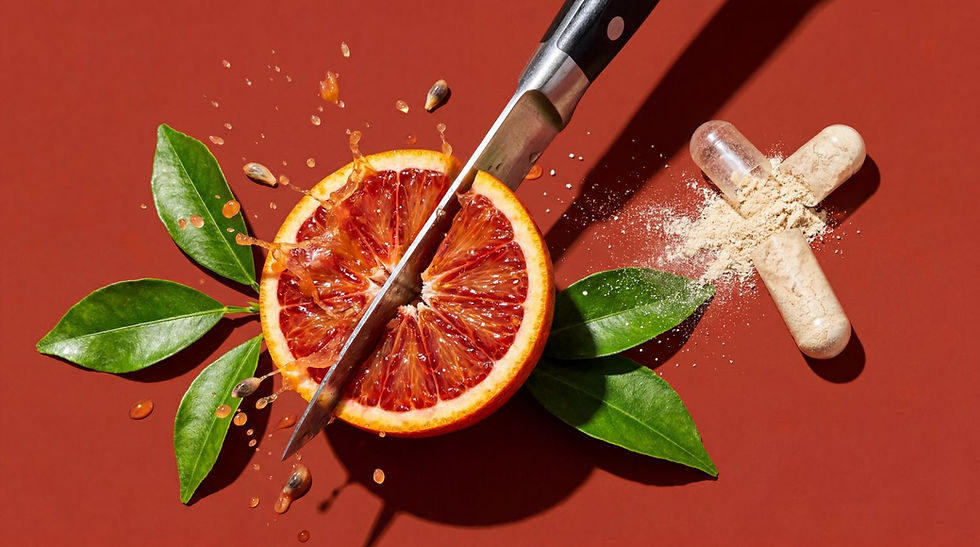
The reason has a name. The food matrix. Take an orange, the vitamin C inside comes packaged with fibre, water, dozens of flavonoids, and a long list of other compounds that change how the body absorbs and uses it. Pull that vitamin C out, put it in a chewable, and the body recognises something different. It absorbs less, processes it differently, and pees most of the excess out within hours. The carrot study did not find that beta-carotene prevented cancer. It found that carrots did.
The two arguments that come up every single time
Two arguments come up every time. Worth addressing both. The soil is depleted, so food doesn’t have the nutrients it used to. There is some truth that intensive farming has lowered certain mineral levels in some crops, but the effect is routinely overstated in supplement marketing. A carrot is still mostly a carrot. The studies showing benefits from food were done on food grown in current conditions, not in 1840.
We can’t eat fish because of mercury. Mercury levels vary enormously by species. Smaller, shorter-lived fish like sardines, anchovies, salmon, and trout are low in mercury and safe to eat regularly, including for children. The fish to limit are the large predatory ones, such as sharks, swordfish, and big tuna. A capsule is not the only alternative to a fish you are nervous about. The right fish is. The capsule may not be harmless either. Independent laboratories have found roughly 45% of omega-3 supplements on the market are rancid, with children’s products showing the highest oxidation values of any category tested.
Where the goodness in the capsule actually comes from
A question worth sitting with. Where do you think the things inside those capsules come from? Unicorn tears? Vitamin C is almost never extracted from a lemon. The cheapest route is to take corn starch, convert it to glucose, hydrogenate it with a nickel catalyst, ferment it with bacteria, and put it through chemical conversions until ascorbic acid falls out the other end. The process was developed in a Zürich laboratory in 1933, won a Nobel Prize, and is now behind almost every vitamin C supplement on the planet.
Vitamin D3, the one most kids’ bottles proudly contain, is extracted from sheep wool grease. Wool is sheared, washed in hot detergent, and the lanolin is saponified, centrifuged, refined, and irradiated with UV light. Your toddler’s chewable comes from sheep wool grease. Vitamin E, the one the trials kept showing harm from, is typically stripped out of vegetable oils with chemical solvents.
The industry runs on the premise that you can take the goodness out of a food and bottle it. What made the nutrient useful was everything sitting next to it inside the food. This is, by every reasonable definition, ultra-processed food. The exact category parents are told to avoid. Reformatted into a chewable.
The execution is also a mess
Even if you accept the premise, the quality control is worse than you think. In its 2025 review, Stiftung Warentest, the consumer testing body Swiss and German families know, tested 18 children’s supplements from familiar brands like Abtei, Centrum, Doppelherz, Sanostol, and Orthomol. Seventeen of the 18 had defects. The institute strongly advised against five of them because they contained levels of copper or vitamin A high enough to cause health problems in children. Some doses exceeded the recommended upper limits for adults.
A year earlier, the Bern University of Applied Sciences ran its own analysis of children’s supplements on the Swiss market. The conclusion was three words: superfluous, expensive, overdosed.
Then there is melatonin, the new darling of the supplement aisle, marketed as a calm, natural sleep aid for children. In Switzerland, it cannot legally be sold as a food supplement at all. Swissmedic classifies it as a prescription-only medicine. The same is true in the UK, Denmark, the Czech Republic, and Slovenia. A 2025 European analysis still found melatonin products reaching EU consumers via American-style channels that exceeded permitted doses by triple, several aimed straight at children. Pediatric melatonin poisonings in countries where the gummies are sold freely have risen over 500% in the last decade. Two children have died.
In 2024, the French food safety agency ANSES, after reviewing 165 documented adverse event cases, officially recommended suspending vitamin supplements for children under three except under specific medical advice. That is a government agency telling parents to stop.
If your child is a picky eater
You did not cause this. Picky eating is developmentally normal and deeply common, peaking between two and six years old. Most children grow out of it. A supplement is not protecting you from a deficit you created.
The thing that actually helps is patient, repeated, low-pressure exposure to a wide variety of foods, supported properly, over months and sometimes years. The evidence suggests it takes around 8 to 15 exposures to a food before a child reliably accepts it. Not eight times in a week. Eight times spread out, without pressure, without bribes, without the parent at the table holding their breath. Not a powder. Not a gummy. The work is slower and far less satisfying to scroll past. It also works.
Before you buy another bottle, ask three things. Has a paediatrician identified a specific, diagnosed deficit? Has someone who actually knows your child’s full diet, history, and growth recommended this product? Have you worked on food first, with proper support, for long enough to know?
If the answer to all three is no, the bottle can wait and so can the guilt.
Read more from Anastasia Schenk
Anastasia Schenk, Pediatric Feeding Specialist/Integrative Nutrition
Anastasia Schenk is a Pediatric Feeding Specialist and Integrative Nutrition Health Coach who reversed her own autoimmune disease through nutrition. A mother of two, she combines clinical expertise with lived experience to help families navigate picky eating, Pediatric Feeding Disorders, ARFID, gut health, and chronic inflammation. Her programs are evidence-based and rooted in real life, supporting children from starting solids to young adulthood. She is the founder of Early Eaters Club, a platform dedicated to raising resilient, adventurous eaters for lifelong health.



