All Work And No Play? 10 Reasons Why We Should Prioritise Play In Our Lives
Written by: Karen Stallard, Executive Contributor
Executive Contributors at Brainz Magazine are handpicked and invited to contribute because of their knowledge and valuable insight within their area of expertise.

When was the last time you got lost in play? Take a moment to recall a memory of when you last immersed yourself in a fun activity, let yourself remember how it felt, and reflect on how much time has past between then and now. For some lucky people work is play and they can enjoy the wonderful combination of having fun and earning money at the same time, but for many of us work is a serious business; maybe full of responsibility and fraught. On top of a busy day, we battle with internal voices telling us that we can only stop and play once the job is completed, fun is certainly not allowed whilst there are responsibilities to be fulfilled. Tasks are prioritised, relationships are put on hold, sleep is compromised and playtime is squashed into the twilight hours. We are socially conditioned to believe that we are only a success if we work for 70 hours a week; look after two children, a dog, a rabbit, and complete the housework without having a breakdown, this is surviving rather than thriving.
My hope is that this article will encourage you to know that prioritising play every day alongside all the other important tasks you need to do is essential for your ongoing wellbeing. So rather than fitting in play when you can, you begin to make sure it is a protected part of your daily living. Of course, as with everything there is a balance to be had, we can’t play all day every day, but if you are ‘all work and no play’ then this article is for you.
Watching children play freely is inspiring. It takes me back to my own childhood where I used to play a game in the school playground called ‘Down the plug hole’. In this game, my friends and I would be sucked down an imaginary plug hole into another land where pirates, cowboys, and astronauts ruled. Take a moment to recall what games you enjoyed as a child, can you remember feeling those moments of excitement and satisfaction when you were lost in play? We now know that children, when playing, are developing their brains in many different ways and that children stop playing when they are frightened, neglected, or anxious. A child’s lack of security and safety can deprive them of the huge benefits of play and this has a detrimental effect on their early development. When children feel secure enough then they can begin to play and learn again.
As adults, we also stop playing when we are frightened or stressed and it is precisely in those moments that we need to calm ourselves down and find ways to play again. Play keeps our brains and bodies healthy for longer and here are some of the many other good reasons why we should play more:
1. Creativity is inextricably linked to play: without play we are arguably limiting ourselves within a narrow frame of conscious experience, reducing our capacity to think creatively and overcome life obstacles. Creative play particularly helps expand our creative capacity generally.
2. Practising mindfulness: whilst you are focusing on a game of chess you are not thinking about that stressful call you had earlier. Playing teaches us that our mind is so much greater than our worries.
3. Calming down our nervous systems: it is impossible to engage fully with play if we are feeling frightened or anxious, allowing ourselves to sink into a playful activity enables the ventral vagal nerve to be activated, releasing anti-inflammatory and natural opioids such as dopamine into our bodies.
4. Release of trapped emotional energy: this is particularly true with physical play. Lion cubs have been witnessed playfully re-enacting a life-threatening chase with each other shortly after escaping the jaws of a predator, as they are doing this their bodies are ‘finding their power’ again. Intense playful workouts can work wonders after a scary encounter with an aggressive boss.
5. Building relationships and bonding: children love to play with their caregivers as they feel seen and affirmed. This is also true for adults as play helps us to be seen and to see others in a relaxed and fun way.
6. Stimulating laughter: we all know laughter is contagious, there are many games which make us laugh and the simple act of laughing with others can completely change our sense of perspective as well as making our body feel great.
7. Connecting with the inner child: play keeps us feeling young, thinking with agility whilst helping us to let go of our adult responsibilities for a while.
8. A safe platform for feelings to exist and be expressed: playing can make us feel many emotions such as excited, happy, triumphant, defeated, angry, sad, ecstatic, and many others. Playing a game is a great way for people to feel and express all of these valid emotions sometimes in rapid succession and helps us experience fluidity of emotional experience rather than just getting stuck with one feeling.
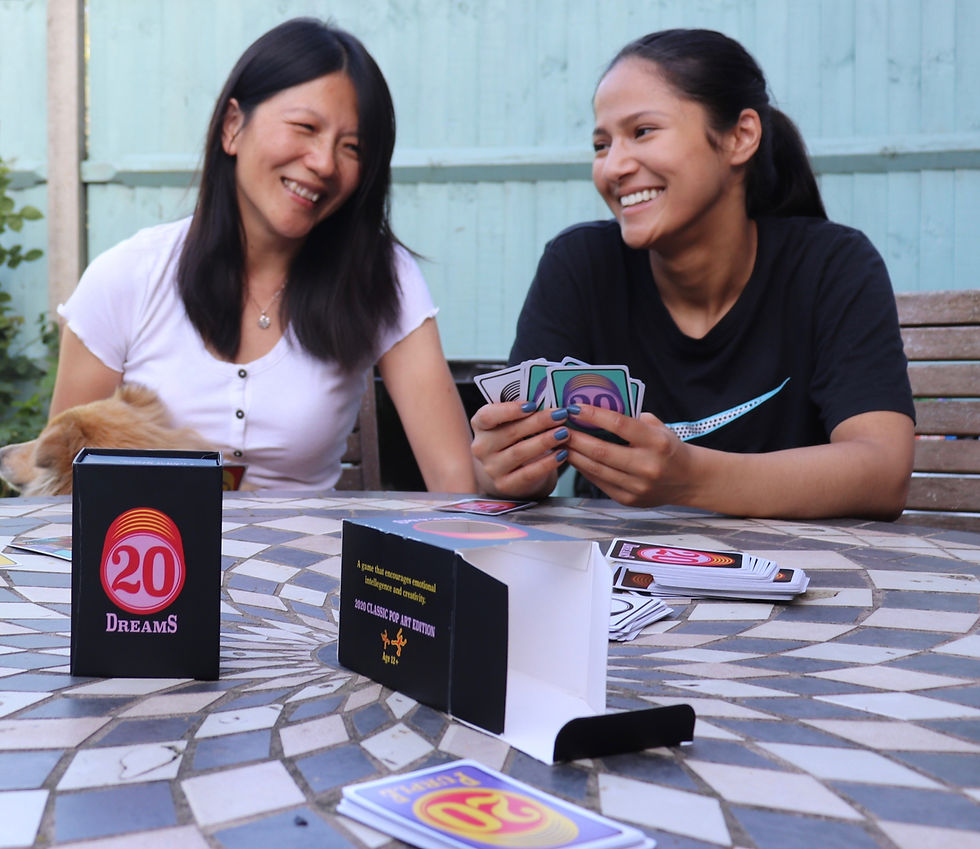
9. Creating communities where people belong: In developing my own game ’20 Dreams’ I have had the privilege to get to know the gaming world and found it to be a community that is wonderfully welcoming and inclusive. Play always encourages a gathering of like-minded people.
10. Different types of play activate different areas of our brain: We can train our brain whilst having fun if we choose the right games to play, learning doesn’t have to be a serious slog. Also, certain games can help us achieve a difficult task; for example, sorting play is very good for improving concentration before going to work on something complex.
You may well be drawn to one type of play depending on your own personal strengths and so I have created a list of types of play below. Take a look, have a think about which sort of play appeals to you but also remember it is always good to give something different a try especially if you want the challenge of developing your brain in a new way.
Sorting Games - Collecting, sorting, arranging, e.g. Jigsaw puzzles.
Games with Rules - Following patterns, strategic thinking, logical moves, e.g. Chess. Imagination Games - Storytelling, art-making, music-making, drama, improvisation, e,g. 20 Dreams.
Powerful play - Rough and tumble, catch me if you can, contact sports, e.g. Rugby.
Building Games - Bricks, lego, model building, e.g. Jenga.
Role Play Games - Figurines, creating worlds, dressing up, e.g. Murder mystery
I hope this has inspired you to set your work aside for a while and go and play, think about what type of play you might enjoy the most, schedule it in your diary, and notice the benefits of play on your body and mind.
If you are interested in understanding more about the psychological and neurological benefits of play then here is some suggested reading for you:
Nurturing Natures, Attachment and Children’s Emotional, Sociocultural and Brain Development by Graham Music. (Psychology Press, 2011)
Playing and Reality by D.W Winnicott. (New York, Basic Books, 1971)
The Polyvagal Theory by S.W Porges (Norton and Company, 2011)
Waking the Tiger, Healing Trauma by P.A. Levine (North Atlantic Books,1997)
Follow me on Facebook, Instagram, Linkedin, and visit my website for more info!
Karen Stallard, Executive Contributor Brainz Magazine
Karen Stallard began her career, having trained in performing arts, working in the theatre. She went on to pursue a spiritual path by training in theology, becoming an ordained Christian minister and working in the inner city for 20 years. Her work included promoting spiritual and cultural care within the British NHS medical system and spending time creating community activities for people experiencing mental distress. Karen went on to work as the minister at Union Chapel, Islington, an award-winning music venue for 8 years where she led the church to become one of the first in the UK to authorise same-sex marriages. Whilst working at Union Chapel she completed training as an Integrative Arts Psychotherapist and now runs a successful private practice. Karen is currently a trainer and supervisor for Trauma-Informed Schools UK and has also created and published a card game, "20 Dreams", a unique game of emotions which is designed specifically to engage the right hemisphere of the brain. Karen is also an artist, musician and beer brewer in her spare time and is passionate about external and internal liberation.