Why You Can’t Lead if You Can’t Speak
Updated: Oct 15, 2025
Hana Brellah is an international leader in the pharmaceutical industry, a keynote speaker, and a communication expert. As CEO & Founder of Find Your Voice by Hana Brellah, she empowers leaders to master public speaking, leadership presence, and career growth, helping them communicate with confidence, influence, and impact.

I was delivering a keynote to a group of senior executives, smart, seasoned, strategic. A few minutes into the talk, I asked a simple question, “How many of you have ever received feedback on your communication skills?” Three hands went up. Out of twenty. That moment stayed with me. Not because of the silence, but because of what it revealed. That silence was not just personal. It pointed to a deeper issue in leadership culture, communication is undervalued, undertrained, and underchallenged.
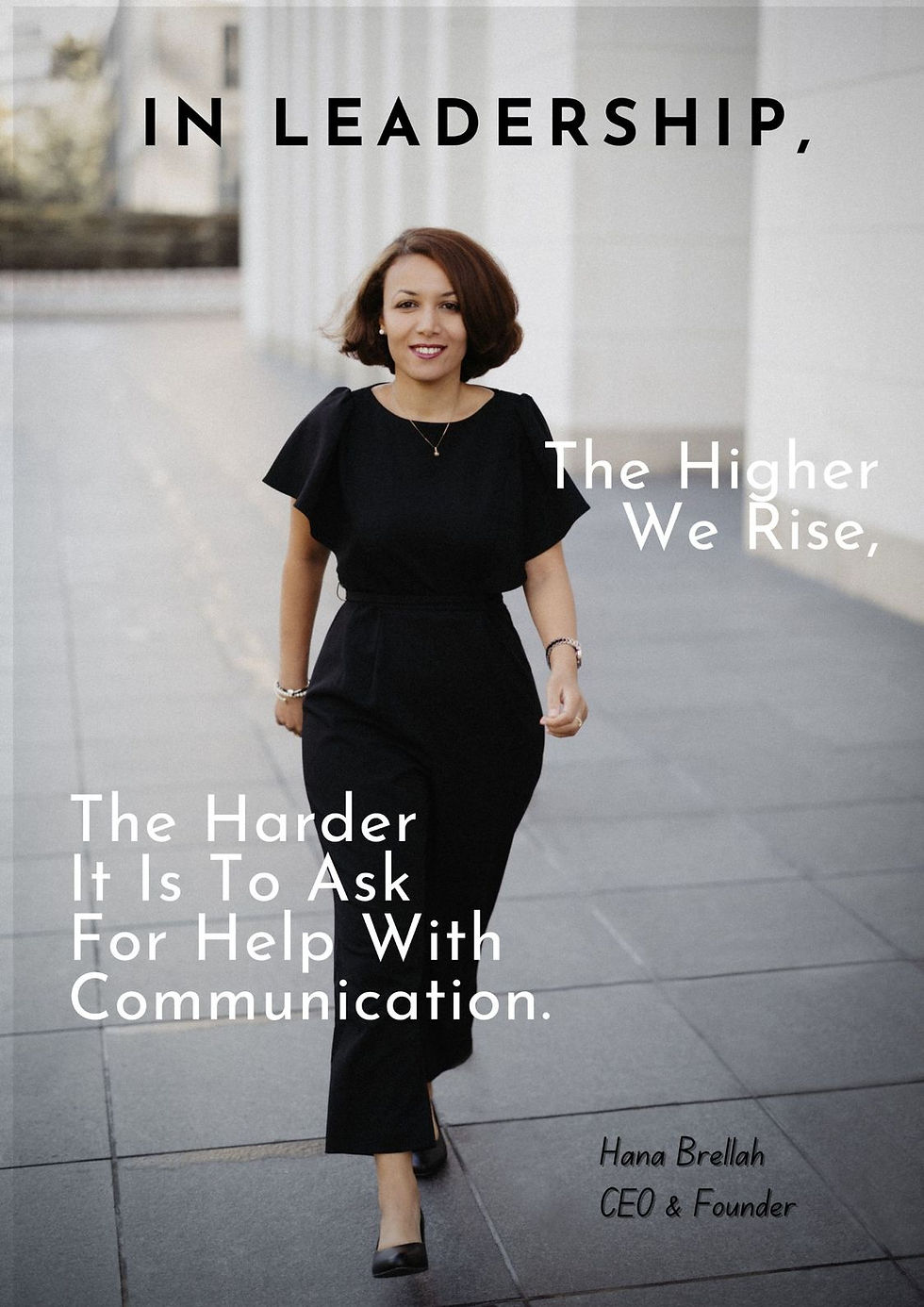
According to McKinsey & Company (2024), only 5 percent of leaders actively seek feedback on their communication, missing critical opportunities for improvement. That is not just a gap. It is a blind spot. And it is costing organizations clarity, trust, and execution.
It is not just feedback that is missing. The very systems designed to shape leaders often overlook the skill that makes leadership visible, communication.
According to Harvard Business Publishing (2023), only 25 percent of leadership development programs include communication training. That means 75 percent of programs are training leaders to think, plan, and decide, but not to speak, connect, or inspire.
The blind spot in leadership development
Leadership programs are built around business acumen, decision-making, planning, and operational strategy. These are essential, but they often come at the expense of the one skill that determines whether those strategies ever see the light of day, speaking.
It is assumed that leaders naturally know how to communicate. But titles do not guarantee influence. When communication is treated as intuitive rather than intentional, it gets neglected.
When leaders are not trained to speak with clarity, the consequences ripple outward.
Add to that the pressure to justify return on investment. Leadership programs prioritize measurable skills like finance and operations because they are easy to track. Communication, by contrast, resists quantification. So it is sidelined, even though it is the skill that determines whether those spreadsheets ever become reality.
The cost of miscommunication
Without strong communication, vision becomes noise, strategy becomes guesswork, and ideas die in translation. Misalignment festers. Execution stalls. Trust erodes.
So what is the antidote to this silence and misalignment? Speaking. Not just talking, but intentional, impactful communication.
Here is the deeper issue. Even when leaders know communication matters, they rarely seek feedback. The higher they rise, the fewer people feel safe offering it. And most leaders do not ask.
That is how blind spots form. Not from ignorance, but from isolation.
Speaking is leadership
Speaking is not just for stages. It is for boardrooms, town halls, meeting rooms, and every moment that demands influence. It is how leaders build trust, spark action, and shape culture.
In today’s world, leadership is performance. The stage is already here.
Speaking is the highest form of leadership communication. It is not about perfection. It is about presence. Not about volume. It is about vision. And not about being heard. It is about being felt.
Find your voice, lead with impact
I have stood in the same rooms where communication makes or breaks trust. I have led teams, made high-stakes decisions, and learned firsthand that leadership is not just about what you know. It is about what you say and how you say it.
That experience led me to create Find Your Voice. It began as a personal mission and grew into a platform for helping leaders speak with clarity and conviction. Whether someone is preparing for a keynote, leading a transformation, or simply trying to connect more deeply with their team, the goal is the same, to make their voice match their vision.
Because when leaders speak with intention, they do more than communicate. They inspire.
A call to speak
Leadership is not just about decisions. It is about connection. And connection begins with voice.
So I will ask you what I ask every audience:
When was the last time you asked for feedback on your leadership communication?
When was the last time you received honest feedback that challenged you to grow as a leader?
Because in the end, you cannot lead if you cannot speak.
The leaders who choose to speak with clarity, courage, and conviction are the ones we remember.
Read more from Hana Brellah
Hana Brellah, CEO & Founder of Find Your Voice
Through Find Your Voice, Hana Brellah empowers leaders to elevate their presence, refine their message, and speak with clarity and confidence. Her work centers on helping professionals strengthen their leadership voice, the unique blend of authority, empathy, and strategic storytelling that defines impactful leadership.
If you are exploring how to refine your leadership voice or seeking a speaker who brings both emotional depth and strategic clarity, Hana Brellah welcomes meaningful connection.
References:
McKinsey & Company, Leadership Mindsets for a Changing World, 2024
Harvard Business Publishing, Leadership Reframed for the Workplace of the Future, 2023