

Why New Year’s Resolutions Fail
Updated: Jan 16
Written by Millah, Founder & CEO of YouTuneIn
Millah Barbosa, Founder & CEO of YouTuneIn, is a wellness innovator dedicated to elevating consciousness through sound and frequency. She bridges science and spirituality to help people and organizations achieve clarity, balance, and transformation.

Every year begins the same way. A moment where we look at our lives and feel the desire to live differently, more present, more aligned, more whole. Every December, millions of us sit down with a notebook (or a hopeful wish in our minds) and declare that this will be the year. The year we finally break old habits, build new ones, get healthier, meditate every day, launch that dream, or become the best version of ourselves.
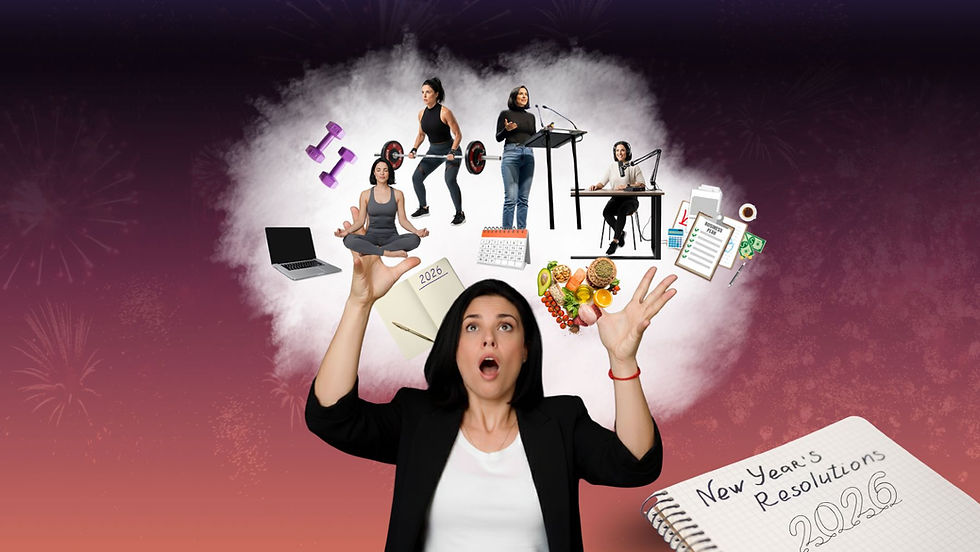
We call these desires resolutions, but most of the time they are not resolutions at all. They are longings. And longings don’t respond well to pressure.
By February, nearly 80% of New Year’s resolutions dissolve into guilt, frustration, and self-judgment.
By February, many people feel discouraged because the way we are taught to change rarely honors how human beings actually evolve.
The 3 reasons most resolutions fail
Most resolutions fail for three core reasons:
We set goals based on who we wish we were, not who we are becoming: We create unrealistic expectations overnight: go from zero to perfect in 24 hours. But the brain does not transform on command. It transforms through repetition.
We rely on willpower instead of wiring: Willpower is a temporary state. Without understanding how your brain forms habits, you end up fighting against your biology.
We focus on outcomes, not identity: “I want to lose weight.” “I want to meditate every day.” “I want to stop overthinking.”
These are outcomes. Resolutions built on outcomes crumble. Habits built on identity, who you decide to become, are sustainable.
Most resolutions fail because they are created from the mind alone. They are ideas about who we should become, rather than listening to who we are already becoming. When we decide to change by ignoring our nervous system, our emotional rhythms, our seasons of energy and rest, the body quietly resists, not out of sabotage but out of protection.
The brain does not open to change when it feels threatened. It opens when it feels safe.
Why your brain resists change and how to rewire it
Your brain is not a fixed machine. It’s a living, evolving organ constantly forming new neural pathways. Every thought, emotion, and repeated action strengthens a pattern. Every new intention creates a possibility.
Motivation is an emotional spark, not a stable ground. Some days it is there, some days it is not. Life doesn’t pause because January began. Work continues. Emotions arise. Fatigue visits. And when motivation fades, the old habit of self-judgment steps in.
To create real change in the new year, you must work with your brain, not against it.
How neuroplasticity actually creates lasting change
Small steps create strong pathways. Tiny, repetitive actions build lasting habits. Meditating for 3 minutes daily creates a stronger neural circuit than meditating for 30 minutes once a week.
Consistency beats intensity. The brain rewires through frequency. Doing a habit five days in a row matters more than doing it perfectly.
What truly creates change is not doing more, but doing less, more often. Small actions, repeated gently, signal safety to the brain. They say, we are not in danger, we are learning. And the brain listens.
Neuroplasticity is not activated by intensity; it is activated by frequency. By rhythm. By return.
Why sensory-based practices accelerate transformation
Your brain doesn't change through logic alone; it changes through experience. And the most powerful experiences are sensory.
When you combine sound, breath, visualization, and frequencies, you activate multiple neural networks at once, making it easier for the brain to create and strengthen new pathways.
Frequencies shift your brain into states where change is easier.
Specific frequencies can guide your brain into specific states, each associated with different mental functions: relaxation, creativity, emotional release, subconscious learning, heightened focus, insight, and problem solving.
When your brain enters these states, it becomes more plastic, more receptive to new patterns, behaviors, and beliefs.
Sound and frequencies lower the “mental noise.”
New habits fail when your mind is overwhelmed by stress, overthinking, or emotional tension. Frequencies regulate the nervous system, lowering cortisol and calming the amygdala.
A calm brain learns faster. A regulated nervous system adopts habits more easily.
Visualization becomes more effective when the brain is in a receptive state. When paired with frequencies, visualization activates both the emotional and cognitive centers of the brain. The brain begins rehearsing the new habit as if it’s already real, strengthening the neural pathway before the behavior even happens.
This is why athletes and peak performers use mental rehearsal with sound stimulation, the brain doesn’t differentiate between imagined practice and physical practice.
Repetition plus sensory immersion equals faster rewiring. The more senses involved in a ritual, the stronger and faster the neural networks form.
Regulation before transformation
Change is emotional. We don’t abandon habits because we are lazy. We abandon them because, underneath, something feels unsafe, overwhelming, or unsupported.
When the inner environment is noisy, when stress hormones are high, and the mind is racing, the brain prioritizes survival, not growth. This is where regulation becomes essential.
Sound, breath, and frequency work not because they “fix” you, but because they bring you back into coherence. They quiet the excess mental noise. They soften the alert systems. They create a state where the brain becomes receptive again, where learning, imagination, and new identity can gently take root.
When the nervous system is calm, consistency stops feeling like effort. It becomes a natural extension of self-care.
Why tools like YouTuneIn make this process easier
Platforms that integrate binaural beats, 8D sound, affirmations, and guided practices create the ideal neural environment for transformation. They help your brain:
Enter the right brainwave states
Reduce resistance and stress
Reinforce new beliefs
Anchor new behavioral patterns
Accelerate the neuroplasticity process
Your brain operates through electrical activity called brainwaves. These waves shift throughout the day depending on what you’re doing, feeling, or thinking. Each frequency corresponds to a different mental and emotional state. In the app, you can find 7 different frequencies for different purposes.
But for this purpose, we should focus on Theta and Delta states, the brain’s critical filter quiets. This allows affirmations to bypass conscious resistance and directly influence the subconscious, where habits, self-image, and emotional patterns are formed.
So with customizable routines, daily reminders, and a full library of binaural frequencies, you can build a habit system that adapts to your lifestyle and keeps your transformation consistent and sustainable.
Let’s plan a different way to meet the new year
Instead of writing resolutions, I invite you to try something softer and far more powerful! Set aside ten quiet minutes. No phone. No pressure. Just presence.
Begin by placing one hand on your chest and one on your belly. Let your breath slow down and allow yourself to arrive.
Then ask yourself a different question than usual.
“What kind of relationship do I want to have with myself this year?” Choose one small action, something so realistic that it feels almost too easy. Instead of attaching this action to a future outcome, attach it to an identity.
“I am someone who pauses and listens to myself.” “I am someone who returns even when I drift.”
Finally, make one quiet agreement with yourself, “I will practice this action with kindness, not perfection.”
The new you is not created on January 1st
The version you are becoming was not created on January 1st. It is created quietly, in ordinary moments, repeated with care.
One breath. One pause. One choice to return to yourself. This is how identity shifts. This is how habits last. This is how life changes. Not through pressure. Through presence.
Watch this video with Millah about this article.
Read more from Millah
Millah, Founder & CEO of YouTuneIn
Millah Barbosa is the Founder & CEO of YouTuneIn, a wellness innovation company pioneering advanced sound and frequency solutions for emotional balance, clarity, and resilience. With two decades of experience as a creative entrepreneur and coach, she bridges science and spirituality to help people and organizations align with their highest potential. Her work empowers leaders, teams, and individuals to live with greater purpose and consciousness.


