Why Communities Are Rewriting the Rules of Online Business
Updated: Apr 23
Written by Viviana Castaneda, Digital Mompreneur
Viviana Castaneda, a mom of two and entrepreneur since 2017, is the founder of Digital Mompreneurs, an empowering brand helping moms bring their digital business ideas to life. With a focus on confidence, time management, and content consistency, Viviana is dedicated to empowering fellow moms in the digital world.

Let’s be honest about something most marketing advice won’t say out loud. A lot of entrepreneurs are doing more than ever on social media and getting less back, less real conversation, less loyalty, and less momentum that turns into actual clients. It's not because they're doing it wrong. It's because the way people behave online has changed. The data confirms it, Instagram's engagement rate dropped from 2.94% to 0.61% in a single year. Gartner projects that 50% of consumers may abandon social media entirely due to distrust and fatigue. You don't own your followers. You're renting visibility, and the rent keeps going up while the returns keep shrinking.
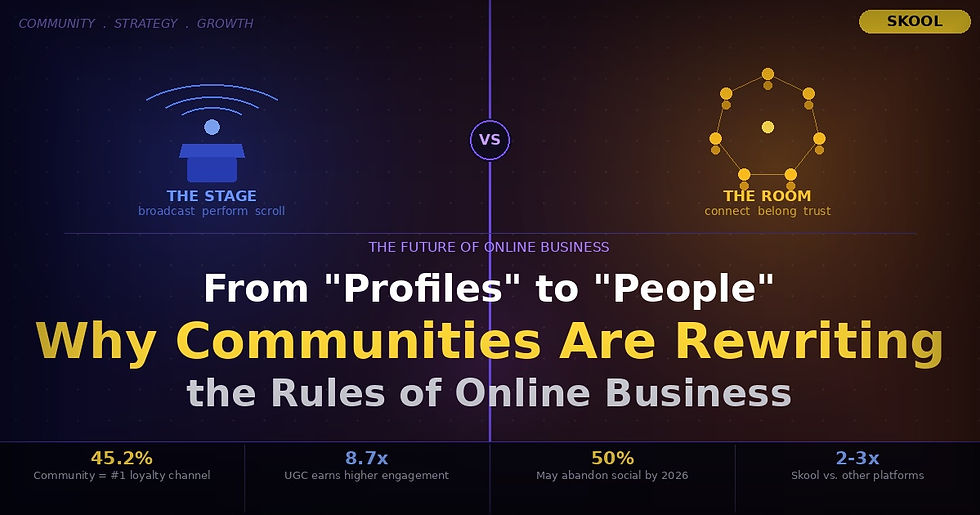
Social media is a stage, a community is a room
Most social platforms are built like stages. You post, people watch, some engage, and most scroll. Tomorrow, you're back up there again, earning attention from zero.
A business profile is your shop window. A personal brand is you as the channel. Both can create visibility, but visibility is not the same as connection. You can work hard on Instagram, LinkedIn, or TikTok and still feel like you're speaking into the void.
A community is different. It's not a stage, it’s a room. People don’t just watch you, they interact with you. More importantly, they interact with each other. Trust builds faster. Conversations go deeper. Interest turns into belonging. Belonging is when someone stops being a follower and becomes "I'm part of this."
That's why communities are becoming the most genuine path to people who are truly interested in what you offer, without performing daily for an algorithm.
What people actually want
People aren't tired of businesses. They're tired of being marketed at.
What they're hungry for is a place where their questions get real answers, where the people around them are working toward something similar, something that comes from a community. When it's built right, the commercial results follow naturally. Not from pressure, but from trust.
45.2% of marketers now rate community-driven efforts as their highest-performing channel for loyalty and repeat engagement.
User-generated content (what flows naturally from engaged communities) earns 8.7x higher engagement than branded content.
69% of creators say member transformation, not follower count, is now their primary growth driver.
Why most platforms still miss it
Social media isn't going away, it's still great for discovery, reach, and visibility. But when someone is genuinely interested, social doesn't always give them a place to land. A community is that landing space.
Discord is great for real-time chat but chaotic at scale. Circle is capable, but it gets expensive and feels like managing infrastructure. Mighty Networks, Patreon, and Slack are each built for something adjacent to community, not community itself.
Then there's Skool. It keeps coming up because it’s built around one idea, make it easy for people to participate, not just consume.
Skool: Where community actually works
Skool was built by Sam Ovens around a gap that sounds obvious in hindsight, course platforms had no community, and community platforms had no learning structure. Nobody had done both well in the same place.
Skool fixes that. One roof, a community feed, a classroom for courses and content, a calendar for live events, and gamification that makes showing up feel like a game worth playing rather than an obligation. Members earn points, level up, and see each other regularly. You move from "we follow each other" to "we actually know each other."
The results are hard to ignore. Skool generates a reported 2–3x higher engagement than competitors. Daily logins in tested communities doubled within 30 days. The 2024 Skool Games winner hit $100k+ in monthly recurring revenue during the competition. Alex Hormozi called his investment in Skool the biggest bet of his life.
"Skool saved me 10 hours a week on admin, and people actually keep coming back."
The bottom line
Use social as your front door, visibility, discovery, and reach. Use a community as your living room, trust, transformation, and real relationships.
Most people don't buy from a post they saw once. They buy when they feel close enough to trust. Communities are where that closeness happens, especially when the room is genuinely led.
A profile can make people admire you. A community can make people know you.
In a world where everyone is creating content, the businesses that win won’t always be the loudest. They’ll be the ones that build a room people actually want to stay in.
On social media, you're an advertiser. On Skool, you're a host and that changes everything.
Want to give it a go? This is the best way to test it! Start building on Skool.
Read more from Viviana Castaneda
Viviana Castaneda, Digital Mompreneur
Viviana Castaneda has been making waves in the entrepreneurial world since 2017. With a bachelor's degree in marketing and a dedication to her role as a mother, she has seamlessly balanced her entrepreneurial journey with raising her children. As the founder of Digital Mompreneurs, she leverages her personal experiences to develop empowering tactics and strategies that assist fellow mompreneurs in regaining the confidence essential for success, delving deep into the understanding of the human brain, mind, and behavior.