

When Leaders Silence Truth and the Hidden Cost of Bullying at the Top
Written by Shery Saeed, Executive Coach & CEO Advisor
Shery Saeed is a transformational executive coach and trusted advisor to bold CEOs, visionary founders, and culture-shaping leaders. With over 25 years of experience navigating high-stakes leadership moments, she blends strategic rigor with deep psychological insight to help clients lead with clarity, scale with conviction, and evolve with purpose.

It rarely starts with open aggression. It starts with a room going quiet. Someone offers a perspective. There’s a pause. A glance. A correction, subtle, but sharp enough that everyone registers it. Nothing overt. Nothing reportable. But from that moment on, the room learns.
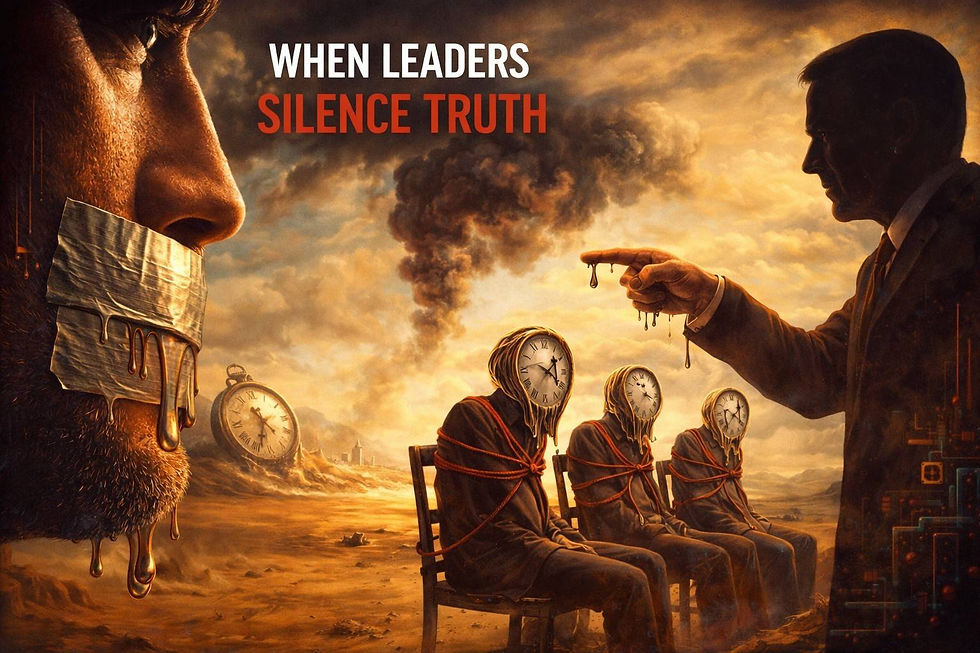
What not to say. When to stay silent. How to survive. And that’s how it begins.
Bullying in leadership is not new. What has changed is not the behavior, it’s our understanding of its consequences, and, in some cases, our willingness to name it.
In boardrooms, cabinet rooms, and corner offices, the bully leader follows a familiar pattern: Public pressure. Private charm. Loyalty rewarded. Dissent punished. Uncertainty introduced, then controlled.
In the short term, it can look like strength.
Decisions are fast. Authority is clear. There is no ambiguity about who is in charge. But speed is not the same as clarity. And control is not the same as leadership.
Where the damage actually begins
The first thing an organization loses is not performance. It’s truth.
Employees begin managing the leader’s moods instead of managing the business. Meetings shift. People stop offering ideas and start offering versions of what the leader already believes. Middle managers stop leading and start translating volatility.
Over time, the organization stops surfacing reality. And when reality stops moving upward, decision quality collapses, even if confidence at the top does not. That collapse is rarely visible at first. But it is already underway.
A pattern I recognized early
I saw this dynamic up close early in my career at Bear Stearns. On the surface, it was a high-performance environment. Fast decisions. Strong personalities. No tolerance for hesitation. There was a phrase that came up often, "Failure is not an option."
It sounded like a standard of excellence. In practice, it created something else. Because if failure isn’t an option, neither is full transparency. Problems get softened. Risks get reframed. Information gets managed before it moves upward.
And over time, the question quietly shifts, not “What’s true?” but “What holds under pressure?” You could feel the change.
People were reading the room before they were reading the data. Conversations adjusted in real time to match the dominant voice. The room didn’t get less intelligent. It got less honest.
And that distinction matters more than most leaders realize. Because when honesty erodes, decision quality follows, even if confidence doesn’t.
What fear does to a system
Fear doesn’t just silence people. It reshapes behavior. Innovation slows because risk becomes personal. High performers leave because they have options. Successors aren’t developed because talent feels threatening. Alignment becomes compliance.
What remains often looks stable. But it is a weaker system. Because stability built on fear is not resilience. It is fragility, waiting for pressure.
At senior levels, leadership is not measured by output alone. It is measured by the quality of thinking the environment allows.
When fear enters a system of power
In business, the damage is costly. In government, it is structural. When fear enters a system responsible for public decision-making, it doesn’t just affect culture, it distorts reality itself.
Information is filtered before it reaches the top. Dissent disappears. Expertise is replaced by alignment. The issue is no longer behavior. It is decision integrity.
And any system that cannot tolerate contradiction cannot make sound decisions, no matter how strong it appears externally.
Why these leaders rise, and stay
Bully leaders don’t appear randomly. They are often selected, especially in moments of pressure. When uncertainty rises, systems tend to reward dominance. Confidence is mistaken for competence. Certainty is mistaken for clarity. Decisiveness, even when poorly informed, is mistaken for strength.
Many of these leaders share a deeper pattern: an intolerance for ambiguity. They don’t just silence dissent. They remove the conditions required for good judgment.
And once in place, they persist. Because confronting them carries risk. Because results can mask damage, for a time. Because by the time the cost becomes visible, the system has already adapted to survive them.
The real cost
By the time a bully leader exits, the damage is rarely contained. Trust is fractured. Leadership benches are weakened. People are exhausted. And most critically, the organization has learned to hesitate.
Even after the leader is gone, the imprint remains. People second-guess. They hold back. They wait for reactions that no longer come. The leader leaves. The fear stays.
What accountability actually requires
This is not solved by individual courage. It requires design. Organizations that address this early don’t rely on personality, they rely on structure. Independent reporting channels. Real feedback loops. Board-level attention to culture. Clear consequences that apply at the top.
But structure alone is not enough. Because policies don’t stop behavior. Environments do. When challenge is expected, not punished. When dissent is treated as signal, not threat. When leaders are evaluated not just on results, but on how those results are produced.
Bully behavior loses oxygen. Not because it is prohibited. Because it cannot survive.
The bottom line
Bully leaders are not strong leaders. They are leaders who extract performance by compressing truth. And any system that cannot tolerate truth will eventually lose its ability to make good decisions, no matter how powerful it appears in the moment.
The question is not whether a bully at the top will cause damage. The question is how long the system will protect the illusion of strength, before the cost becomes impossible to ignore.
Read more from Shery Saeed
Shery Saeed, Executive Coach & CEO Advisor
Shery Saeed works with founders and CEOs at the moment when success starts to feel heavier instead of easier. Known for her Founder Ceiling framework, she helps leaders evolve their identity, decision-making, and leadership model so their companies can scale beyond founder dependence.
Drawing on decades of transformation work with executives and growth-stage companies, Shery focuses on the human side of scale, where leadership evolution and business performance rise or stall together. Her forthcoming book, The Founder Ceiling, explores why strong companies plateau and how founders can become the CEO their next stage requires.



