What Procrastination Is Really Trying To Tell You
Written by Carmel Shami, Holistic Time Management Mentor
Carmel is a time management mentor, author, and former social worker who helps overwhelmed professionals and individuals with demanding lives break free from burnout and constant overload. Using a holistic productivity and time management framework, she helps them regain clarity, balance, control, and live intentionally.

Going to save this article for later because you truly want to understand your procrastination? You are exactly the person I wrote it for. Give yourself just seven minutes to read it now, and it may help you move toward real change.
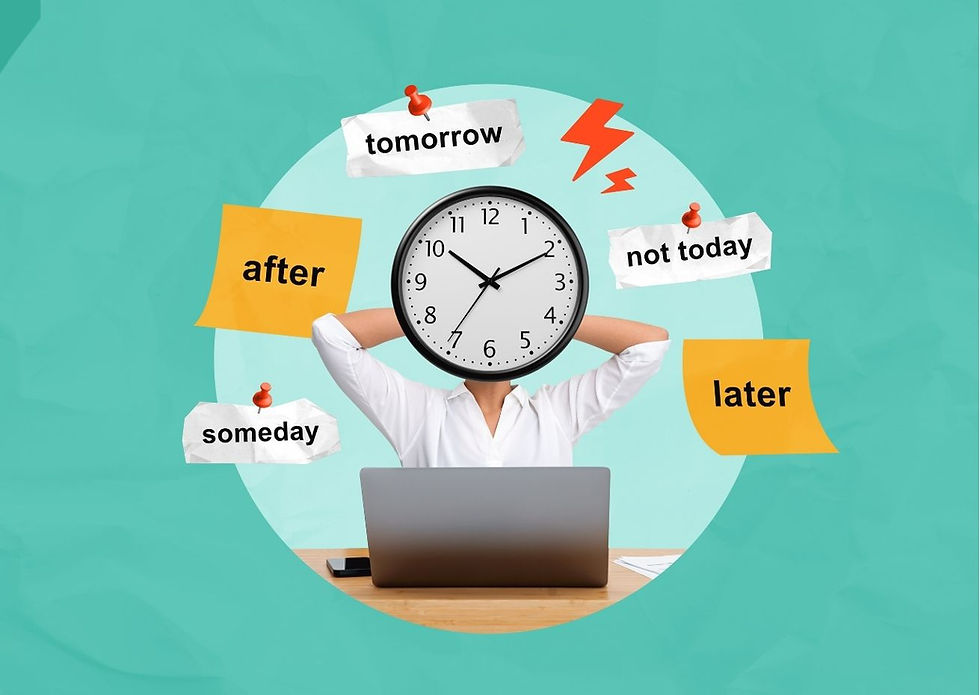
Most of the time, when I hear people talk about procrastination, it is wrapped in guilt, shame, and frustration. Almost without exception, at some point, the word "lazy" comes up. We blame ourselves, mentally beat ourselves up, and try to fight procrastination with more pressure. But in my experience, that approach rarely solves the problem. It only adds more emotional weight to a task that was already hard to face.
The question that changes everything
So rather than judging the delay, I try to understand it. When a task keeps getting pushed from one week to the next, I do not start by asking, “Why am I not doing it?” I ask, “What is blocking this task?”
Because procrastination is not one simple problem, the same solution will not work for every task. A task may be delayed because it is unclear, emotionally loaded, boring, overwhelming, or simply asking for more energy than you have at that moment. Sometimes there is one blockage, and sometimes several are layered together. Once you understand what is truly blocking the task, it becomes easier to respond in the right way. That is when work begins to feel lighter, clearer, and less like a constant inner fight.
What is procrastination really telling you?
Research increasingly supports what many people feel but do not always know how to explain, procrastination is often tied to emotional discomfort, not just poor discipline. A 2025 systematic review and meta-analysis found a moderate positive association between procrastination and negative emotions, especially depression, anxiety, and stress, and pointed to emotion regulation as an important part of the picture.[1]
In other words, procrastination is often the brain’s attempt to avoid discomfort now, even when that creates more stress later. That is why the better question is not, “How do I force myself to do this?” It is, “What about this task feels hard for me?”
What I have found is that procrastination usually falls into six broad categories. Under each category, there may be several possible blocks. Once you identify the block, it becomes much easier to understand what the task needs from you, choose the right tool, and place it in your schedule at a time that matches the kind of energy it requires.
The 6 categories behind procrastination
1. Clarity gap
The problem: Sometimes the task is not being avoided because you are lazy or resistant. It is being avoided because it is still too vague for your brain to begin. When the task is unclear, the mind keeps circling instead of moving.
Possible blocks: needing more information, not knowing where to start, not knowing what “done” looks like, unclear next step.
Examples: writing a proposal without knowing what to include, delaying an email because you are not clear about what you are asking for, wanting to start a project but not knowing the first step.
One shift to make: Define “done” in one sentence, then identify the smallest next action.
Research supports this too. A 2025 study found that a brief procrastination intervention helped by naming emotions, breaking the task into smaller steps, and making the outcome feel more worthwhile.[2]
2. Decision and mental overload
The problem: Sometimes procrastination is really decision fatigue. The task is too mentally crowded. There are too many options, too many moving parts, or too many questions trying to get answered at once.
Possible blocks: too many choices, overthinking, decision fatigue, overwhelm, trying to solve the whole thing at once.
Examples: delaying a business decision because too many directions seem possible, putting off planning because everything feels important, avoiding a task because it feels like ten tasks inside one.
One shift to make: Do a brain dump first to unburden your mind and get everything onto one page. Then reduce the options to two, or decide only on the next decision instead of the entire outcome. Once the mind stops trying to hold everything at once, the task usually feels lighter and more workable.
3. Emotional friction
The problem: Some tasks carry emotional weight. They trigger fear, discomfort, self-doubt, or vulnerability, so the brain avoids them. In these moments, procrastination is often less about time and more about emotional protection.
Possible blocks: fear of failure, perfectionism, self-doubt, fear of exposure, fear of rejection, hard conversations, difficult decisions with emotional weight.
Examples: posting online and feeling exposed, raising your prices, sending a pitch, having a boundary conversation.
One shift to make: Ask, “What feeling am I trying not to feel here?” Then make the step smaller, safer, or messier so it becomes emotionally doable. It can also help to get a pep talk from a friend who believes in you and can help move you toward action. Another useful question is, “What is the worst that can happen?” Many times, the worst-case scenario is much bigger in our head than in reality.
4. Dopamine gap
The problem: Some tasks are not emotionally hard or mentally unclear. They are just low-stimulation. The reward is too far away, while the discomfort is immediate, so the brain reaches for something that feels better now.
Possible blocks: boredom, craving immediate reward, low interest, repetitive tasks, tasks with distant payoff.
Examples: admin work, follow-up emails, paperwork, repetitive household tasks.
One shift to make: Add immediate reward. Pair the task with music, coffee, a timer sprint, a visible win, or a small reward at the end.
A 2024 Scientific Reports study found that people who placed less value on future rewards were also more likely to procrastinate. In plain language, when the payoff feels too far away, it is harder for the brain to get moving now.[3]
5. Energy mismatch
The problem: Sometimes the task is not wrong, but it is wrong for your current energy state. You are trying to do something that requires focus, emotional capacity, or physical energy at a time when you simply do not have it.
Possible blocks: low mental energy, emotional depletion, physical fatigue, brain fog, mismatch between task demand and available energy.
Examples: trying to write at the end of an exhausting day, putting off a difficult conversation because you have no emotional capacity left, delaying a decision-heavy task when your brain is already overloaded.
One shift to make: Match the task to the energy it requires, not the energy you wish you had. You can ask, "Deep focus? emotional courage? social energy? physical effort?" Then place it where it actually fits.
A 2024 study looked at general procrastination, bedtime procrastination, sleep sufficiency, and daytime fatigue together. The takeaway is simple, tiredness and sleep patterns can shape how procrastination shows up, which means delay is not always just a discipline issue.[4]
6. Accountability and environment gap
The problem: Sometimes the issue is not inside you at all. The environment is full of friction, or the task has no structure around it. Without support, urgency, or the right setting, some tasks simply do not move.
Possible blocks: distractions, unsupported environment, no clear start time, no accountability, no one expecting progress.
Examples: trying to focus with your phone next to you, working in a noisy house, business development tasks.
One shift to make: Create structure and find an accountability partner or coach. Change the setting, remove distractions, set a clear start time, and build in follow-up so the task does not live only inside your head.
Why this matters
What makes this framework matter is that it helps connect your daily tasks to your bigger picture. Tasks are not just things to get done for the sake of being productive. They are meant to support your goals, your values, and the life you want to create. When you understand what is blocking a task, you are not only making it easier to follow through, you are making it more possible to move toward your deeper purpose and aspirations with more clarity, intention, and alignment.
Over time, this understanding is what led me to create my TaskFlow method, a practical way to work with resistance, energy, and time so tasks can be planned more wisely and completed with more ease. In other words, it helps bridge the gap between insight and action, so people are not only aware of what blocks them, but also know how to build a task management system that works with the way they actually function.
If you made it to the end of this article instead of saving it for later, that is already a small win. It means procrastination is not as powerful as it sometimes feels.
A good place to begin is by looking at the tasks you keep postponing and getting curious about what may be underneath the delay. Once you start to see the reason more clearly, it becomes easier to plan that task at a time that matches what it truly requires from you, whether that is focus, emotional courage, energy, or structure. And if you find that you want further support and guidance as you work through that process, I am here to help. I would also love to hear how it goes for you and whether this way of looking at procrastination makes a difference.
Read more from Carmel Shami
Carmel Shami, Holistic Time Management Mentor
Carmel is a time management expert who helps people rebuild clarity and balance in demanding lives. She is the founder of It’s About Time, a holistic productivity practice rooted in mindset, structure, and energy management. Drawing on her years of work with the elderly and families facing grief, she developed an approach that considers the whole person, not just their schedule. Witnessing how often people reach the end of life with unspoken regrets shaped her mission to help others choose intentionally how they live. As she often reminds her clients, no one dies finished. Choose what matters.
References: