

What is Holistic Health? And How It Took Me From Bedbound to Rebuilding My Life
Berta Kaguako is the Co-Founder and Managing Director for EthVida, a patient educational platform that promotes plant medicine and a holistic healthcare approach. As a patient herself, Berta has made a remarkable transformation, using cannabis based medical products to manage 7 diagnoses and 50+ symptoms. And now advocates for plant medicine.

I received my first diagnosis at 22. I did not realise at the time that it would mark the beginning of an adulthood shaped not by career progression or personal expansion, but by survival.
One diagnosis became two. Two became five. Today, I live with ten diagnoses and more than fifty symptoms affecting my neurological, immune, metabolic, and musculoskeletal systems. My body became a battleground of competing conditions. Managing one often aggravated another. Stabilising inflammation could flare neurological symptoms. Addressing pain could destabilise energy. Every decision had consequences. And then long COVID arrived and brought everything to the surface.
Conditions that had once been somewhat controlled spiralled. I became bedridden four to five days a week. I lost my job. I lost friendships. Relationships dissolved under the weight of unpredictability and exhaustion. My world narrowed to the four walls of my bedroom. There were days when I did not have the strength to walk to the bathroom. To urinate, I would throw my blankets and pillows onto the floor, roll my body onto them to cushion the pain, and drag myself slowly across the room. That was the only way I could tolerate the movement. That was my reality.
This was not tiredness. This was systemic collapse. And in that collapse, I lost hope.
The chronic illness gap in modern healthcare
Modern healthcare can be quite good at managing acute and emergency conditions. Trauma, infections, and cardiac events are areas where the system performs well.
But for chronic illness, it is different.
Chronic conditions require long-term, multi-system management. They demand integration across disciplines. They require continuity, patience, and personalised oversight. Yet healthcare systems globally are structured around short consultations, symptom suppression, and crisis management.
If you live with one chronic illness, navigating that system is exhausting. If you live with multiple diagnoses, it becomes fragmented and overwhelming. Specialists focus narrowly. Prescriptions are layered. Symptoms are treated in isolation. Rarely does someone step back and assess the body as a whole system.
And when you are too sick to advocate for yourself, you fall through the cracks, as even trained healthcare professionals are programmed to overlook you as a person. I looked around and saw so many people with chronic illness accepting decline, not because they lacked resilience, but because fighting the system made them worse. Chronic stress exacerbates inflammation. Advocacy requires energy. Repeated dismissal erodes hope.
Eventually, I stopped fighting too, until I discovered medical cannabis, which enabled me to re-establish a holistic approach to improving and sustaining my health and wellbeing.
What is holistic health?
Holistic health is an integrative approach to wellbeing that recognises the body as an interconnected system, not a collection of isolated symptoms. It considers physical health, mental health, emotional regulation, metabolic function, nervous system stability, nutrition, movement, sleep, environment, and purpose as interdependent components of overall wellbeing.
Rather than asking, “How do we suppress this symptom?” holistic health asks:
What systems are dysregulated?
Where is inflammation originating?
Is the nervous system stuck in chronic fight or flight?
Are nutrient deficiencies impairing cellular repair?
Is sleep preventing recovery?
Is trauma perpetuating physiological stress responses?
Holistic health does not reject conventional medicine. It complements it. It fills the gaps left by a symptom-focused model by addressing root contributors and lifestyle drivers of disease progression. For someone with ten diagnoses, this systems-based thinking was transformative.
Because when you have fifty symptoms, chasing them individually is futile. Supporting core systems, inflammation, mitochondrial function, metabolic health, and nervous system regulation, creates compounding effects across multiple conditions.
But I did not begin this journey from a place of strength. I began it from zero.
February 2022: Rebuilding from collapse
In February 2022, bedridden and out of options, I began exploring plant and botanical medicine within appropriate and legal frameworks. Medical cannabis helped regulate pain and calm an overactive nervous system. Psilocybin, approached intentionally and responsibly, helped manage my brain injury and disrupt deeply ingrained trauma patterns and neurological rigidity created by years of illness and stress.
These interventions did not cure my diagnoses. But they got me out of bed.
And when you have been dragging yourself across the floor just to reach the bathroom, getting out of bed is not minor progress. It is life-changing. Once upright more consistently, I began rebuilding the foundations of health through a holistic framework.
The core pillars of holistic health and how they changed my body
Nutrition as inflammation control
Chronic illness and systemic inflammation are deeply intertwined. I implemented a ketogenic nutritional approach to stabilise blood sugar, reduce inflammatory load, and support metabolic flexibility. This was not a trend-driven decision. It was strategic. With multiple diagnoses, blood sugar instability amplified neurological symptoms, fatigue, and pain. Reducing glucose spikes created measurable stability in my energy and cognition.
Nutrition is medicine.
Targeted supplementation
Chronic illness often depletes micronutrients essential for mitochondrial function, immune balance, and neurological health. Under informed guidance, I reintroduced targeted vitamins and supplements based on deficiencies and symptom presentation. This was not random biohacking. It was structured and intentional. Supporting cellular function gradually improved resilience.
Sleep as non-negotiable repair
Sleep is when the body regulates inflammation, clears metabolic waste from the brain, and repairs tissue. For years, pain and nervous system dysregulation disrupted mine. Through strict sleep hygiene and nervous system support, restorative sleep became a priority rather than an afterthought. Enhanced sleep contributed to a decrease in symptom flares, which in turn promoted greater consistency in daily routines. Although sleep remains an area for ongoing improvement, there has been progress. The duration increased from two hours without medication to five hours. This incremental advancement highlights the gradual nature and benefits of holistic health approaches.
Nervous system regulation
Living with chronic illness keeps the body in survival mode. Prolonged sympathetic activation worsens inflammation, impairs digestion, disrupts hormones, and heightens pain perception. Medical cannabis, breathwork, stress reduction strategies, and trauma-informed approaches helped shift my nervous system out of constant fight or flight. When the nervous system stabilised, multiple symptoms softened simultaneously.
Movement as gradual reconditioning
When I first reintroduced movement, it was from the floor. Gentle mobility exercises. Short, monitored walks. Every increase was measured against potential crashes. Holistic health required patience. If I pushed too far, I paid for it. If I progressed strategically, improvements compounded.
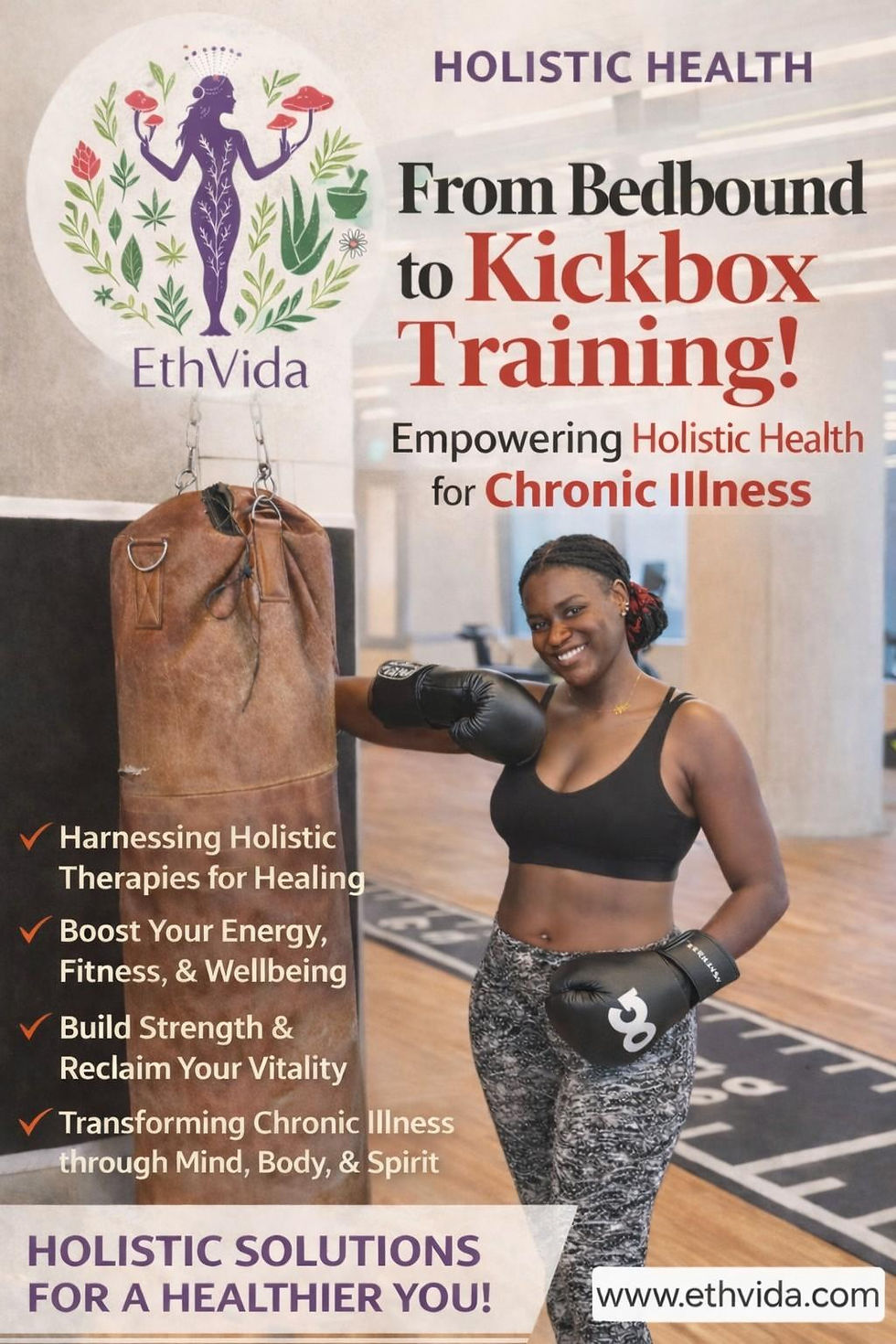
Four years later, I am training in kickboxing. Will I ever return to full athletic capacity? I do not know. But for the first time, I am strong and excited enough to try.
The reality of slow healing
One of the hardest lessons was accepting that holistic healing is gradual. We are conditioned to expect rapid pharmaceutical effects. Holistic interventions are cumulative. For nearly a year, I questioned whether anything was changing. I gave up repeatedly. I felt broken long after others might have assumed I was “better.”
But when you start at zero, progress is microscopic before it becomes visible. By February 2026, four years after beginning treatment, I was no longer bedridden. I returned to part-time work. I began travelling again. I rebuilt structure and purpose into my life.
I still manage ten diagnoses. I still pace myself carefully. I still experience symptoms. But I am living. And that is something I once believed would never be possible again.
We are disabled, not dead
Chronic illness does not mean life is over. It means adaptation. Strategy. Resilience.
For too long, I saw people quietly accept decline because navigating the system alone was overwhelming. I understand that exhaustion. I lived it. But we are disabled, not dead. There is still potential within us. There is still growth available. There is still life to build.
EthVida bridging the gap in healthcare
Out of this journey, I founded EthVida, a nonprofit organisation dedicated to promoting holistic health and plant-based therapeutic approaches for the management of chronic illness.
EthVida exists because there is a gap in healthcare today, a space between acute crisis care and long-term sustainable support. Too many people are told to “manage” without being shown how to rebuild.
Through ethvida.com, we provide educational resources, structured guidance, and signposting to supportive services. We are continuously developing tools designed to empower individuals to take informed control of their wellbeing. Our mission is not to replace conventional medicine, but to bridge the gap it often leaves behind.
If you are tired of navigating a broken system alone, you do not have to. There is another way to approach healing. There is community. There are strategies. There is possibility. Four years ago, I was dragging myself across the floor to reach the bathroom.
Today, I am rebuilding my life. I am excited to see where my journey will take me.
Takeaway: Holistic health requires patience and the strength to rebuild
Holistic healing is not easy. In fact, it is one of the hardest things I have ever done. Finding strength when my body had none. Staying disciplined when your body is determined to work against you, especially when you are not seeing results. So many factors are involved that make it the toughest journey you will ever be on and the reason you will want to quit every single day. But always remember, no pain, no gain, and life starts at the end of your comfort zone. Speak to a healthcare professional and get the process rolling.
There will be moments when you lose hope. There will be months when progress feels invisible. Unlike medication, which can produce immediate and noticeable effects, holistic health unfolds gradually. It requires consistency, discipline, and faith in results you cannot yet see.
But here is the difference. The progress is sustained.
With many medications, when you remove the prescription, the progress often disappears with it. The symptom returns because the underlying system has not been strengthened. It has simply been managed. Holistic health works differently. It builds resilience. It supports foundational systems. It creates internal stability that does not vanish overnight.
This is not a condemnation of medication. I still use conventional treatment for my arthritis, and I am grateful that option exists. Modern medicine has an essential and irreplaceable role. But where I once relied on eight or nine prescriptions, today most of them are gone, replaced with strategic nutrition, targeted supplementation, nervous system regulation, movement, sleep discipline, and plant-based therapeutic support.
That transformation did not happen quickly. It happened slowly, sometimes painfully, and often with doubt. But it happened. If you are living with chronic illness, I will not tell you this path is simple. It is not. It requires effort at a time when effort feels impossible. It requires persistence when you are exhausted. It requires believing that improvement is possible even when your current reality suggests otherwise.
Yet if there is one thing my journey has taught me, it is this:
You are stronger than your symptoms.
Your body is not your enemy.
And you are allowed to fight for a life beyond mere survival.
Find your strength, even if it is fragile at first. Protect it. Build on it. And piece by piece, take your life back. Check out our goal planner to help you get started.
Read more from Berta Kaguako
Berta Kaguako, Health and Social Care Consultant
Berta Kaguako is a Health and Social Care Consultant, with an Undergraduate in Psychotherapy and a Master's in Psychoanalysis. Berta’s background is in Mental Health, Substance Misuse and Children & Families, in both a therapeutic and senior management capacity, having won 3x Blooming Strong Awards (Recognition from UN for contribution to violence against Women). Berta is also the Co-Founder and Managing Director for EthVida, and independently runs the wellbeing service/educational platform.
References:
Engel, G. L. (1977). The need for a new medical model: A challenge for biomedicine. Science, 196(4286), 129-136.
World Health Organization. (1948). Constitution of the World Health Organization.
Bessel van der Kolk, M. (2014). The Body Keeps the Score. Viking.
Sapolsky, R. M. (2004). Why Zebras Don’t Get Ulcers. Holt Paperbacks.
Calder, P. C. (2013). Omega-3 fatty acids and inflammatory processes. Nutrients, 5(4), 123-140.
Paoli, A. et al. (2013). Beyond weight loss: A review of the therapeutic uses of very-low-carbohydrate ketogenic diets. European Journal of Clinical Nutrition, 67, 789-796.
Irwin, M. R. (2015). Why sleep is important for health. Annual Review of Psychology, 66, 143-172.
Hill, K. P. (2015). Medical marijuana for treatment of chronic pain and other medical conditions. JAMA, 313(24), 2474-2483.
Carhart-Harris, R. L. et al. (2016). Psilocybin with psychological support for treatment-resistant depression. The Lancet Psychiatry, 3(7), 619-627.
Dantzer, R. et al. (2008). From inflammation to sickness and depression. Nature Reviews Neuroscience, 9, 46-56.


