The Return to Human Intelligence
Written by Catalina Brusnevsky, Executive & Life Coach
Executive Coaching/Leadership a unique way to reach the Integrated Human Intelligence™ approach in the complex global environment and AI era

It’s easier than ever to access information, generate ideas, and move quickly from thought to output. From the outside, this looks like clarity and progress, yet in practice, something more subtle is often happening beneath the surface of our decisions and communication. This article explores how human intelligence is not just speed or knowledge, but an integrated process of awareness, emotion, interpretation, and action, and why returning to this integration may be the most important shift in an increasingly automated world.
It’s easier than ever to find answers. You can ask a question and receive ten directions in seconds. You can generate ideas, structure thoughts, and move forward quickly. From the outside, it looks like progress.
Yet, in simple moments, something doesn’t align. You have an idea. It feels clear while it’s still in your mind. But as you prepare to express it, something shifts. The words slow down, doubt appears, and the certainty you had a few seconds ago becomes less stable. Nothing changed in the idea itself, but the way you relate to it has already moved.
These are the moments we tend to ignore, even though they reveal something essential. What we call intelligence is often reduced to knowledge, speed, or the ability to produce results. But in reality, intelligence is not something that sits in isolation. It moves through how you observe, interpret, feel, adjust, and decide to act.
In everyday life, these processes do not happen one after another. They overlap. You notice something in a conversation without being able to immediately explain it. At the same time, you sense a subtle tension, maybe in yourself, maybe in the other person. You adjust your tone without planning it. You choose your words more carefully than usual. You pause for a second longer before responding. From the outside, nothing remarkable is happening. It looks like a normal interaction. But internally, multiple layers work together simultaneously.
Awareness allows you to notice, emotion gives you information, adaptation shifts your approach, behavior translates intention into action, and context shapes how that action is received. It happens quickly, almost invisibly, but it is not random. It is a coordinated movement.
When these layers are connected, responses feel natural. You do not need to force clarity or search for the right reaction. There is alignment between what you think, what you feel, and what you do. But when they are not connected, the experience changes. You may think clearly but struggle to express it. You may feel something strongly but not understand why. You may react quickly but realize later it was not appropriate. You may adapt too much and lose your own position, or hold your position so tightly that nothing else can enter. The situation remains the same, but the way it is lived becomes fragmented.
This fragmentation is subtle. It does not always look like a mistake. Often it looks like hesitation, overthinking, tension, or disconnection, and over time it becomes normal. The more the external environment accelerates, the more visible this gap becomes. Technology can provide answers, structure, and efficiency. It can support decision making and reduce effort, but it cannot replace the internal process through which a human being makes sense of a situation, filters what matters, and chooses how to respond. That process is where clarity either holds or dissolves.
This is also where something often misunderstood becomes essential, what we call etiquette. Not as a set of rules, but as awareness in interaction. In fast, digital, and increasingly AI supported environments, communication has become quicker, shorter, and often more transactional. Messages are sent without context, responses are generated without presence, words are correct, but something feels missing.
Because etiquette, in its real form, is not about formality. It is about recognizing that every interaction has an impact. It is the ability to sense timing, to understand how something is received not just how it is said, to hold respect even when there is disagreement, and to choose clarity over speed when it matters. Without this awareness, communication becomes efficient, but empty. In a world where AI can replicate language, structure, and tone, what remains distinctly human is not what is said, but how it is carried.
This is where integration becomes visible, not in theory, but in presence. Whether someone can stay with a thought long enough to understand it, whether they can recognize what they feel without being carried by it, whether they can adjust without losing direction, and whether they can interact with others without reducing the interaction to a function. These are not separate abilities. They form a single movement.
Over time, they have been named differently, studied separately, and developed in isolation, but in real situations they return to their original form, integrated, immediate, and often unnoticed. Perhaps this is why it can feel complex today, not because it is new, but because it has been fragmented for so long that seeing it whole again requires a different kind of attention.
Maybe this is where the shift begins, not in learning something entirely new, but in noticing what is already there, reconnecting the parts that have been separated, and allowing them to work together again in the moments that matter most. Because intelligence, in its human form, is not something we acquire, it is something we return to.
The return to human intelligence is not a reaction to technology. It is a response to disconnection. It begins in small, almost invisible moments, when you pause instead of reacting, when you stay with a thought instead of replacing it, and when you choose awareness over speed. Not everything that can be done faster needs to be. Not everything that can be generated should be followed.
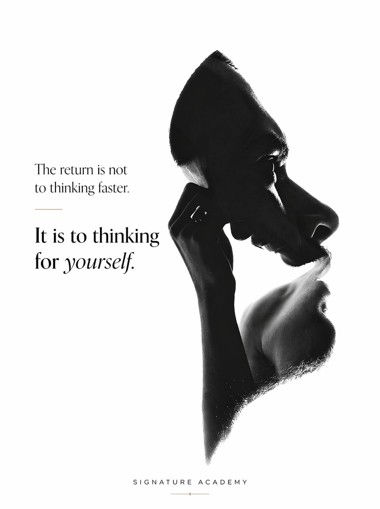
The real shift is quieter than that. It is the moment you stop outsourcing your thinking, your judgement, your voice, and take them back.
Read more from Catalina Brusnevsky
Catalina Brusnevsky, Executive & Life Coach
Catalina Brusnevsky is the founder of Signature Academy and a leadership coach specialising in Integrated Human Intelligence™ and executive judgement. Drawing on senior international experience in hospitality and multinational environments, she works with leaders navigating complexity, cultural dynamics and technological acceleration. Her perspective emphasises psychological integration as a key stabilising force in contemporary leadership.