Supporting Your Partner Through Business Pivots
Written by Mason and Nic, Founders of Aligned Union™
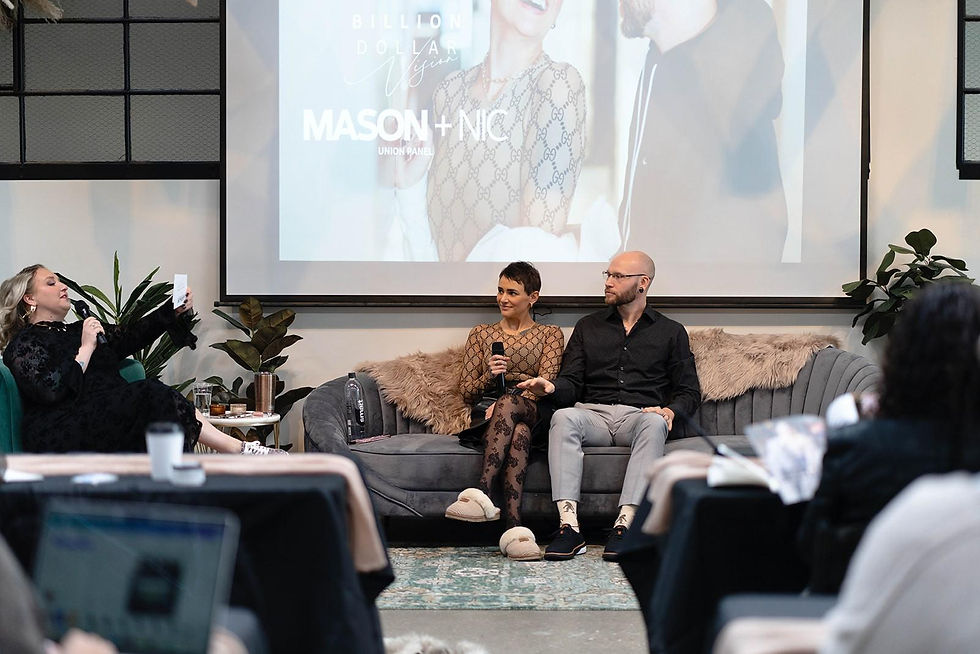
Mason and Nic are the founders of Aligned Union, mentoring couples who desire to build wealth, business, and life together. Through their Duality Method and their leadership at Auralis Media, they help conscious partners create legacy-level impact rooted in alignment and lived experience.

In business, there are endless opportunities to grow, learn, and evolve. Anyone who has spent real time building something knows that a company rarely stays the same for long. Markets shift. Opportunities emerge. Personal growth begins to influence the direction of the work itself.
Movement is a natural part of entrepreneurship. When growth stops and curiosity fades, a business often loses momentum. The same principle applies to the people building it. Human beings are meant to grow alongside their work, and with each new level of success comes a deeper need for discipline, emotional awareness, and self-trust. Visibility expands, income grows, and opportunities increase, which means the person leading the business must also expand internally to carry that responsibility well. “Every new level of success asks more from you,” Mason says. “More discipline, more self-trust, and more awareness of how you lead yourself and the people around you.” That internal expansion naturally leads to external adjustments. Founders begin refining their offers, evolving their messaging, or restructuring their companies to match the next version of the vision they feel called to build.
When two people share both an intimate relationship and a business partnership, those seasons of adjustment bring a unique layer of complexity. A pivot rarely exists in isolation when a couple is building together. Decisions about direction affect finances, time, lifestyle, and long-term vision. Conversations around change, therefore, require a deeper level of communication and trust.
Many couples discover that pivots become one of the most important tests of their partnership's strength. Often, one person moves through the thought process faster than the other. This dynamic appears frequently in entrepreneurial relationships because the person initiating the pivot has often been sitting with the idea privately for days, weeks, or even months before bringing it forward. By the time the conversation happens, they have already evaluated possibilities, explored outcomes, and mentally committed to the direction they believe makes sense. The partner hearing about the pivot is encountering the idea for the first time. Questions naturally arise. Concerns may surface as well. This moment can feel tense if both people misunderstand the timing difference that is taking place. “The person presenting the pivot has already done a lot of thinking,” Mason says. “The person hearing it is just beginning that process.” Recognizing this gap allows both partners to approach the conversation with patience rather than frustration. One person needs space to ask questions and process the information. The other needs to remember that clarity often develops through dialogue.
Trust becomes the foundation that allows these conversations to remain productive rather than combative. A business pivot can carry emotional weight because it touches multiple areas of life at once. Finances, reputation, workload, and plans often sit inside the same decision. Without trust, every adjustment can begin to feel like instability. When trust is present, the conversation becomes collaborative rather than defensive. “Trust is what allows two people to move through uncertainty together,” Mason says. “Without trust, every decision feels like a threat.” Building that trust requires transparency and communication long before a pivot is implemented. Major shifts should never appear suddenly without conversation. Even when an idea feels clear to one partner, bringing the thought process forward early invites the other person into the evolution of the business. This allows both people to weigh possibilities together, challenge assumptions, and contribute insights that may strengthen the decision itself. A partnership grows stronger when both voices participate in shaping the direction of the company.
For the partner hearing about the pivot for the first time, the role of listening becomes a powerful form of leadership. Support does not mean immediate agreement. Support means being present enough to understand the reasoning behind the change being proposed. Asking thoughtful questions allows the conversation to expand rather than shut down. Why does this shift feel important right now? What possibilities does the pivot create? What challenges might appear as a result? Exploring these questions together helps both partners see the full picture before deciding how to move forward. “Ask why the move feels important,” Mason says. “Ask what they are seeing that you might not see yet.” Curiosity opens space for deeper understanding, which allows both individuals to align around the best possible path for the business and the relationship.
The language used during these conversations also plays a significant role in how smoothly they unfold. Certain phrases quickly escalate tension and push the conversation away from problem-solving. Statements like “you always” or “you never” shift the focus toward personal criticism instead of collaborative progress. Couples who build successful companies together often become very intentional about the words they choose during difficult discussions. Framing the conversation around shared responsibility creates a different emotional atmosphere. When both people remember that they are working toward the same outcome, communication becomes more constructive. “Use the word we as often as possible,” Mason says. “We are building this together. We are navigating these decisions together.” That shift in language reinforces the truth that the partnership itself is part of the foundation of the business. Both individuals carry responsibility for its direction and its success.
Entrepreneurship often attracts people who are willing to pursue a path beyond the expectations of average thinking. Building a company requires resilience, creativity, and a willingness to face uncertainty with courage. The same qualities strengthen the partnership supporting that company. Choosing thoughtful communication, patience, and trust requires effort. It asks both individuals to show up with maturity during moments when stress or urgency could easily lead to reactive behavior. “It is easy to fall into lazy communication,” Mason says. “It takes effort to stay thoughtful in how you show up for your partner.” That effort pays off over time as the relationship becomes stronger and the business benefits from the clarity created by two people who trust each other’s intentions. Pivots will always exist in entrepreneurship. Companies evolve. People evolve. Partnerships that approach those changes with respect, communication, and a shared sense of responsibility create the kind of stability that allows both the relationship and the business to grow for years to come.
Read more from Mason and Nic
Mason and Nic, Founders of Aligned Union™
Mason and Nic are the founders of Aligned Union, a mentorship firm guiding couples in divine partnership into legacy-level wealth and impact. They are also the operators of Auralis Media, which they successfully relaunched and scaled to over $1.2M in cash in a single year. Through their proprietary Duality Method, they help couples build businesses together while strengthening intimacy, trust, and shared leadership.
Their work is rooted in lived experience, shaped by a relationship that required conscious repair, evolution, and deep alignment. Together, Mason and Nic are devoted to placing more wealth and resources into the hands of values-driven leaders committed to elevating the collective.