Some Family Roles Were Assigned to You, Not Chosen by You
Written by Mahvish Hasan, Heaven on Earth Strategist
Mavi Hasan is a Reiki master, breathwork facilitator, and soul strategy guide. Through her brand, Amor by MaviB, she helps individuals heal from trauma, release emotional blockages, and embody higher consciousness. Her mission is to guide humanity in remembering Heaven within, one heart at a time.

What if the life you're living isn't fully yours? Many South Asian women unknowingly carry family roles assigned to them in childhood, roles that taught them to please, achieve, sacrifice, and stay silent. Over time, these expectations become identities. This article 0explores the courage it takes to honor your family while also honoring yourself and why choosing authenticity may be one of the most loving legacies you leave behind.
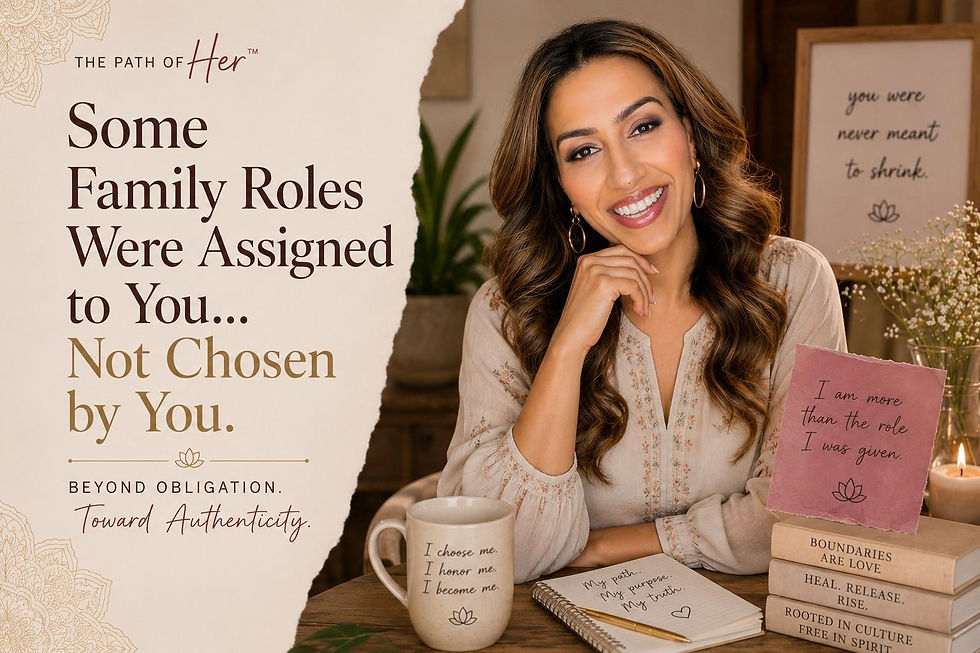
The Path of Her™ series
If you grew up in a South Asian household, chances are you were given a role long before you discovered who you truly were. Not because your family didn't love you, but because every family system has unspoken jobs that someone is expected to fulfill.
Perhaps you became the peacemaker, the one who kept everyone happy. Maybe you became the responsible daughter, carrying responsibilities far beyond your years. Or perhaps you became the achiever, believing your worth came from grades, promotions, or making your parents proud. Maybe you became the caretaker, putting everyone else's needs before your own until you could no longer remember what you needed.
The heartbreaking part is that no one ever asked whether you wanted those roles. They were assigned, and over time, they became your identity.
The invisible contract that many South Asian women carry
In many South Asian families, daughters often become the emotional glue holding everything together.
We're taught to respect elders without question, keep the peace, protect the family's reputation, put others first, be grateful, even when we're exhausted, and stay quiet to avoid conflict.
These values are beautiful when they come from love, but they become heavy when they require us to abandon ourselves.
Many women don't realize they're living from an inherited identity rather than an authentic one. They aren't making choices; they're fulfilling expectations.
When your role becomes your identity
I see this often with the women I work with.
She says yes when she wants to say no. She apologizes before speaking. She feels guilty for resting. She cannot enjoy success because someone else might feel left behind. She overexplains every decision. She constantly wonders, “Am I disappointing someone?”
Not because she's weak, but because her nervous system learned to associate love with fulfilling her assigned role.
If she kept everyone happy, she belonged. If she achieved, she was celebrated. If she sacrificed, she was considered a “good daughter.”
Over time, the role became so familiar that she forgot it wasn't who she truly was.
Healing doesn't mean rejecting your family
One of the biggest fears South Asian women carry is this, “If I stop playing my role, am I becoming selfish?” The answer is no.
Healing isn't about rejecting your culture. It isn't about dishonoring your parents. It isn't about becoming rebellious. Healing means recognizing that honoring your family should never require abandoning yourself.
There is room for both respect and authenticity, both tradition and personal truth, and both love and healthy boundaries.
The moment everything changes
The transformation begins with one simple question, "Who am I when I stop performing the role I've always played?"
At first, the question feels uncomfortable because many women have spent decades becoming who everyone else needed them to be.
But beneath the people pleaser, beyond the perfectionist, and underneath the caretaker, there is a woman who has dreams that belong solely to her. She is a woman with opinions, desires, boundaries, joy, and purpose.
She has always been there. She's simply been waiting for permission to emerge.
The Path of Her™
The Path of Her™ isn't about becoming someone new. It's about remembering who you were before the world told you who you had to be.
It's the journey from obligation to authenticity, from inherited expectations to intentional choices, and from surviving family roles to creating a life aligned with your soul.
The role you were assigned may have helped you survive, but it was never meant to define the rest of your life.
Perhaps the greatest gift you can give future generations isn't being the perfect daughter. It's becoming the woman who had the courage to choose herself, with love, compassion, and respect for where she came from.
When one South Asian woman steps out of an inherited role and into her authentic voice, she doesn't break the family legacy. She transforms it.
She gives the next generation permission to inherit freedom instead of obligation, and that may be the most loving role of all.
Read more from Mahvish Hasan
Mahvish Hasan, Heaven on Earth Strategist
MaviB is the founder of Amor by MaviB, a spiritual wellness brand devoted to helping women heal generational wounds, reclaim their voice, and rise into sovereign embodiment. As a Soul Strategist™, energy alchemist, and channel for divine guidance, she weaves ancient healing with modern leadership. Her work integrates Reiki, breathwork, intuitive coaching, and quantum energy work to support conscious transformation. MaviB’s mission is to co-create Heaven on Earth, one soul at a time. She specializes in guiding South Asian women and spiritual visionaries into alignment, purpose, and deep inner peace.