Repurposing Fight or Flight – Turning Survival Into Strength
Alfonso (AL) Gonzalez is an ISSA Master Trainer, Certified Wellness Coach, and Co-Founder of the Kairos Wellness Experience. Known for his multidimensional approach to wellness, AL helps individuals cultivate physical vitality, emotional resilience, and inner peace through integrative practices rooted in both science and lived experience.

Most people think of fight or flight as a negative stress response, something to be managed, suppressed, or avoided. At Kairos, we take a very different view. This ancient survival mechanism is not the enemy of wellness, it is a latent source of strength and creativity, waiting to be repurposed.

In fact, during a recent podcast interview, I was asked directly, “What do you mean by repurposing fight or flight?” That question struck me because it reminded me how often this concept gets oversimplified or misunderstood. I knew then that I wanted to create a definitive explanation, not just for our Kairos community, but for anyone who struggles with stress, performance anxiety, or burnout. This article is that explanation.
By reframing fight or flight, we uncover its hidden potential, the ability to regulate our emotions, harness energy, and redirect primal survival reactions toward resilience, mindfulness, and peak performance. Repurposing allows us to take the “butterflies in the stomach” and reconfigure them into a strategic V-formation that actually carries us forward. In other words, the goal is not to eliminate stress, but to regulate it, transforming survival energy into good stress that fuels motivation and purposeful action.
Understanding the stress response
When our ancestors faced a predator, the sympathetic nervous system surged to life. Adrenaline and cortisol flooded the bloodstream. The heart raced. Breathing quickened into shallow breath. All of this happened instantly, without conscious thought. It was survival on autopilot, presenting us with two options, to literally fight a predator with all our strength or flee as fast as possible.
The problem today is that modern stressors, overflowing inboxes, traffic jams, looming deadlines, and doom-scrolling, provoke the same cascade. Our bodies do not distinguish between a lion in the grass and a late-night email from the boss. This means our stress response is constantly triggered, yet rarely completed. Instead of sprinting away or fighting off danger, we sit frozen at our desks, bodies simmering in unresolved tension.
That is when fight or flight backfires. What once saved us now silently erodes our posture, breath, focus, and even our relationships.
Dysevolution: When survival backfires
Harvard biologist Daniel Lieberman uses the term dysevolution to describe what happens when useful adaptations are lost in harmful new environments. Text neck, shallow chest breathing, and chronic stress are all examples of dysevolution.
Think about it, an upright posture that was necessary for scanning the horizon for threats also helped us breathe fluidly, maximizing our ability to protect ourselves. Today, many of us are hunched over phones and laptops, minimizing our still-essential posture and, in turn, our ability to breathe diaphragmatically. The same primal stress signals that used to sharpen our senses now deteriorate our spines and shallow our breath.
In other words, fight or flight is not broken. It is simply misdirected.
Repurposing through breath-first practices
Here is where the Kairos approach begins, with the breath.
Nasal diaphragmatic breathing is the most direct way to shift the nervous system from fight or flight overload into balanced regulation, and to maximize the benefit of good stress. By breathing through the nose, we engage the diaphragm fully, recruit the “invisible inner core” muscles (diaphragm, transversus abdominis, pelvic floor, multifidus), and stimulate the vagus nerve, the body’s natural brake pedal for stress.
Simple practices like the 10-second breath (3-4 second inhale, pause, 4-5 second exhale) create a physiological anchor. Suddenly, the stress cascade does not run unchecked, it is redirected. The body remembers it has a choice.
In practice:
During exercise
Squats and curls: Inhale on the descent, exhale with intention on the ascent. Each rep becomes a repurposed breath, not just a muscular effort.
Bridge exercise: Instead of unconsciously lifting with glutes and hamstrings, inhale to prepare, then exhale while bracing the transversus abdominis, rising with precision and control.
Off the mat
Managing challenging situations at home: When emotions rise, pause to breathe intentionally through the nose before responding, transforming reactivity into measured compassion.
Public speaking: When words push you toward breathing solely through the mouth, find micro pauses to inhale and exhale through the nose, recentering calm and creativity during your presentation.
Working on a deadline: Instead of shallow rapid breathing that fuels anxiety, anchor into a few cycles of 10-second nasal breaths to regain clarity and pace.
From reactivity to creativity
When we learn to repurpose fight or flight, we transform reactivity into creativity. That same surge of energy once meant to fuel escape or attack becomes fuel for presence, focus, and performance.
Athletes discover it in their ability to stay calm under pressure. Corporate leaders find it in decision-making clarity during high-stakes meetings. Students feel it when their anxiety transforms into the grounded energy of authentic self-expression.
Instead of being carried away by survival instincts, we reclaim authorship over how we respond. And we can manage this most effectively with the intentional nasal breath, which quiets both our thoughts and emotions. The 10-second breath is especially powerful, it helps synchronize heart rhythms with brain activity, creating what researchers at the HeartMath Institute call heart-brain coherence, a state linked to creativity, resilience, and peak performance.
The Kairos Framework: Choosing response over reaction
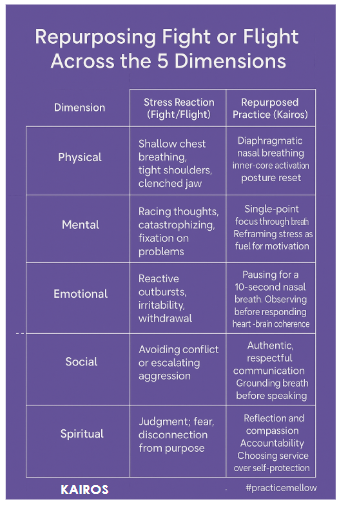
At Kairos, we organize wellness through five dimensions, physical, mental, emotional, social, and spiritual. Each of these dimensions has both unhealthy stress reactions and repurposed mindful practices.
Conclusion: A call to repurpose
Fight or flight is not a flaw in human design. It is a brilliant, time-tested system of energy mobilization. The problem arises only when we misinterpret it as something to fear or suppress. By bringing mindful awareness and breath-first practices into our daily lives, we learn to stop being victims of stress and instead become architects of resilience.
We do not eliminate fight or flight, we repurpose it.
In that shift lies the pathway to balance, strength, and creativity across every dimension of wellness.
Read more from Alfonso Gonzalez
Alfonso Gonzalez, ISSA Master Trainer and Wellness Coach
AL Gonzalez is redefining what it means to be “well” in today’s fast-paced world. His approach at the Kairos Wellness Experience goes beyond surface-level fitness, offering deep, integrative practices that restore balance, build resilience, and foster community. By teaching participants how to “breathe for power and peace,” AL empowers people from all walks of life to reclaim their wellness, not just as a destination, but as a daily practice.