Not All Qigong Systems Are Created Equal
Kellie and Kelly are the founders of the Academy of Embodiment Arts and hosts of the Soul Discovery podcast. They combine Qigong with meditation and energy mastery to guide people to embody new frequency through transmutation and transformation for lasting change.

Qigong has become a popular exercise for health and wellness, but few understand its origins or the history behind it. Qi is synonymous with blood flow or life force energy. Gong means mastery or skill learned over a long period of time. Together, they mean mastering the skill of your blood flow and life force energy by activating the fascia in the body in a specific way.
Fascia is connected to all tissues in the human body, and the more fluid it is, the easier it is for the fourth phase, or Exclusion Zone, water to maintain its integrity and protect the cells in the body. For more information on fourth-phase water, you can look up the works of Gerald Pollack.
Qigong is meant to build momentum in the nervous system, blood, and lymphatic fluid flow by opening and closing the joints in a specific sequence to maximize health benefits. Modern fusion systems, while providing some benefit due to movement and breathwork, mix and match movements from different systems, thereby negating the beneficial momentum that would have otherwise developed over time.
In resistance training, body confusion can be good for muscular development and endurance. This is not the same for Qigong, which moves the blood and nutrients through the body in a specific fashion while engaging the fascia, joints, and tendons. Mixing and matching Qigong systems can cause damage in the body due to the way Qi and blood are supposed to flow, especially when you do not understand what one particular system was designed to do.
Some Qigong fusion sets are actually just joint loosening exercises. While this is beneficial for mobility and range of motion in the body, it does not have the same benefits as a living system of Qigong.
The four main formalized sets of Qigong allow for building the Dan Tiens, or energy centres, to run Qi in the body, refine blood flow, and engage the fascia in a way that maximizes energy production, ATP. Over time, you develop stillness and enervation correctly in the body.
The four main formalized sets of Qigong that have been around for approximately 3,600 years are:
Ba Duan Jin, 8 Pieces of Brocade Qigong
Yi Jin Jing, Muscle Tendon Changing Classic
Liu Zi Jue, Six Healing Sounds
Wu Qin Xi, 5 Animal Frolics Qigong
The Ba Duan Jin, 8 Pieces of Brocade Qigong, is the set we teach regularly. It is 3,600 years old and was used in China as a diagnostic and healing method. It massages the organs, trains the body to relax under tension, engages the fascia, strengthens the tendons, and trains the nervous system to relax through breathwork.
The Yi Jin Jing, Muscle Tendon Changing Classic, is designed to maintain or regain your youthful physical state, improve the quality of your Qi, and ensure a strong power supply.
Liu Zi Jue, Six Healing Sounds, is a Qigong set coordinating movement and breathing patterns with specific sounds.
Wu Qin Xi, 5 Animal Frolics, is a Qigong set based on the movements of five animals: deer, tiger, bear, monkey, and crane.
These four Qigong systems are considered living art forms. Broken or partial systems promote fragmentation of your energy, not the unification of it. Different systems do different things for the body that bring about a particular balance. These days, there is an obsession with “flow,” which is aesthetically pleasing to watch, but flow does not mean smooth, uninterrupted movement. True flow comes from achieving stillness, something that each of these systems brings about in its own way.
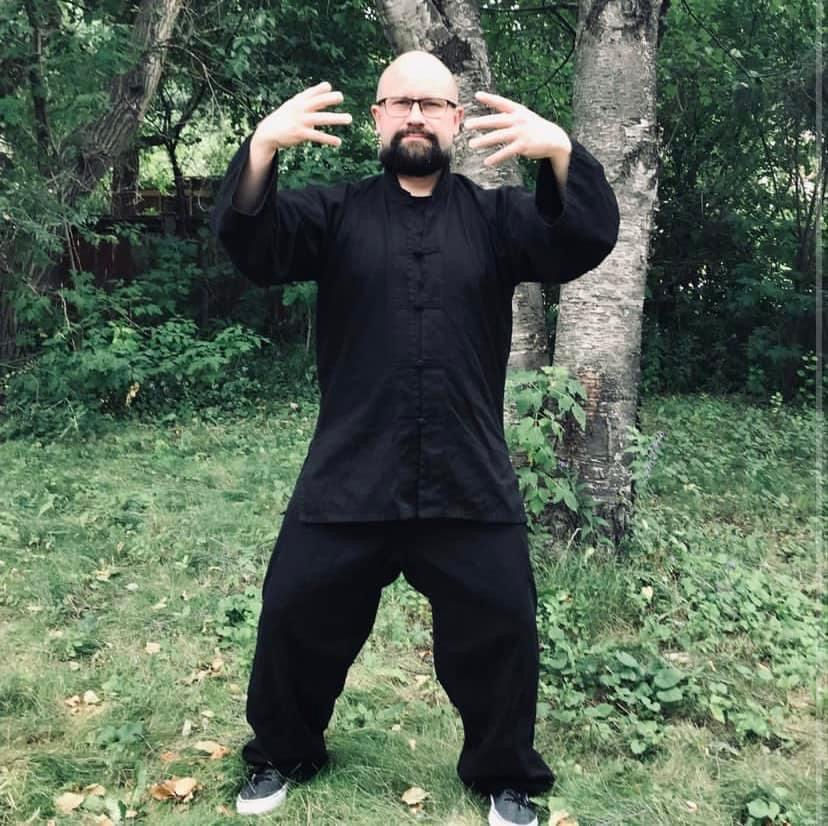
Kelly has also trained and taught the arts of Tai Ji, Tai Chi, Xingyi, and Baguazhang. Baguazhang, for example, has several styles, each training the body slightly differently depending on which region of China it was developed in.
The three main systems are built on the yin and yang methods of practice. Tai Chi is built on a yin method. Xingyi is a yang method. Baguazhang combines both.
Tai Chi softens the body and mind to be yielding and absorbing as a means to defeat aggressive energy and to see beyond our own personal patterns of aggression. Xingyi is a spear art designed for the battlefield, uses fire-breathing methods, and is meant for destruction in the transmutation process.
Baguazhang combines the fire of destruction and teaches how to be soft and yielding, to hear not only your body but the energy of another. Baguazhang moves you into deeper awareness of yourself so you can understand stillness by having a balanced and regulated yin and yang flow, to such an extent that your body is not triggered to respond in the same way to external stimuli.
Fusion systems often replace true spiritual wisdom, as they project an individual’s beliefs onto the movements, which only makes it true for them, not true for everyone. What works for one may not work for another.
Living systems of Qigong, depending on which region they are from, embody the wisdom of the collective and hold true wisdom of the body for many. This is why internal martial artists study several systems and master them over their lifetime. In this way, they learn and embody the wisdom of multiple systems, knowing and understanding when and how to use each system for better health and longevity.
Listen to our podcast episode on this topic: Spotify
We will be holding an in-person and online nine-week program on the Six Healing Sounds and the 8 Pieces of Brocade. You can register here.
We are available for private Qigong or Baguazhang classes, Shaolin Qi healing, or Aligned Embodiment sessions with Kellie.
Read more from Kellie Winzinowich and Kelly Whelan-Enns
Kellie Winzinowich and Kelly Whelan-Enns, Active Embodiment Coaches
Kelly Whelan-Enns is a master of Shaolin Qi Healing, Qigong, and the internal art of Baguazhang. Plagued by asthma and hypoglycemic in his youth, Kelly's journey of healing and self-mastery has spanned over 35 years, training with master teachers, and studying Taoist, Zen Buddhist, and Tibetan meditation, teaching many along the way.
Kellie Winzinowich is a former elite gymnast whose journey brought her to Qigong and the study of internal alchemy. Now a Certified Hypnotherapist, she helps others navigate personal transformation Together Kellie and Kelly guide others to embody lasting change through physical, emotional, and spiritual self-mastery.