

Merula Manifesto II – Autistic and Fabulous
Updated: Sep 29
Sandra Merula is a Mental Health & Life Coach, author of “ADHD and Autism. The ‘Together’ People,” working as a mentor with Autism, ADHD, and AuDHD, as well as trauma and narcissistic abuse recovery. Known for her direct yet unique approach with cat-assisted philosophy, she combines professional expertise with lived experience and a bit of magic.

A raw and powerful manifesto on late autism diagnosis, self-recognition, and the freedom that comes from no longer performing “normal.” Through grief, motherhood, identity, and reclaimed intensity, this article celebrates the neurodivergent woman who finally stops shrinking and starts living honestly.
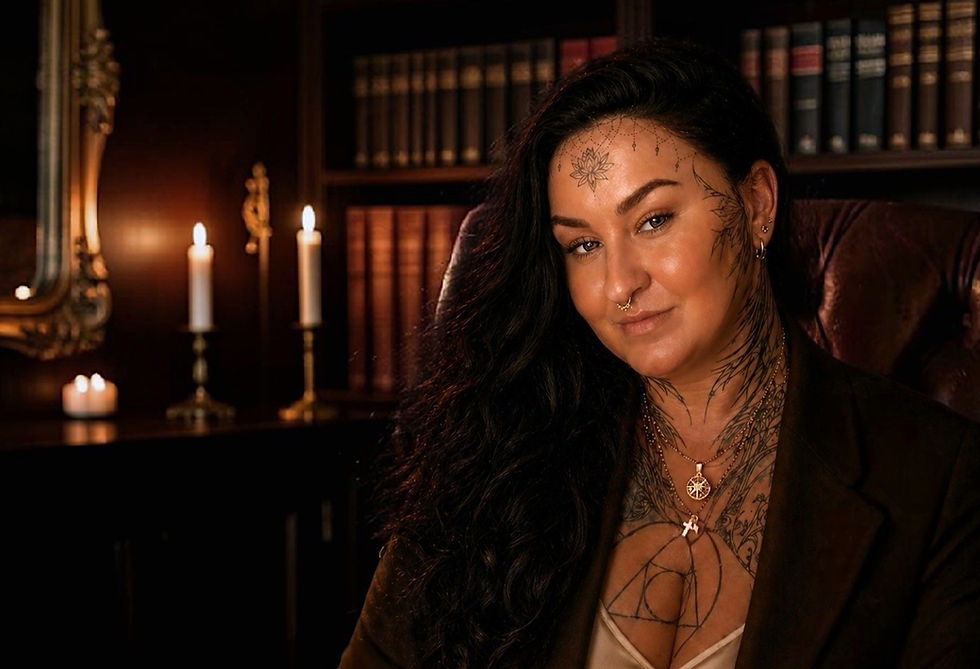
They are not here for a small life, they just don’t know it yet
Before I knew I was autistic, I spent years trying to look as normal as possible. Which is ironic now, considering that the woman hiding underneath all that adaptation was covered in tattoos, dressed in black even when nobody was watching, emotionally intense, deeply obsessive, creatively chaotic, and looked like what they used to silently call “The Agony Woman” with the personality of an emotional golden retriever.
Back then, none of that felt funny. Back then, it felt dangerous. Because when you grow up feeling fundamentally different without understanding why, normality becomes survival. So I learned how to perform it.
I worked in the fashion industry for years. While very young, I became a general manager in the sales of jewellery and beauty products. My life was built around people, schedules, noise, expectations, performance, lights, pressure, conversations, and social adaptation. Externally, I looked highly functioning. Internally, I was bleeding from the exhaustion of trying to maintain that image every single day.
The strange thing about high-functioning autistic women is that the world often mistakes survival for success. If you are intelligent enough, attractive enough, socially trained enough, and emotionally hyper-aware enough, you can spend years appearing functional while privately feeling like your nervous system is quietly collapsing underneath your skin.
That was my reality. I did not understand why certain sounds could ruin my entire day emotionally. I did not understand why relationships exhausted me so deeply, why I could hyperfocus obsessively for hours but struggle with basic structure, or why social interaction often felt less like connection and more like performance art with consequences.
I only knew one thing for certain, whatever everybody else seemed to do naturally, I was manually calculating. Every reaction. Every facial expression. Every tone. Every version of myself.
Because I did not know I was neurodivergent, I explained all of this to myself the only way many women do, something must be wrong with me.
The invisible war of high-functioning women
Perhaps one of the most painful consequences of living undiagnosed for so long is how vulnerable many neurodivergent women become to psychological abuse. Not because they are weak. Quite the opposite.
Many autistic women are deeply open-hearted, intensely loyal, emotionally honest, and painfully willing to see good in people long after others would walk away. We are often taught to question ourselves before questioning someone else’s behaviour.
So when manipulation enters the picture, many of us do not immediately recognise it as abuse. We interpret it as a misunderstanding. Miscommunication. Oversensitivity. Another personal failure to “function correctly” and because high-functioning autistic women frequently spend years adapting themselves to make other people comfortable, they can become dangerously tolerant of emotional environments that slowly destroy them. Not only in romantic relationships. In families. In friendships. At work. In social circles. Anywhere love, approval, belonging, or authority becomes emotionally conditional.
Many neurodivergent women grow up learning that acceptance is something earned through performance. Through being agreeable enough, useful enough, and emotionally manageable enough. So they become hyper-aware of everyone else’s emotions while quietly disconnecting from their own instincts.
That is why so many autistic women end up trapped in psychologically abusive dynamics without fully understanding why they feel constantly exhausted, anxious, guilty, or emotionally unsafe. Their nervous systems recognise the danger long before their minds can name it.
When you spend enough years disconnected from your own internal signals, you stop trusting yourself altogether. That is where many women disappear. Not physically. Psychologically.
The diagnosis that did not break her, but returned her to herself
The strangest thing about finally understanding you are neurodivergent is that the diagnosis itself changes nothing externally, and yet somehow changes absolutely everything internally. The world looks the same the next morning. The streets are still loud. Your nervous system still reacts intensely.
You still forget things, hyperfocus too deeply, overthink conversations, feel emotions with terrifying depth, and become exhausted by environments other people seem to navigate effortlessly. Yet something fundamental shifts.
Because for the first time in your life, your experiences stop looking random. The chaos becomes structured. The confusion becomes language. The woman who spent years believing she was failing at being human suddenly realises something almost impossible to describe, she was never failing at life. She was trying to operate a neurodivergent nervous system according to neurotypical rules.
That realisation changed my life more than any therapy session, relationship, achievement, or professional milestone ever could. Not because autism magically solved my problems. But because understanding creates a form of peace that self-hatred never can.
For years, I explained my exhaustion as weakness. My overstimulation as emotional instability. My intensity as “too muchness.” My social exhaustion as personal failure. My emotional depth as dysfunction. But suddenly everything connected.
The burnout. The masking. The addictions. The obsessive thinking. The relationship patterns. The constant feeling of existing half a step outside the world around me. It was not randomness. It was pattern.
Perhaps the most emotional part of late diagnosis is grief. Not grief for being autistic. Grief for the years spent misunderstanding yourself. Grief for the younger version of you who genuinely believed she was broken. Grief for every moment you forced yourself to stay in environments that were destroying your nervous system because everybody else seemed capable of handling them. Grief for every relationship where you accepted emotional confusion as normal because you had spent your whole life distrusting your own instincts.
Underneath that grief, something else slowly begins to emerge, relief. Massive, life-altering relief. Because when you finally understand how your mind actually works, you stop fighting yourself constantly.
The energy that once went into survival suddenly becomes available for something else entirely, creation, purpose, identity, life.
For me, that was the moment everything began changing. Not overnight. Not perfectly. But honestly.
I stopped trying to become smaller. I stopped trying to become easier to digest. I stopped trying to perform “normal” at the cost of my nervous system.
Ironically, that was the exact moment I became more powerful than I had ever been before. Because once a neurodivergent woman understands herself properly, she stops wasting extraordinary energy trying to become someone else and that amount of reclaimed energy can change an entire life.
The advantages nobody talks about
What nobody tells you about neurodivergence is that once shame disappears, many of the traits you spent years trying to suppress begin transforming into advantages. Not cute little “superpowers.” Real advantages. The kind that quietly change the direction of an entire life once you understand how to work with your mind instead of against it.
High-functioning autistic women are often extraordinarily perceptive. We notice patterns quickly. We sense emotional shifts instantly. We remember details other people miss. We become deeply immersed in subjects that matter to us. We think intensely, feel intensely, love intensely, and create intensely.
Once those traits stop being buried underneath survival, something remarkable starts happening. The same mind that once felt impossible to manage becomes capable of extraordinary depth.
For me, one of the biggest changes was finally understanding that my intensity was never the enemy. It was fuel.
The hyperfocus that once consumed me became the foundation for building methodologies, studying human behaviour obsessively, understanding emotional patterns, and eventually creating work that feels deeply aligned with who I actually am.
The emotional sensitivity that once made relationships painful became the exact thing that allows me to understand people beyond surface-level conversations. The pattern recognition that once overwhelmed me became one of the strongest tools in my professional life. Perhaps most importantly, my inability to tolerate superficiality stopped being a social problem and became a compass.
Neurodivergent people often struggle inside systems built on performance, emotional dishonesty, hierarchy, social games, and unspoken rules. But once we stop forcing ourselves into environments that damage us, many of us become exceptionally powerful in spaces built on authenticity, creativity, emotional intelligence, innovation, and meaning.
That is the part modern society still misunderstands about autism. An autistic mind is not automatically weak because it struggles in artificial environments. A tiger would also look dysfunctional in the middle of the ocean. Context matters.
Once the environment changes, the same traits that once looked problematic can become extraordinary. That realisation changed motherhood for me, too.
Understanding my own neurodivergence allowed me to raise my son differently, not through fear, shame, punishment, or constant correction, but through understanding. I know what it feels like to grow up believing your natural self needs editing. I know what it feels like to be constantly self-aware of your personality just to be acceptable.
Perhaps that is the greatest irony of all. The very thing I spent years trying to hide eventually became the foundation of everything beautiful in my life, my work, my purpose, my motherhood, my voice, my methodology, my ability to help others, even this version of myself. The woman who is deeply alive, wonderfully weird, and no longer remotely interested in becoming smaller just to make other people feel comfortable.
Once a neurodivergent woman truly understands herself, she stops asking, “How do I become normal?” and starts asking a much more dangerous question, “What could I become if I used my mind exactly the way it was designed to work?”
The woman she became
Maybe that is where the real story finally begins. Not in diagnosis. Not in survival. But in the moment a woman stops experiencing herself as a problem to solve and starts recognising herself as a system to understand.
Once I stopped forcing myself into lives that looked socially successful but felt psychologically suffocating, everything began changing in ways I never expected. Not only professionally. Existentially.
For the first time in my life, solitude stopped feeling like failure. That was one of the biggest surprises.
For years, I thought relationships were proof of worth, closeness, success, and emotional value. Like many women, I was taught that being chosen mattered more than choosing yourself. So I stayed too long in environments that exhausted me emotionally, because I believed love meant adaptation.
Now I understand something completely different. Peace is not loneliness or boredom and self-abandonment is not love.
Today, I live very differently. My life is quieter externally and infinitely louder internally, in the best possible way. I no longer build my identity around being understandable to everyone around me. I build it around being honest with myself.
That changed everything. The way I dress changed. The way I speak changed. The way I work has changed. The way I love has changed.
Ironically, I became far more “myself” after diagnosis than I had ever been before. The tattoos no longer felt like rebellion. They felt like recognition. The intensity, the emotional depth, the obsession with meaning, the refusal to participate in superficial social performances, none of it was random personality chaos anymore.
It was coherence. For the first time, my outside finally started matching my inside.
That alignment creates a type of confidence that has very little to do with self-esteem in the traditional sense. It is deeper than confidence. It is self-recognition. The calm that appears when your nervous system no longer spends every second trying to become someone else.
That is also the moment my work completely transformed. Because when you spend your entire life learning human behaviour from the inside out, eventually, you begin to understand people on a level that is difficult to teach academically. You recognise emotional patterns quickly. You sense hidden dynamics instinctively. You hear contradictions between words and nervous systems. You notice survival mechanisms underneath personalities.
Suddenly, the things that once made life harder begin making your work extraordinary. That is how the Merula Methodology was born. Not from theory alone, but from observation, from survival, from pattern recognition. Emotional intelligence is built through necessity. From understanding what it feels like to search for answers your entire life and constantly receive the wrong ones.
I did not want to create another polished self-help system teaching people how to become more socially acceptable while privately miserable. I wanted to create something human. Something emotionally honest. Something that helps people stop performing healing and start actually reconnecting with themselves.
That is also why I work so differently from traditional coaching structures. I do not believe transformation happens through endless scripted conversations detached from real emotional experience. I believe people change when they finally feel safe enough to understand themselves honestly.
Sometimes that understanding happens during a dialogue. Sometimes during a monologue. Sometimes, while sitting on the floor surrounded by enormous Maine Coon cats who somehow understand nervous system regulation better than half the wellness industry.
Maybe that sounds strange to some people. But then again, almost every beautiful thing in my life began the moment I stopped being afraid of the weird and the strange.
The weird gave me my purpose. The strange gave me my voice. It gave me the ability to help people who spent years feeling emotionally homeless inside themselves, like me. Perhaps most importantly, the strange gave me back to myself.
The son
Perhaps the most emotional part of me being so “weird” my whole life, and thanks to a special someone, understanding my neurodivergence was realising that it changed not only my life, but the special someone’s, a.k.a. my son’s life, from the very beginning.
When you grow up undiagnosed, you spend years learning how to survive yourself before you ever learn how to understand yourself. Many neurodivergent children are taught adaptation before identity. They learn very early which parts of themselves are “too much,” too emotional, too sensitive, too intense, too different.
I know that pain intimately and because I know it, my son received something I never truly had growing up, a mother who understands what it means to live behind glass doors, inside a nervous system that feels everything so deeply.
A mother who does not immediately mistake sensitivity for weakness. A mother who understands overstimulation, emotional exhaustion, hyperfocus, shutdowns, intensity, emotional honesty, and the desperate need for safety in a world that often feels unbearably loud.
But perhaps most importantly, he had a natural possibility of becoming himself before becoming socially acceptable. That changes everything because neurodivergent children do not become emotionally free by learning how to perform perfectly, they become emotionally safe by learning that who they naturally are is not something shameful they must hide.
In so many ways, my son became part of my own healing, too. Through him, I began seeing my own mind differently. More gently. More honestly. More compassionately.
He was not born as simply my son. He was the reason I finally understood myself, my angel.
The final ascension
Maybe that is the biggest misunderstanding about neurodivergence of all. People think the goal is to become “less autistic.” Less sensitive. Less intense. Less emotional. Less obsessive. Less different.
As if healing means reducing yourself into something more digestible for the comfort of the world around you. I no longer believe that.
I think the real transformation begins when a neurodivergent person finally understands which parts of themselves were never wounds to begin with.
Yes, there are things I had to learn, emotional regulation, boundaries, nervous system awareness, rest, self-respect, recognising manipulation, understanding burnout before collapse, and building a life that works with my mind instead of against it.
Understanding those things did not make me less myself. It made me more myself. Stronger. Calmer. More intentional. More alive.
That is the difference. People often assume that self-awareness softens intensity. Sometimes it does the opposite. Sometimes self-awareness removes shame, and what remains underneath is a person who finally stops apologising for their depth.
That is what happened to me. I no longer see my emotional intensity as weakness. It allows me to connect profoundly with people. It became the foundation of my work, my writing, and my methodology. I no longer see my sensitivity as a dysfunction. It became the reason people feel emotionally safe around me.
Even the parts of me that once looked chaotic now make sense through the correct lens, the tattoos, the refusal to live superficially, the hunger for honesty, the inability to tolerate emotionally performative environments, and the deep need for meaning in everything I build.
None of it was random. It was identity trying to survive before identity had language.
Honestly? I think many neurodivergent women experience that same silent loneliness for years. The feeling that there is a version of themselves trapped underneath adaptation, underneath performance, underneath the endless attempt to become socially acceptable enough to feel loved safely.
Eventually, something shifts. It means recognising that some minds are not built to fit neatly inside existing structures because they were built to create entirely new ones.
Today, I no longer want a smaller personality, a quieter mind, or a more socially convenient identity. I want the truth. I want depth. I want meaning. I want emotional honesty. I want a life that actually feels like mine.
So no, I would never choose to become “normal.” I was never meant for a small life. I was meant for an honest one.
Read more from Sandra Merula
Sandra Merula, Mental Health Coach, Neurodiversity Mentor
Sandra Merula is a Mental Health & Life Coach, author of “ADHD and Autism. The ‘Together’ People,” working as a mentor at the intersection of Autism, ADHD, trauma, and power dynamics. A neurodivergent thinker herself, she challenges rigid diagnostic narratives and explores identity beyond labels. Her work blends structure with intuition, psychology with depth, and clarity with unapologetic honesty. Through her writing and cat-assisted philosophy, she invites individuals to rebuild identity consciously, not obediently.







