How An International Student Built A $45K ARR Business in 3 Months By Betting On Strategic Networking
Jaival Vikal is the founder of Vikal Consulting Group, delivering advanced SaaS platforms and custom AI systems that streamline operations, accelerate revenue, and modernize digital strategy for growing companies.

Some entrepreneurs wait for the perfect moment. Others create it. Jaival Vikal belongs to the second category. At 23, he has built a multimillion-dollar network spanning the country, won over $50,000 in pitch competitions nationwide, and transformed those wins into seed capital for Vikal Consulting Group. His Social Showroom AI platform generated $600K in additional revenue for his flagship client in just 100 days. The Birmingham Business Journal recognized him as an Alabama Inno Under 25 award winner. But three years ago, he was an international student from Ahmedabad, India, standing in a Birmingham networking event with a pocket full of business cards and absolutely no idea how to use them.
The journey between those two moments reveals something most business advice skips over. Networking is not about charisma or natural talent. It is about systems. And for Vikal, developing that system became a matter of survival before it became his competitive advantage.
The isolation that forces innovation
When Vikal arrived at the University of Alabama at Birmingham in 2021, he carried two suitcases and one persistent question. What if this does not work? He had left behind the comfort of family, familiar social circles, and a hometown where his name opened doors. In Birmingham, his name meant nothing. His network was zero. His advantage was unclear.
"I thought networking was what you did at job fairs," Vikal recalls. "Shaking hands, awkwardly nodding, and pretending to remember names. That was my perspective. Relationships were either transactional or tied to family and social circles."
That perspective collapsed at his first real networking attempt. He showed up with energy and business cards. He left with neither connections nor clarity. The traditional advice to just be confident and put yourself out there felt hollow when you were operating without a foundation. Vikal realized something critical, he could not rely on the networking strategies designed for people who already had networks. He needed a different approach entirely.
When failure becomes curriculum
The breaking point came during his attempt to walk onto UAB's Division 1 soccer team. Vikal had been a trained athlete and club player in India, but he knew American collegiate soccer operated at a different level. Still, he showed up to practice anyway.
"The coaches told me to train and try again next semester," he says. "I failed. I embarrassed myself. But that experience changed me. Not just in skill, but in resilience."
The soccer field taught him something unexpected about networking. Growth happens when you step beyond comfort. Showing up despite the odds rewires your relationship with rejection. And that willingness to be uncomfortable in pursuit of progress applies everywhere, from athletics to business relationships to career opportunities.
Vikal started experimenting. He tracked his networking attempts like data. He asked himself why certain interactions went nowhere and what he could do differently next time. He wrote down three things he was good at or passionate about, creating a foundation for how he could add value to conversations. Slowly, patterns emerged. Networking was not magic. It was methodology.
Building the INVERT framework: A systematic approach to strategic networking
What crystallized into the INVERT framework began as survival tactics. Each letter represents a lesson Vikal learned by testing, failing, and refining his approach to building relationships that actually created opportunities. Unlike generic networking advice that tells you to simply be confident or authentic, INVERT provides a step-by-step methodology that anyone can implement, regardless of their starting point or personality type.
Identify your unique value addresses the fundamental question that stops most people before they even begin networking. "Many people assume they have nothing unique to offer," Vikal explains. "But that is simply not true. Your skills, background, and experiences shape your perspective." For him, that meant recognizing his combination of technical expertise in AI and business development, his entrepreneurial mindset, and his international perspective. The practical application starts with writing down three authentic strengths. For a computer science student, it might be debugging code, understanding user experience, and explaining technical concepts simply. For a business professional, it might be financial modeling, building consensus, and identifying market inefficiencies. Vikal applied this when entering pitch competitions by positioning Vikal Consulting Group not as another marketing agency but as an AI implementation partner solving specific dealership problems. That clarity made judges remember him and potential clients understand exactly why they needed his services.
Navigate toward growth, not comfort, became the second principle after Vikal noticed that staying within familiar circles felt safe but produced minimal results. Real growth happened in spaces where he felt like an outsider. "It is easy to surround yourself with people who speak your language and share your background," he says. "But the connections that push you forward come from different circles entirely." The implementation requires intentionality. Look at your calendar and ask whether upcoming events push you into new circles or simply reinforce existing ones. Then commit to attending one event per month where you will be the outsider. Vikal applied this literally when he showed up to Division 1 soccer practice knowing he was not qualified, and again when he entered pitch competitions in cities where he had zero connections. Each unfamiliar environment forced him to develop new skills and build relationships outside his comfort zone.
Validate yourself before expecting others to become the pivot point that transformed Vikal's entire approach. He stopped waiting for permission to take action. Moving to the United States was itself an act of self-validation. No one handed him permission to succeed. He had to give it to himself. This principle directly addresses the imposter syndrome that plagues students and early-career professionals. The practical implementation involves reversing your decision-making process. Instead of asking whether you are qualified enough, ask whether you can learn what you need along the way. Vikal competed in pitch competitions before his business had massive traction. He reached out to dealership owners before he had case studies to reference. Each action built the confidence foundation for the next one. For students and professionals, start with low-stakes practice this week. Reach out to one person who intimidates you slightly with a message that offers specific value or asks a thoughtful question.
Embrace the awkwardness, address the universal networking fear that keeps talented people isolated. "I embarrassed myself countless times at networking events, club meetings, and pitch competitions," Vikal admits. "But I realized something. If you avoid awkwardness, you avoid growth." His mentor, Dr. Patrick Murphy, gave him a phrase that stuck. "Ready, fire, aim." Most people overthink and wait for the perfect moment. But Vikal learned that action creates clarity. You take the shot first, then adjust your aim based on what you learn. The implementation requires reframing how you measure success. Instead of tracking smooth conversations, track how many awkward ones you survived. Set a goal of three awkward networking conversations this month. Vikal applied this every time he approached pitch competition judges after losing to ask for feedback. Those conversations felt awkward, but several judges who gave him critical feedback later became mentors, advisors, and even clients.
Reframe rejection as data transformed how Vikal processed inevitable setbacks. Every no became feedback rather than failure. He started asking productive questions. Why was I rejected? What can I do better next time? What patterns am I seeing across multiple rejections? "The real failure is not rejection," Vikal notes. "The real failure is never trying at all." The practical implementation involves creating a simple tracking system. Vikal kept a spreadsheet with four columns. What I tried, what happened, what I learned, what I will do differently. Over time, patterns emerged. He noticed that cold emails with specific value propositions got responses while generic networking requests got ignored. He saw that pitch competition judges responded better to concrete traction metrics than to theoretical market opportunities. For students and professionals, start tracking your networking efforts this week. After ten attempts, review your notes and look for patterns. You will discover that rejection follows predictable patterns you can adjust for.
Turn your network into a movement, complete the framework, and elevate it beyond personal advancement into sustainable relationship building. Vikal shifted from networking for personal gain to helping others connect and grow. He introduced people to each other, shared resources, and supported projects without expecting immediate returns. "The more I gave, the stronger my network became," Vikal explains. When you provide value authentically, people remember you and want to help you when opportunities arise. The implementation requires asking yourself what you can offer rather than what you need. Value takes many forms. You can introduce two people who should know each other, share a relevant article, offer to beta test a product, or provide feedback on a pitch deck. Vikal applied this systematically at pitch competitions by connecting founders to supply chain experts, introducing startups to legal services, and sharing resources freely. The compounding returns proved remarkable. The founders he helped started referring clients to Vikal Consulting Group. Judges who saw him supporting other entrepreneurs remembered him as a community builder. For students and professionals, commit to one giving action per week and notice what happens over three months.
How INVERT transformed pitch competitions into funding
The framework proved itself first on the pitch competition circuit. Vikal began competing nationwide, and the results reflected how strategic networking amplified his success. Over $50,000 in competition winnings became more than prize money. It became validation, working capital, and proof that his methodology worked under pressure.
"Pitch competitions are not just about your slides or your business model," Vikal explains. "They are about the relationships you build with judges, mentors, and fellow competitors. I started applying INVERT principles before, during, and after each competition."
He identified a unique value by positioning Vikal Consulting Group not as another marketing agency but as an AI implementation partner solving specific dealership problems. He navigated toward growth by entering competitions outside his comfort zone, in cities where he knew no one. He validated himself by competing before his business had massive traction, building confidence through the pitching process itself.
The embrace awkwardness principle meant approaching judges after losing, asking for feedback, staying in touch. Reframing rejection as data turned each loss into a curriculum for the next competition. And turning his network into a movement meant connecting other founders he met to resources, investors, and opportunities, even when it did not directly benefit him.
The compounding effect was dramatic. Early competition wins provided seed capital. The connections made at those events opened doors to clients, advisors, and partnerships. Judges became mentors. Fellow competitors became collaborators. What started as pitch competitions became a systematic approach to building a multimillion-dollar network across the country.
"Every competition was a networking event disguised as a funding opportunity," Vikal reflects. "The
$50,000 in winnings mattered, but the relationships I built were worth exponentially more."
From framework to business results
The INVERT methodology proved itself through measurable outcomes. Vikal applied these principles while developing Vikal Consulting Group, using his pitch competition winnings as seed capital and his multimillion-dollar network as the foundation for rapid growth. The connections he built nationwide became clients, partners, and advisors.
Building a team that now includes brilliant technical and operational minds like Gaurav Rathi, Meet Patel, and Joshua Jackson was itself a product of strategic networking. Each team member came through relationships Vikal had intentionally cultivated. Together, they created Social Showroom AI, the first product under the Vikal Consulting Group umbrella that transforms how car dealerships convert social media presence into actual sales.
The nationwide network Vikal built through pitch competitions and strategic relationship building gave him access to markets beyond Birmingham. Dealerships in multiple states became aware of his work through referrals from people he had helped, mentored with, or competed alongside. The network effect compounded. One connection led to three more. One satisfied client referred two others.
Their flagship client, Dixie Motors, saw dramatic results. Thirty additional cars were sold in the first 100 days. A social media following built from zero to 4,000 in three months, with over 400,000 impressions. Fifteen extra cars sold monthly as a sustained new baseline. The numbers represented approximately $600,000 in revenue boost for the dealership. For Vikal Consulting Group, it meant validation that their AI-driven approach worked in the real world.
The company now operates with $45,000 in annual recurring revenue and zero percent churn. Every dealership that started with them remains a client. That retention rate speaks to the relationship-building principles embedded in how Vikal runs his business. The connections are not transactional. They are partnerships built on delivered value.
When the Alabama Inno Under 25 award recognition came, Vikal saw it less as personal achievement and more as confirmation. Strategic networking could compress what typically takes decades into years. The Birmingham Business Journal highlighted him among young innovators who were not waiting to kick-start their careers but were acting now. For an international student who arrived three years earlier with no local network, the recognition marked how far intentional relationship building could take you.
Sharing the methodology
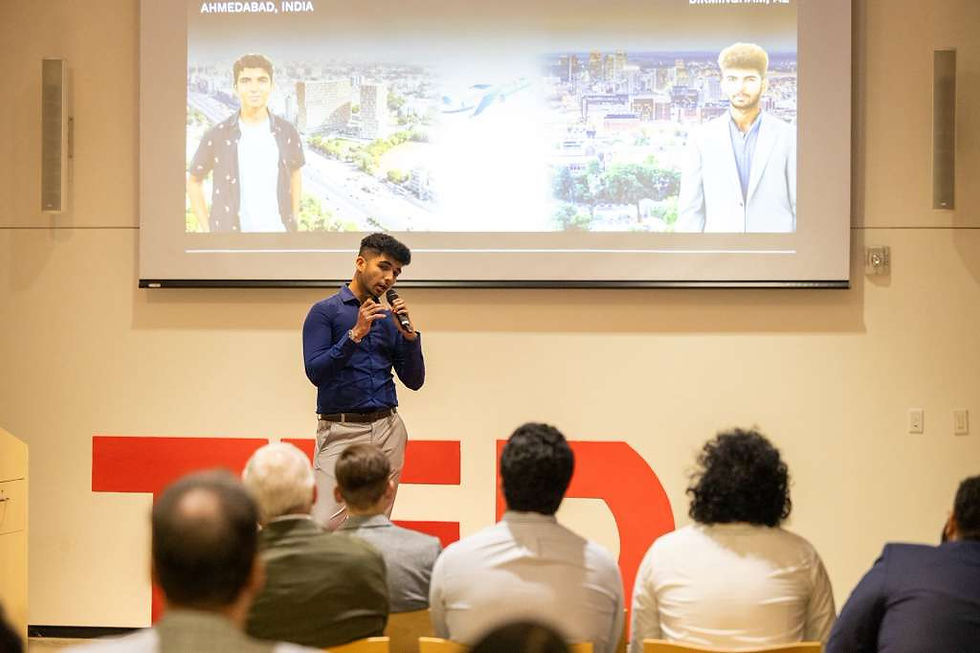
Vikal presented the INVERT framework at TEDx, crystallizing three years of experimentation into a system others could apply. The response validated what he had discovered through necessity. People everywhere struggle with networking, but especially those operating without built-in advantages like existing family networks, alumni connections, or geographic familiarity.
"Standing in a room full of people, unsure if I should introduce myself, afraid of saying the wrong thing," Vikal reflects. "I have been there. But every time I pushed past that discomfort, something amazing happened. I learned. I grew. And I made connections that continue to shape my life."
The framework resonates particularly with international entrepreneurs, technical founders, and anyone who feels networking does not come naturally to them. It is not about personality. It is about process. You do not need to be the most charismatic person in the room. You need to be the most intentional.
At Vikal Consulting Group, these principles now inform how the team approaches client relationships, partnership development, and market expansion. The same methodology that helped an international student build a network from zero helps dealerships transform their social media into revenue engines. Both require authentic relationship building at scale.
What Vikal wants you to know
For entrepreneurs still hesitating, Vikal offers direct advice drawn from building a multimillion-dollar network from zero. Start with what you can control. Your effort, your mindset, and your habits. You do not need permission to begin. Take one step forward today. Apply for that opportunity. Pitch your idea. Reach out to someone you admire.
"If you do this, you will not have to chase opportunities," Vikal says. "They will come to you."
The proof sits in the results. The $50,000 in pitch competition winnings became seed capital. The nationwide network became distribution channels, referral sources, and talent pipelines. Social Showroom AI became the first of multiple products under development at Vikal Consulting Group, each one built on relationships that started with intentional networking.
He acknowledges he is still figuring it out himself, still taking risks and embracing awkwardness. But what he knows for certain is this. Every step forward, no matter how uncomfortable, brings you closer to the life you want to build. The international student who arrived with two suitcases and zero connections became the founder who built a business by betting on strategic networking.
The INVERT framework is not theoretical. It is what worked when traditional networking advice failed. It is what turned pitch competitions into funding. It is what built a multimillion-dollar network across the country. It is what happens when you systemize relationship building instead of leaving it to chance. And for Vikal, it represents the difference between waiting for the perfect moment and creating it yourself.
Learn more about Jaival Vikal's work at Vikal Consulting Group and the Social Showroom AI platform, transforming automotive retail through strategic AI implementation.
Read more from Jaival Vikal
Jaival Vikal, Founder/CEO of Vikal Consulting Group
Jaival Vikal is the founder of Vikal Consulting Group, where he builds SaaS products and custom AI automation systems for fast-growing businesses. His work spans digital marketing infrastructure, AI sales engines, and operational automation. Jaival has helped companies streamline their operations, scale revenue, and modernize their online presence through data-driven execution. He focuses on solving real business problems with lean, high-impact technology. Readers can explore more of his work and insights on his profile page.