Five Percent Beef and a Disney Princess, A Field Guide to the Baby Food Aisle
Updated: Apr 13
Anastasia Schenk is a Pediatric Feeding Specialist and Integrative Nutrition Health Coach. She supports children from starting solids to young adulthood with evidence-based strategies for ARFID, picky eating, gut health, immune support, allergy prevention, and chronic inflammation.

I was standing in a Swiss supermarket last week, doing what I always do in the baby food aisle, ignoring the fronts of packages and flipping them over. I picked up a Big Brand’s “Spaghetti Bolognese” tray, the one in the heart-shaped container that looks like it was designed by someone who genuinely loves children. The front said meal. The back said, 5% beef, 5% pasta, water, rice flour, corn starch. This “Bolognese” is roughly 90% not Bolognese. Somewhere in Italy, a grandmother just felt a little queasy.
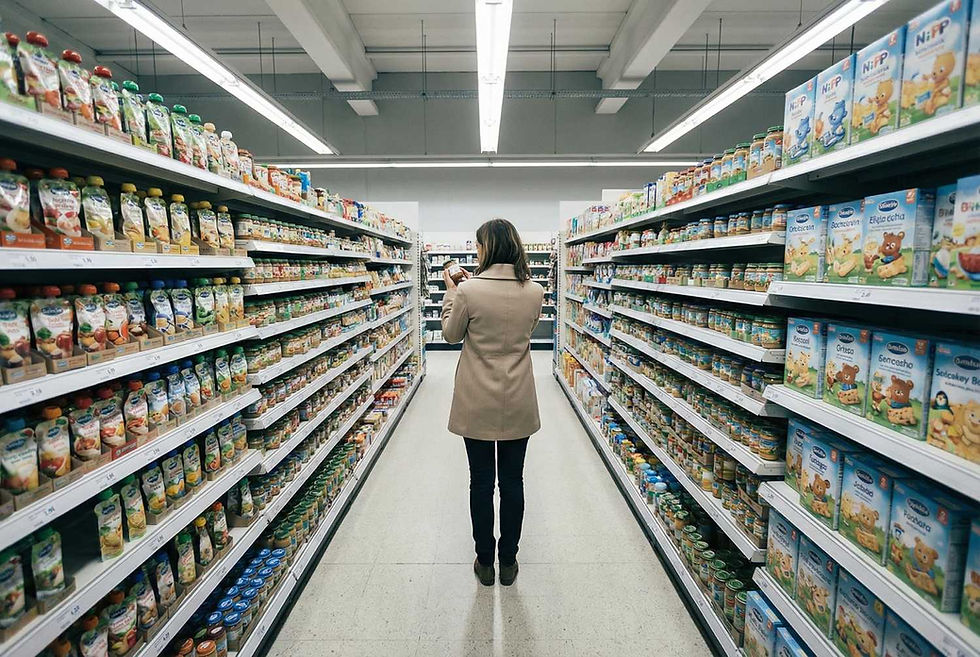
I kept going. I picked up every jar, every pouch, every tray, every bottle. I read the backs the way you read a contract. And by the time I reached the end of the aisle, I wasn’t angry. I was fascinated. Because this aisle tells a story, and it’s not the one on the label.
The front sells, the back tells
Next to the trays sat a row of Big Brand’s juices. “100% Bio Direktsaft,” the label announced. Organic. Direct-pressed. Beautiful glass bottles. And on the cap, ab 5. Monat. From the fifth month.
Fruit juice. For a five-month-old. The WHO’s own draft nutrient profile model explicitly states that fruit juices should not be marketed as suitable for infants and young children. Most paediatric bodies worldwide agree. Yet there they sat at CHF 3.20 a bottle, looking wholesome, wearing the organic seal like a medal of honour.
One shelf over, things got more colourful. A Disney Princess “Bio Heldinnen Porridge” featuring Moana and Ariel. A Paw Patrol “Helden Bio Müsli” with Chase the police dog on the front. Both stamped “Bio.” Both marketed for children 3+.
The word “Bio” does extraordinarily heavy lifting on these packages. It signals health. It whispers, trust me. But organic sugar is still sugar. And when the packaging features cartoon characters, who exactly is making the purchase decision? Not the parent reading the back. The child pointing at Chase.
A WHO study across four European cities found that between 28% and 60% of commercial baby foods were marketed as suitable for infants under six months, directly contradicting WHO guidance. In three of those cities, half or more of the products derived over 30% of their calories from sugars. A separate analysis of 2,634 baby food products across ten European countries found that, on average, roughly a third of all energy came from total sugar. The best-selling baby finger foods were often as high in sugar as standard confectionery.
These are not fringe findings from activist blogs. They come from the WHO, published in peer-reviewed journals, and presented to governments. And the aisle hasn’t changed.
What processing actually does
Between the farm and the jar, something happens that most parents never think about. Most jarred baby foods undergo ultra-high-temperature processing or retort sterilisation, heating to 120°C or higher to guarantee shelf stability. This is necessary for safety. Nobody is arguing against food safety. But it comes with trade-offs that are rarely mentioned on the packaging.
Heat-sensitive nutrients, such as vitamin C, certain B vitamins, and delicate enzymes, degrade under those conditions. Flavour complexity flattens. The result is a product that tastes uniform. Jar after jar, brand after brand, the sensory experience is remarkably similar, soft, mild, predictable. For a developing palate, that predictability is the opposite of what’s needed.
Pouches face a similar fate. Homogenisation creates a texture that bypasses chewing entirely. Freeze-dried puffs and “melties” dissolve on contact. They teach a baby’s mouth that food requires no effort. Compare that with a home-prepared meal, variable textures, intact micronutrients, genuine flavour diversity. It’s nothing out of the ordinary, “ancestral”, or high effort. Just food that still behaves like food.
Baby cereal was never the hero we were told it was
For decades, iron-fortified cereal was the undisputed first food. Paediatricians recommended it. Baby books enshrined it. Parents spooned it dutifully into tiny mouths that didn’t seem particularly impressed.
Here’s what those recommendations rarely mentioned, babies under nine months produce very little pancreatic amylase, the enzyme required to break down starch efficiently. Salivary amylase is present, but limited. So we’ve spent generations handing babies a food their digestive systems aren’t fully equipped to process and calling it “gentle.”
The real nutritional priority in early weaning is fat, specifically for brain development, DHA, choline, and fat-soluble vitamins A, D, E, and K. These are the building blocks of myelination, synaptic growth, and neural membrane integrity. None of them appear in a bowl of baby cereal or “brei.” What does appear, maltodextrin, iron in forms with limited bioavailability, and a flavour profile that is essentially blank.
The first food a baby tastes teaches the brain what food is. When that first impression is bland starch, the palate has been given a very boring opening lecture. Emerging paediatric guidance is shifting toward nutrient-dense whole foods as ideal first introductions, egg yolk, well-cooked liver, avocado, soft meat. Foods with fat, flavour, and actual developmental purpose.
Forget “100 foods” and “1,000 days”, think five years
The “first 1,000 days” framework did something important, it put early nutrition on the public health map. But it also created a false finish line. Parents hear “1,000 days” and assume the window closes at age two. It doesn’t.
Gut microbiome composition continues to shift and mature until approximately age three to five. A 2012 study published in Nature, by Yatsunenko and colleagues, tracked microbial communities across populations and found that the microbiome does not reach adult-like stability until well into early childhood. Immune programming via the gut, as shown by Gensollen and colleagues in Science (2016), extends over the same period. Taste preference formation has sensitive windows that stretch to at least age four or five, with repeated exposure research showing that food acceptance patterns at age two are nowhere near fixed.
Myelination of the prefrontal cortex, the region governing impulse control around food, is barely getting started at age two.
So when the baby food aisle targets 6 to 36 months and then drops children into the “kids’ food” category of chicken nuggets and fruit bars, it abandons them mid-sentence. That Paw Patrol müsli, the one marketed for “3+,” lands right in this gap, cartoon branding and fruit-derived sweetness arriving at exactly the moment when a child’s palate needs continued expansion, not a reward for eating.
The aisle that’s missing
I walked the entire section. I read every label. And here is what I didn’t find, a single product designed around developmental feeding science. Nothing built for texture progression. Nothing formulated with fat-first, nutrient-dense priorities. Nothing that treats the period from six months to five years as the continuous developmental arc it actually is.
There are products designed for shelf life. Products designed for margins. Products designed for Instagram. Products designed to make a three-year-old point and say “Chase!” But products designed for how a child’s body and brain actually develop?
Those are conspicuously, almost impressively, absent.
The baby food aisle isn’t “damaged.” It was never built for babies in the first place. It was built for shoppers and busy, overwhelmed parents, reading “Bio” and justifying a “great ingredient list”, with no time to dive into the depths of industrial production processes and tacit practices. And until someone builds it differently, the gap between what children need and what the shelf provides will keep widening, one heart-shaped tray of 5% beef at a time.
Read more from Anastasia Schenk
Anastasia Schenk, Pediatric Feeding Specialist/Integrative Nutrition
Anastasia Schenk is a Pediatric Feeding Specialist and Integrative Nutrition Health Coach who reversed her own autoimmune disease through nutrition. A mother of two, she combines clinical expertise with lived experience to help families navigate picky eating, Pediatric Feeding Disorders, ARFID, gut health, and chronic inflammation. Her programs are evidence-based and rooted in real life, supporting children from starting solids to young adulthood. She is the founder of Early Eaters Club, a platform dedicated to raising resilient, adventurous eaters for lifelong health.