

Could Fascia Be the Missing Link Between Western and Eastern Medicine?
Dr. Kali Foster is a Chinese Medicine Practitioner and Somatic Trauma Therapist with over 25 years of experience in body-based healing. Her work weaves together Somatic Experiencing, parts work, Tantra yoga, and embodied practices, supporting deeper connection, nervous system regulation, and well-being.

Imagine being able to look beneath the skin and see the body not as a collection of separate muscles, bones and organs, but as one continuous, living network. We once tended to think of fascia as little more than the body's version of Glad Wrap, something that wrapped around our muscles and organs, largely unnoticed until it became a problem. But when we look more closely, something much more extraordinary appears: a translucent web of connective tissue rich in fluid, layers that glide and slide over one another, collagen fibres arranged in complex patterns, tissue that responds to pressure, movement and tension, and a sensory network woven throughout the body. What if this living network offers us a new way to understand something Chinese medicine has described for thousands of years: the interconnectedness of the human body?
What is fascia?
Fascia is connective tissue that surrounds, supports and connects structures throughout the body. It forms sheets and layers around muscles and organs, accompanies nerves and blood vessels, and creates planes through which tissues can move in relation to one another.
Rather than being one single structure, fascia is a complex family of connective tissues extending throughout the body. For a long time, fascia received relatively little attention in mainstream anatomy. It was often treated as something to cut through or move aside to get to the structures underneath. But the more closely researchers look, the harder it becomes to think of fascia as merely packaging.
It is dynamic tissue, and it is deeply connected to how we sense and move through our bodies. Research into fascia and its role in force transmission continues to expand our understanding of this complex connective tissue network.
A living, moving network
Imagine looking beneath the skin and seeing layers of tissue gently sliding over one another as you breathe. Imagine a shoulder moving and seeing the movement ripple through neighbouring tissues. Imagine the subtle changes that happen when you reach, twist, walk, dance or simply shift your weight from one foot to the other.
This is not quite as simple as dropping a pebble into still water and watching the ripples travel. The human body is far more complex than that, but the image is useful. Fascial tissues are mechanically connected, and research suggests that forces can be transmitted through interconnected muscle and connective tissue structures. Exactly how much force is transmitted, over what distance, and how clinically important these effects are is still being investigated.
What we do know is that fascia is not inert. It contains collagen and other components of the extracellular matrix, fluid, cells and sensory nerve endings. Different fascial tissues have different patterns and densities of innervation, including receptors involved in sensing mechanical changes and pain.
This gives us a very different picture of the body. The place where we feel a problem isn't necessarily the only place we need to look. A painful hip may exist within a larger pattern of movement. A tight neck may be influenced by how we breathe, stand or use our shoulders. The way we walk can change how forces are distributed through the body. We are not a collection of isolated parts. We are a system of relationships.
Fascia as an information network
This is where fascia becomes particularly fascinating. The body is constantly receiving information about pressure, stretch, movement and position. Mechanical forces can influence cells and tissues through processes collectively described as mechanotransduction, the conversion of mechanical stimuli into cellular responses. In other words, movement creates information.
Not information in the sense of a thought or a message travelling down a wire, but information in the sense that the cells and tissues of the body respond to changes in their mechanical environment. Stretch a tissue, compress it, load it or move it, and the tissue changes and cells respond. This is part of the extraordinary intelligence of the living body.
It gives us another way of thinking about ourselves, not as machines made from separate components, but as continuously interacting systems in which movement, sensation, pressure and adaptation are intimately related. This is where, for me, the conversation with Chinese medicine becomes particularly interesting. Long before we had microscopes, imaging technology or the language of mechanotransduction, Chinese medicine was working with a map of the body based on connection and relationship.
Another map of the body
For thousands of years, Chinese medicine has understood the body through a network of pathways known as meridians. The meridians are not anatomical structures in the conventional Western sense. You won't find a physical tube or cord beneath the skin that corresponds neatly to a particular meridian. They belong to a different system of mapping the body, a traditional framework for understanding relationships between different regions, functions, symptoms and patterns.
What fascinates me is that this map doesn't divide the body into isolated parts. A practitioner may treat the feet when someone presents with a problem elsewhere. Points on the lower leg may be selected according to patterns involving digestion. Points on the hands or arms may be used when working with the chest or breathing. The treatment makes sense within the relationships of the whole body rather than simply the location of the symptom.
After more than 20 years of practising Chinese medicine, I have watched these relationships play out again and again in the treatment room. This is where the conversation between fascia and meridians becomes intriguing.
We need to be careful not to say that fascia has somehow proven that meridians exist. It hasn't. Fascia is a physical, observable system of connective tissue. Meridians belong to a traditional Chinese medical framework. They are not simply two names for the same anatomical structure. But perhaps we can ask a more interesting question: could our growing understanding of the body's connective and sensory networks give us a new physiological lens through which to explore some of the relationships described by Chinese medicine?
Acupuncture: Working with the network
An acupuncture needle is tiny. Yet when it enters the body, it doesn't encounter empty space. It passes through skin and connective tissue and interacts with the complex mechanical and sensory environment beneath the surface.
When a needle is inserted and manipulated, the surrounding tissue can deform and move with it. Research has demonstrated measurable tissue displacement during acupuncture needling, and laboratory studies have found changes in connective tissue cells following needle rotation. Researchers have proposed that this mechanical interaction may be one component of how acupuncture produces effects in the body, although the mechanisms of acupuncture are complex and remain an active area of research.
From the perspective of Chinese medicine, however, we are working with something much larger than the small area where the needle enters. We select acupuncture points according to their relationship to the meridian system, the person's symptoms and the pattern we see throughout the body. The needle is local. The intention is systemic.
This is one of the things that has fascinated me throughout more than 20 years of practising acupuncture: the body rarely behaves as though its parts are completely separate. Perhaps this is one place where our ancient and modern maps can begin a meaningful conversation.
The meridian system gives us a map of relationships. Fascia gives us a physical network of connective tissue that participates in movement, force transmission and sensation. They are not necessarily the same thing. But both invite us to look beyond the isolated symptom and ask a larger question: What is happening in the whole body?
Where the two maps meet
Perhaps the most interesting place to explore this question is through movement. When we move, we don't move one muscle in isolation. Reach an arm overhead and the movement involves the shoulder, ribs, spine, pelvis and feet. Turn your torso and the movement travels through layers of muscle and connective tissue. Walk across a room and every step becomes a conversation between gravity, bones, joints, muscles, fascia, balance and the nervous system. The body is constantly reorganising itself.
Chinese medicine has a language for this too. In Chinese medicine, health is understood in terms of the smooth flow and circulation of Qi throughout the body. When Qi becomes stagnant or its movement is disrupted over time, this is understood as contributing to pain, dysfunction and eventually disease. When Qi moves freely, we experience vitality, ease and a sense of being at home in our body.
There is also something profoundly experiential about this idea. When the body is moving freely, we feel more connected to ourselves and more able to sense what is happening in the present moment. We are not simply thinking about the body. We are inhabiting it.
The relationship between fascia and the nervous system is also part of this picture. Fascia contains sensory nerve endings, while the nervous system continually influences muscle tone, breathing, movement and how we experience sensation. The relationship works in both directions: the way we move and sense our bodies can influence the nervous system, while the state of our nervous system can influence how we hold, move and experience the body.
As a practitioner, I find this way of thinking incredibly useful. Rather than asking only, Where does it hurt?, I can also ask: How is this whole body organising itself around the problem?
Sometimes the answer is surprising. A restriction in one place may be accompanied by tension somewhere quite distant. A person's breathing pattern may influence the way they hold their shoulders. Changing the way someone moves, breathes or relates to a particular part of their body can sometimes create a shift somewhere else entirely. The body continually reminds us that connection is not merely a metaphor.
Western fascia research and the Eastern meridian tradition don't have to be declared identical for them to be placed in conversation with one another. They come from very different histories and use very different languages. But both invite us to move beyond the idea of the body as a collection of disconnected parts.
When you inhabit the body
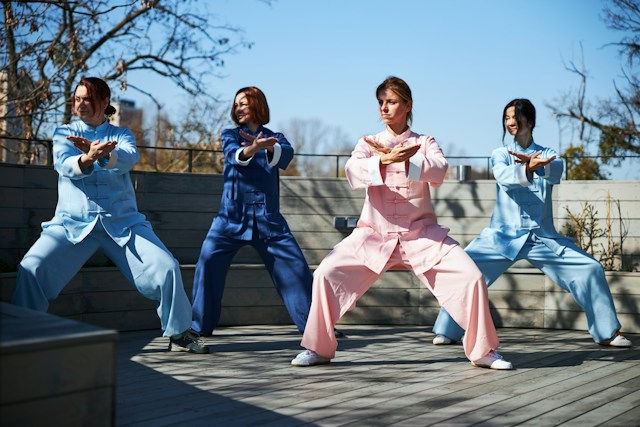
Perhaps you don't need to see a meridian to experience one. Spend time practising Tai Chi, yoga, dance or any form of embodied movement and the body begins to reveal itself differently. Movement travels. A spiral initiated in the foot can wind through the pelvis and spine. The movement of the ribs changes the shoulder. The position of the head changes the relationship of the whole spine. A subtle shift in the pelvis can change how you stand on your feet. You begin to feel pathways of connection that aren't represented on a conventional anatomical diagram.
This is where my experience of fascia and meridians begins to converge. One is described through the language of Western anatomy and physiology, the other through the traditional language of Chinese medicine. The language is different. The maps are different. But the living body we are experiencing is the same body. Perhaps this is where we can begin to appreciate something even more interesting about being human.
We often talk about the brain as neuroplastic, capable of changing in response to experience, learning and use. I think of this as a useful metaphor for the living body as well. Not because fascia is literally neuroplastic, but because the body is continually responding and adapting to how we move, breathe, sense, protect ourselves, connect and inhabit our experience.
The body is not a fixed structure that we simply carry around. It is responsive and alive. Our patterns of movement, sensation and relationship with ourselves are not necessarily set in stone. This is one of the reasons embodied practice can be so powerful.
Seeing the body differently
When we stop seeing ourselves as a collection of separate parts, we can become curious about the relationships between them. A tight jaw might not be just a tight jaw. A painful hip may not exist in isolation. The way we breathe, stand, move or protect ourselves can become part of a much larger pattern. This is where fascia, Chinese medicine and somatic work begin to meet for me.
Somatic work asks us to listen to the body rather than treating it as something that needs to be fixed, overridden or conquered. Instead of immediately trying to change a sensation, we can become curious about it. This kind of embodied awareness is also at the heart of contemporary somatic practice.
Where do I feel it? What happens when I breathe? What changes when I slow down? What happens if I move differently? What am I noticing now that I couldn't notice a moment ago? The integration of talk therapy and somatic approaches is another way of understanding this relationship between mind and body.
The body is constantly giving us information through sensation, tension, movement, breath and subtle shifts in awareness. We don't always need to understand that information intellectually before we can begin to work with it. Sometimes, we simply need to slow down enough to listen.
This is ultimately what interests me more than deciding whether fascia or meridians provide the “right” map. Both perspectives invite us to look again at something we can never fully separate ourselves from: the extraordinary living body. A body that senses, adapts, reorganises and responds. A body that is continually changing in relationship with the world around it and with the way we inhabit it. Perhaps the living web beneath our skin has been speaking to us all along.
Listening to the body
If you’re curious about developing a deeper relationship with your body, I invite you to explore Somatic Therapy with Kali Foster, where body awareness, regulation of the nervous system and practice informed by trauma come together. If you’d like to begin by simply experiencing the work, you can access my free guided somatic practice, Awaken the Spine, a gentle practice lasting 22 minutes for releasing tension, settling the nervous system and reconnecting with the body.
Read more from Dr. Kali Foster
Dr. Kali Foster, Somatic Therapist & Chinese Medicine Practitioner
Dr. Kali Foster is a Chinese Medicine Practitioner and Somatic Trauma Therapist with over 25 years of experience supporting people to reconnect with their bodies and innate capacity for healing. Her work integrates Somatic Experiencing, parts work, Chinese medicine, Tantra yoga, and embodied practices. She is passionate about helping people move beyond surviving into greater connection, vitality, and embodied self-awareness.


