Beyond Baby Food – Designing Cognitive Nutrition for the Developing Brain
Anastasia Schenk is a Pediatric Feeding Specialist and Integrative Nutrition Health Coach. She supports children from starting solids to young adulthood with evidence-based strategies for ARFID, picky eating, gut health, immune support, allergy prevention, and chronic inflammation.

A baby’s brain is the most exquisite construction project on Earth. During early childhood, the brain is in a state of radical expansion, up to one million neural connections form every second. Synapses spark like fireworks. Pathways strengthen or fade based on experience. Every new taste, texture, aroma, and mealtime interaction becomes another circuit laid in place.
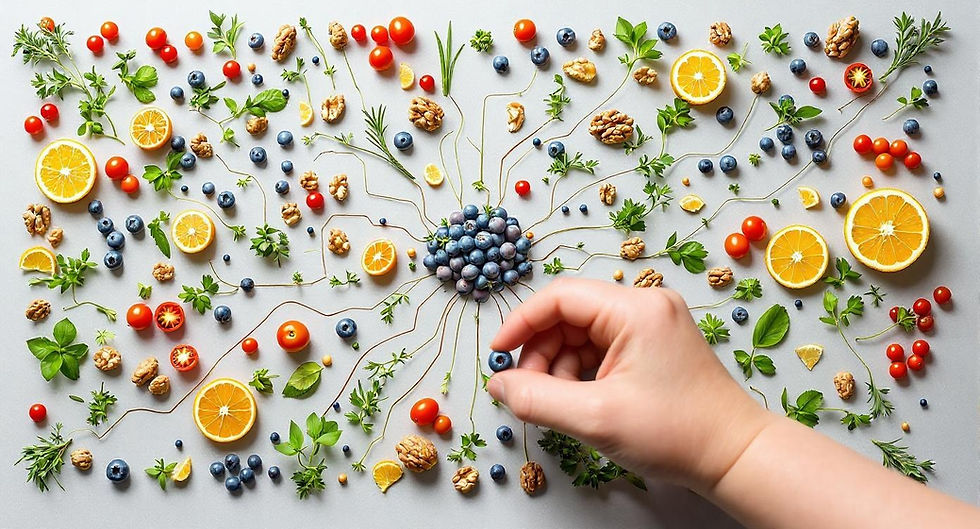
And yet, when it comes to feeding, we often shrink this extraordinary period into something flat and flavorless, powders and gooey drinks as meal replacements, beige purées, toddler snacks, and equipment designed for “no mess,” the same five foods on rotation. Modern baby feeding culture has become safe, convenient, and predictable, but the developing brain isn’t built for predictability. It’s built for exploration.
Nutrition has always been described as fuel, but for young children, it is also instruction. The brain listens to food as closely as it listens to language, movement, and human connection.
It’s time to expand the way we think about feeding, not only to nourish the body but to design cognition itself.
The brain in the highchair
From the first spoonful, a child’s relationship with food becomes a full-body, full-brain experience. A simple piece of mango isn’t just mango. It’s:
Sensory stimulation (texture, aroma, temperature)
Emotional learning (pleasure, frustration, autonomy)
Cognitive mapping (novelty, memory, pattern recognition)
Motor development (pincer grasp, oral coordination)
Feeding is a multisensory lesson that no supplement, no toy, no “educational app” can replace.
Research in developmental neuroscience shows that taste exposure between 6-24 months profoundly influences later openness to new foods, attention, and emotional adaptability. Think of this period as the brain’s “culinary imprinting window”, the time when it learns not just what food is, but how to feel about it.
When food is repetitive, overly processed, or reduced to soft, monotone purées for too long, the brain receives fewer sensory challenges. A curious eater often becomes a cautious one, not because of personality, but because the sensory landscape has been narrow.
By contrast, a child who is regularly exposed to a diversity of colors, textures, shapes, and flavors receives thousands of tiny “data points,” helping the brain develop flexibility.
The forgotten senses
Parents often focus on taste alone, but feeding is a symphony of senses.
Texture trains fine motor skills, oral motor strength, speech musculature, and sensory tolerance.
Color and visual contrast support visual processing, pattern recognition, and curiosity.
Aroma and temperatures activate memory and emotional learning structures in the hippocampus.
Sound, the crunch of a carrot, the fizz of a fermented drink, contributes to multisensory integration.
Children don’t simply eat with their mouths. They eat with their whole sensory systems, and those systems shape cognition.
When early meals are limited to smooth textures or narrow sensory profiles (a common path in picky eaters, ARFID (avoidant/restrictive food intake disorder), or after prolonged purée use), sensory integration weakens. The brain becomes less tolerant of novelty, a dynamic that affects both food and non-food experiences.
As a pediatric feeding specialist, I see this daily, children who are described as “picky” or “fearful” often simply lack the sensory diet they needed for the brain to feel safe exploring.
Nutrients that build minds
While sensory experience shapes neural circuits, nutrients act as the literal building materials.
DHA (Omega-3s): Supports flexible neural membranes and rapid signal transmission. Linked to attention, memory, and emotional regulation. Found in fatty fish, algae oil, and eggs.
Iron & Zinc: Critical for myelination, the brain’s wiring insulation, and for dopamine production, the neurotransmitter of curiosity and motivation.
Choline: Essential for acetylcholine, the neurotransmitter of learning and memory, found in eggs, liver, and some beans.
Folate & B12: Run the methylation “switchboard” that determines which developmental genes activate during brain growth.
Antioxidants & Polyphenols: Protect neurons from inflammation and oxidative stress, and support mental stamina.
Protein & Essential Amino Acids: Provide the raw materials for neurotransmitters, structural brain proteins, and energy stability.
But the real magic lies in diversity. A varied diet supports a rich gut microbiome, the microbial ecosystem that produces neurotransmitters like serotonin (up to 90% produced in the gut). The microbiome is increasingly seen as an extension of the brain itself.
A diet of rainbow foods builds a rainbow mind.
Emotional nutrition: Feeding curiosity, not compliance
Parents often describe feeding as a battle of wills. But for the child, mealtime is an early laboratory of autonomy.
The emotional patterns formed around food, pressure, freedom, exploration, shame, joy, leave traces in the developing brain.
Offer, don’t force: When children feel pressured, the amygdala (the brain’s fear center) activates, suppressing appetite and exploration.
Normalize repetition: The brain loves familiarity before novelty. It may take 20+ exposures for true acceptance. Licking and smelling counts as much as biting and chewing!
Model curiosity: A parent’s facial expression and language shape the child’s neural response to new foods through mirror neurons.
Allow sensory play: Touching purée, smelling herbs, smashing peas with fingers, these aren’t “bad habits.” They’re sensory literacy.
A child who feels safe, autonomous, and curious at the table is learning skills that extend far beyond nutrition. These are the same circuits that later support creative thinking, resilience, and adaptability.
Every mealtime is a tiny leadership lesson for the brain.
Designing a cognitive kitchen
Instead of treating meals as chores, think of them as small sensory-building experiences.
A cognitively rich plate often includes:
Multiple textures (soft avocado, chewy chicken, crisp cucumber)
Contrasting colors to engage visual interest
One small novelty, a herb, a spice, a new shape
Participation, letting children sprinkle seeds or choose a color of fruit
A calm environment that welcomes exploration rather than speed
This is not complicated. It does not require Michelin-star plating.
It simply requires intention and commitment.
Think of yourself as the architect of your child’s sensory world.
The future of feeding
We are living in a moment obsessed with cognitive enhancement. Adults chase nootropics, microdosing, and neuro-biohacking. But the truth is almost comically simple:
The most powerful cognitive enhancer is early childhood nutrition.
Everything else is a footnote.
Despite this, early feeding is often the last frontier in wellness. Doctors tell us what not to give (sugar, processed foods), bloggers teach us how to make 100 different banana pancakes… But we rarely see what feeding could be, a daily, joyful act of shaping the brain for curiosity, emotional intelligence, and healthy risk-taking.
Imagine if pediatric nutrition was treated as early cognitive architecture. Imagine if baby food companies prioritized sensory and cognitive richness instead of convenience. Imagine if daycare menus were designed with neurodevelopment in mind.
Family longevity doesn’t begin with anti-aging clinics.
It begins at the highchair.
A final thought
Feeding is one of the earliest forms of communication. Long before children speak, they learn through food whether the world is predictable or surprising, safe or scary, monotonous or full of possibility.
When we move beyond baby food, beyond smooth beige sameness, we teach far more than eating. We teach curiosity. We teach courage. We teach discovery. And in doing so, we nourish the most important organ they will ever have, their growing brain.
Read more from Anastasia Schenk
Anastasia Schenk, Pediatric Feeding Specialist/Integrative Nutrition
Anastasia Schenk is a Pediatric Feeding Specialist and Integrative Nutrition Health Coach who reversed her own autoimmune disease through nutrition. A mother of two, she combines clinical expertise with lived experience to help families navigate picky eating, Pediatric Feeding Disorders, ARFID, gut health, and chronic inflammation. Her programs are evidence-based and rooted in real life, supporting children from starting solids to young adulthood. She is the founder of Early Eaters Club, a platform dedicated to raising resilient, adventurous eaters for lifelong health.