A Subtle Awakening – Coordinating Consciousness
Updated: Jul 13
Jamee Culbertson integrates Taoist practices, the Alexander Technique, and spiritual healing for transformative experiences. She is a Senior Healing Tao Instructor teaching Tai Chi, Qigong, and Taoist meditations at the Universal Tao Boston School of Taoist Practices. Jamee is a teacher trainer certifying teachers in both disciplines.

I did not come to the Alexander Technique looking for spirituality. My introduction to the Alexander Technique came through an unexpected suggestion that it might help my singing voice, support my long term health, keep me from getting arthritis, and that I might even want to become a teacher of it. Curious, I followed the invitation.
When I received this suggestion, I had just returned from the Pine Ridge Reservation in South Dakota. I was invited by two spiritual teachers with whom I had been studying, a Lakota woman named Deodi and her partner, Oshada. They were both spirit mediums. In particular, Deodi was a trance medium. They lived in a neighboring town and held regular mediumship circles at their home.
I remember after attending my first circle, Deodi took me outside on the porch. She took a puff of her cigarette hanging from a shiny cigarette holder. Smiling, she said, “You can pick your jaw up off the floor now.”
A trance medium brings spirit messages into the room, where everyone can feel their presence. This is where my world opened up to the relationship of spirit inside the physical realm.
Before long, they took me to South Dakota for healing ceremonies. My spiritual encounters on the rez were direct and profound. It was a time I will always remember, especially the singing and drumming during the spiritual ceremonies. I can still hear their voices singing loudly.
By now, visceral, spiritual experiences and the great mystery were not new to me. Following that unexpected suggestion to look into the Alexander Technique, it was time for me to contact a local AT teacher I was referred to, Tommy Thompson, who also happened to have a teacher training course. My first AT lesson was the next step at this transformative time in my life.
What to discover?
My first Alexander Technique lesson with teacher and trainer Tommy Thompson was mild and uneventful, or so I thought. I can’t say I noticed much at all during the lesson. But when I left his office wondering what it was all about, things changed. As I stepped outside to walk across the parking lot to my car, something unexpected happened.
I reached into my pocket for my car keys, but I dropped them. Instinctively, I bent down to pick them up, and as I stood back up, I stopped. Something felt different. Something had noticeably changed.
“Who just picked up those keys?” It sounds like an odd question, but it was the only way I could describe what I was experiencing. The movement felt completely unfamiliar. My body moved in a way I had never experienced before. I had never experienced myself like this. It was like I had briefly stepped outside my “normal” habitual way of moving and encountered another possibility.
I got into my car to drive across town to visit my friend Ruth. As we greeted each other with a warm hug, she looked at me and asked, “What’s up with you?” I said, “What do you mean?” She replied, “You feel different.” I asked, “Different how?” She paused and said, “More supple.” I laughed, shrugged, and walked inside.
At the time, I had no framework for what I was experiencing. I knew nothing of primary control, the nervous system, embodiment, or awareness. I only knew that something had changed. Something shifted, but I didn’t yet have the language for it.
That experience left me with a true sense of wonder. That wonder, fueled by curiosity, led me far beyond movement and coordination into an exploration of awareness itself. After a few more lessons, I joined Tommy’s training course and began a three year journey to become a teacher of the Alexander Technique.
What unfolded over the three year training was far different than I could have imagined. As I applied what I was learning in the Alexander Technique training course, changes occurred that extended way beyond movement. In particular, when I became more aware of the relationship between my head, neck, and spine, my body opened up, a sense of presence became vividly clear, and while my movements eased up, my meditations also deepened.
I often smile and say whites got whiter, brights got brighter. At times, I experienced moments of stillness, clarity, and connection that felt undeniably spiritual. Even the clairs opened up. This led me to an intriguing question, "Could physical coordination influence not only how we move, but how we perceive ourselves and our place in the world?" In this way, are we actually coordinating our consciousness? Or is increased consciousness coordinating our bodies?
The Tao master
I began to notice fascinating parallels between what I was learning with the Alexander Technique and the Taoist practices I was learning from Tao Master Mantak Chia, who created the Universal Healing Tao System. He taught us Taoist meditations, Qigong, and Tai Chi.
Some of the meditation practices awaken energetic portals for energy flow, places called the “Jade Pillow,” the “Crystal Palace,” and the “Crown.” All of these, in particular, are within the region of the head.
I noticed a relationship between these areas and the atlanto occipital joint atop the spine, the A/O joint. Freeing tension patterns beneath this joint opens a doorway for the nervous system, freeing us from insistent fight or flight reactions, which activate the sympathetic nervous system. At the same time, it awakens the vagus nerve, the parasympathetic nervous system for rest and digestion. I found harmony within myself learning about the relationship and function of these areas.
F. M. Alexander, founder of the Alexander Technique, called the dynamic relationship of the head, neck, and spine Primary Control, sometimes referred to as primary movement. He recognized that the way the head balances freely on the spine has a profound organizing influence on the coordination of the entire organism. Rather than describing a fixed posture, he pointed to a living relationship. When the head is free to balance upon the spine, the whole system responds, movement becomes lighter, breathing deepens, and a quiet sense of ease and vitality begins to emerge.
The diagram
During my first year of training, I attended another workshop with Master Chia. Master Chia teaches mainly through transmission. As he embodies the teachings, he brings you a direct experience through an energy transmission. All we have to do is be receptive. This is not unlike having an Alexander lesson.
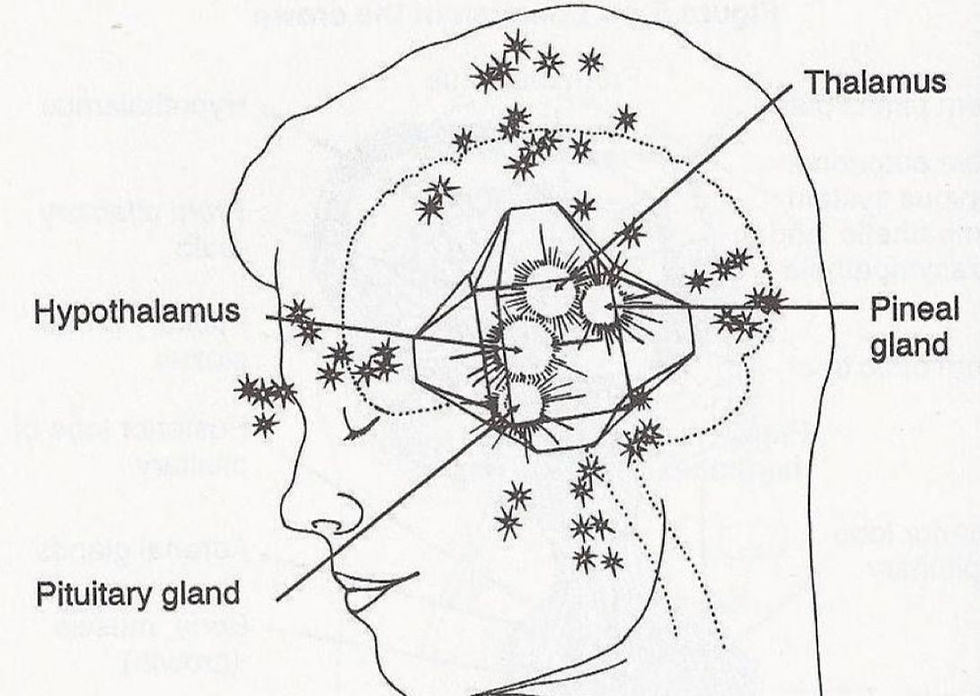
His teaching also includes visuals, diagrams, illustrations, and slides, to map internal practices in a tangible way. During one presentation, I looked up and saw a simple profile of the head and upper spine. Running along the head were these points I mentioned. Something in me awakened, and I sat up.
As he spoke, my attention drifted away from explanation and toward a quiet shift within my own body. I was no longer thinking about the diagram. I was experiencing it. It didn’t feel like new information. It felt like recognition, mmm, like home.
The image showed a simple profile of the head and upper spine. The first area to note was the “atlanto occipital joint,” or A/O joint, a place where the head is allowed to balance rather than be held. Another point in the diagram was located physically at the center of the forehead, the “Third Eye,” and serves as a doorway for inner vision and intuition.
An area inside the brain is called the “Crystal Palace,” which houses the master endocrine system glands, the pituitary, pineal, hypothalamus, and thalamus glands. Another is the “Jade Pillow,” at the base of the skull, where letting go can benefit the whole.
When these areas are entrained, a beautiful flow of energy gets released, which nourishes my whole being. The Jade Pillow is also known in various traditions as the Alta Major chakra, the Ninth Chakra, the Mouth of God point, and the Seat of the Soul.
It is described in Taoist internal arts as an energetic gateway near several key neurological structures, the reticular formation, which influences movement, attention, sleep, and habit, the vagus nerve, the primary pathway between brain and body supporting regulation and rest, and the medulla oblongata, which governs essential life functions such as breathing and heart rate.
In Taoist practice, this region is associated with the movement of qi through the Microcosmic Orbit. In Tai Chi and Qigong, practitioners cultivate song, a quality of relaxed, effortless release, so the head can balance freely and energy can circulate through the central axis. Hmm, F. M. Alexander calls this cultivation “primary movement.”
I find myself returning to the relationship of these areas again and again, not because I choose it, but because attention would return on its own, drawn by a subtle expansion of multi directional freedom and aliveness. Something was becoming more awake. Awake to what? Myself.
F. M. Alexander’s second book is called “The Use of the Self.” What is this Self he spoke about? I was discovering there is so much more to who we are than we realize.
Adjacent perspectives
Three traditions explained within the body. Alexander Technique, primary control, coordination, the release of habitual interference and unnecessary effort, and accessing wholeness. Neuroscience, reticular formation, vagus nerve, medulla oblongata, and autonomic regulation. Taoist internal arts, Jade Pillow, Governor Channel, Crystal Palace, song, circulation of qi, and awakening awareness.
Each language is different, anatomical, energetic, contemplative, yet each points us toward the same possibility, how we organize ourselves physically shapes how we experience ourselves mentally, emotionally, and spiritually as we move around the world moment to moment.
Energetic doorways balanced and communicating through a single field of awareness. What began as a study of coordination gradually became a study of consciousness.
What remains
Over time, I find myself returning to the image as a felt sense of presence, as an expression of our energetic design. This continues to appear for me during AT lessons, in meditation, and in ordinary moments of quiet stillness and listening.
What was emerging was not a concept, but a shift in how attention itself can move. I began to understand this as embodiment, the inseparability of attention, coordination, life force energy, and presence.
How I organize myself shapes the quality of awareness that arises and offers up new experiences.
This has become an ongoing inquiry, a way of listening. Noticing when primary movement is free, when attention is quiet, and when my system is no longer burdened by excessive effort.
A subtle awakening
Looking back, there was no single moment when everything changed. It was more like a gradual shift, so subtle at first it could easily have been missed. Like that first lesson, when I bent down to pick up my keys and something ordinary became extraordinary. It stopped me in my tracks, and yet afterward, I simply carried on with my day.
Over time, it continues. Less effort. Less holding. A more forgiving relationship with myself. A growing awareness of how often responses can be shaped by habit rather than choice.
What F. M. Alexander called primary control began to reveal itself as more than coordination. It became a lively way of meeting life. A hello to presence.
I did not come to the Alexander Technique looking for spirituality. Yet that is what I found, not as something separate from daily life, but as something revealed through the way attention, coordination, and presence coordinate from within us.
Spirituality is not elsewhere. It is something we inhabit, an unseen dimension of energy, awareness, and connection. A subtle awakening, moment to moment to moment, if we allow it.
Read more from Jamee Culbertson
Jamee Culbertson, Senior Instructor, Teacher Trainer
Jamee is a Senior Instructor at the Universal Tao Boston School, teaching Tai Chi, Qigong, and Taoist meditation. With nearly 40 years of experience, she integrates Taoist practices, the Alexander Technique, and spiritual healing. She is an internationally certified Alexander Technique Instructor and teacher-trainer at the Boston Conservatory at Berklee. Jamee has taught at Harvard University, Mass General’s Home Base program for veterans, and community wellness events like Rosie’s Place. Her work blends ancient wisdom and modern techniques to support healing, balance, and self-awareness.