

You're Not AI and Stop Communicating Like One
David Fisher is an award-winning international speaker, executive communication coach, actor and author. Named one of LA Weekly’s “Top 30 Entrepreneurs to Watch” and a Top 10 Speaking Coach by Yahoo Finance, David brings over two decades of experience helping teams communicate and lead with passion, clarity, and intention.

There's a version of "professional communication" spreading through organizations right now that is clean, clear, well-structured and completely devoid of humanity. It arrives in your inbox on time. It has no typos. It covers all the key points. And somehow, you finish reading it and feel absolutely nothing.
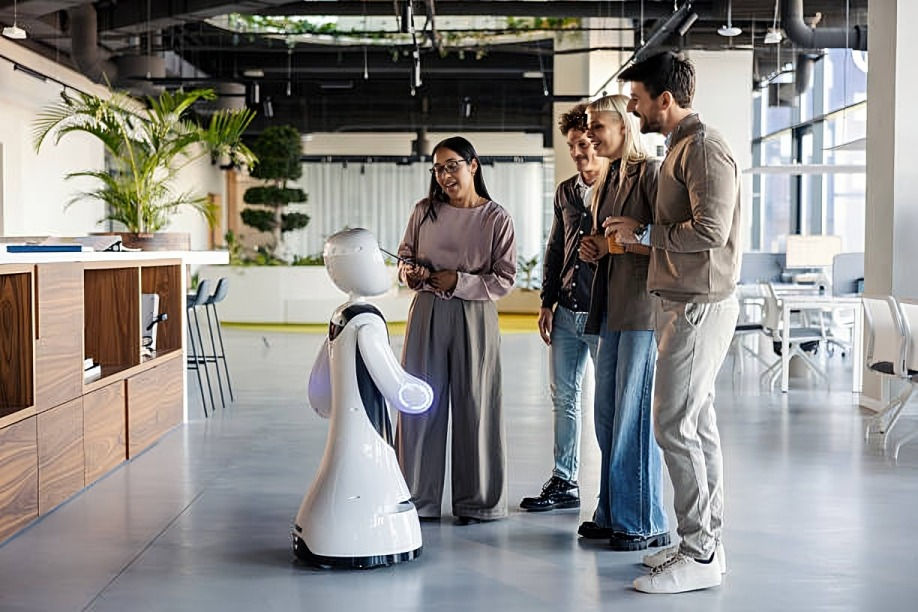
AI is not a communication tool, it is a partner with us. The question and the danger is, how can we prevent ourselves from building bigger silos separating us from each other in an already divided world? Here's the irony at the center of the artificial intelligence revolution: the more we use machines to communicate for us, the more bland and disconnected we become. We become what we created.
Humans are messy, emotional and irrational. We forget this is a good thing! We tell stories with awkward emotion and find ourselves on rabbit trails, struggling to get back on point. We laugh at the wrong moment. We say "I don't know" and mean it. We show up to hard conversations blind and scared. That messiness makes us human. It drives, fosters, and deepens connection.
It's the hesitation in someone's voice that tells you they're struggling. It's the offhand comment in a hallway that becomes the idea your team builds a product around. It's the leader who admits they got something wrong, and in doing so, gives everyone else permission to exhale.
Creativity doesn't come from a probability model optimized on past data. Passion doesn't transfer through a polished algorithm. Resilience isn't built in frictionless environments, it's built in the moments where things are hard and we choose to stay engaged.
AI is genuinely useful. As a research partner, a drafting assistant, a time-saver for the transactional work that consumes too much of our days, it's a remarkable tool. The leaders who figure out how to use it well are going to have a real advantage.
But the leaders who use it everywhere, including in the places that require a real human, are going to find themselves running efficient organizations that no one particularly wants to work in.
That means knowing the difference. Right now, most organizations are making that decision by default rather than by design.
If you're navigating the AI conversation in your organization and want a framework for getting this right for your leaders, your teams, and your culture, let's talk. The Human and Machine keynote is built exactly for this moment.
The roadmap your organization needs before it goes all-in on AI
Every organization is somewhere on the AI adoption curve right now. Some are sprinting. Some are cautious. Most are somewhere in the middle. All of us, to some extent, are confused. As soon as 1.0 is figured out, 2.0 arrives. Our heads are spinning faster than tariff wars. If you don't have a clear compass on when to use AI, you’ll never figure out how to use AI.
Humans tend toward lower energy states. We like the path of least resistance. Which means without a plan, we’ll lean toward automation over connection. There’s a real danger in that. AI is fast, cheap, available 24 hours a day and appears friendly. Of course, it's tempting to let it do more. Besides, you don’t want to be left behind as your competitors surge ahead.
What doesn't show up on a spreadsheet, however, is the conversation that didn't happen. The creative collision that got replaced by a bland and perfect summary. The employee who stopped asking questions because the AI always had an answer. The team that stopped disagreeing because the bot came to a happy beige boring middle.
There are massive losses, by what is still your greatest asset, your people! They're just slower and harder to see. Here's what experience and research both suggest: AI anxiety in organizations doesn't primarily come from the technology itself. It comes from the absence of clear thinking about when to use it and when not to.
Teams that have that clarity feel less anxious, not more. They know what AI is for. They know what it isn't for. And that knowledge is enormously stabilizing. So what does that framework look like in practice?
Use AI for transactional tasks, scheduling, reporting, first drafts, data synthesis, and routine communication. These are tasks with clear inputs and outputs, where speed and accuracy matter more than human nuance.
Keep humans in the loop for the relational, performance conversations, conflict, mentorship, creative problem-solving, anything where the quality of the relationship is part of the output. These are interactions where the "how" matters as much as the "what," and the how is where creativity and out-of-the-box thinking start!
The leaders who implement this clearly are the ones whose teams will adapt fastest, feel safest, and perform best in the long run. The Human and Machine keynote gives your organization a practical, research-backed roadmap for exactly how to integrate AI responsibly without losing what makes your culture work. If that conversation is overdue in your organization, reach out here.
The most powerful technology in your organization is still human
In an era of genuinely astonishing artificial intelligence, the single most powerful force in any organization is still a person with a story to tell. A human being, with lived experience, hard-won perspective, and the ability to make another person feel less alone. This is an organizational strategy and team tactics.
We are in a period of rapid, disorienting change. The pace of AI integration into daily work life is accelerating faster than most organizations' ability to absorb it. In this environment, something predictable happens, people get anxious and they’ll look to their leaders for answers. What they're hoping to find and what they need is a human being who is genuinely present with them.
That is a form of leadership AI cannot replicate. Not because the technology isn't sophisticated enough, but because the source matters. An AI-generated message of support, however well-crafted, is not the same as a manager who chose to walk down the hall or hop on video and have a real conversation. The choice itself is the message.
This is what gets lost in the efficiency argument for AI adoption: we focus on the message and not the messenger. When a leader takes time to think something through and express it imperfectly in their own voice, they are signaling something no algorithm can signal: I was here. I thought about this. You were worth the effort. I see you. I hear you. You are important to me.
That message builds cultures that can handle change. It builds teams with genuine cohesion. It builds organizations that are resilient not because they've eliminated uncertainty, but because their people trust each other enough to navigate it together.
The organizations that will thrive in the AI era are not the ones that automate the most. They are the ones that clearly and fiercely protect the irreplaceable value of human communication, the creativity that comes from real conversation, the passion that transfers between people who actually know each other, and the resilience that grows in cultures where it's safe to be messy, uncertain, make mistakes, and be human.
AI, more than any other previous technology, is a part of our future, but rather than a tool, AI is a partner. The question is, how can you integrate it in a way that doesn’t replace the wonderful messiness of human connection.
The Human and Machine keynote is a story-driven, research-backed exploration of exactly this tension and what to do about it. If your leadership team, conference, or organization is in the middle of the AI conversation, I'd love to be part of it.
Follow me on LinkedIn for more info!
Read more from David Fisher
David Fisher, Global Public Speaker and Communication Coach
Through A Culture of Us™ David Fisher teaches companies, institutions, and everyday leaders how to work with passion, communicate with clarity, and lead with intention, all toward strengthening their connections to create positive change, while having fun along the way. His keynotes, workshops, coaching sessions, and trainings are not just about bettering communication and leadership, they are about genuine transformation.
His approach is simple: A Culture of Us™ helps each of us tap into the hero within, and use that power toward working with others and leading with vulnerability and strength.






