

Why Stress, Not Willpower, Drives Belly Fat After 40
Written by Nelum Dharmapriya, Doctor & Health Coach
Dr Nelum Dharmapriya is a Brisbane-based GP with a special interest in metabolic health, menopause, and lifestyle medicine. She combines 30 years of clinical experience with a personal passion for helping women thrive in midlife and beyond.

By the time women reach their 40s, many feel as though their bodies have quietly turned against them. They are eating less than ever. They are exercising more. They are doing everything they’ve been told to do. And yet the weight creeps up, particularly around the belly. What makes this experience so distressing is not just the physical change, but the story women tell themselves about it. That they’ve lost discipline. That they’re not trying hard enough. That if they could just summon more willpower, things would fall back into place.
As a GP working with women in midlife, and as a woman who has lived this journey herself, I can say with certainty that this narrative is wrong. For most women over 40, belly fat is not a matter of willpower. It is a stress-driven biological response.
Understanding this shifts everything, from blame to biology, from frustration to clarity, and from ineffective dieting to real, sustainable change.
When knowledge isn’t enough: My own wake-up call
For much of my medical career, I believed that good health followed good advice. Eat well. Exercise regularly. Sound guidance, but incomplete.
As a South Asian woman, I also grew up in a culture where food is deeply intertwined with love, celebration, and a sense of belonging. Rice, curries, and shared meals were part of everyday life. At the same time, South Asians are genetically more prone to insulin resistance, type 2 diabetes, and cardiovascular disease, often at lower weights and younger ages than other populations.
Over time, I began seeing the same pattern repeatedly in my clinic, and quietly in myself. High responsibility. Chronic stress. Poor sleep. Long working hours. Doing everything “right” and still feeling tired, bloated, foggy, and stuck in a body that no longer responded to effort.
What finally changed my approach, personally and professionally, was realising that willpower was never the missing ingredient. Biology was.
The stress insulin connection that most women aren’t taught
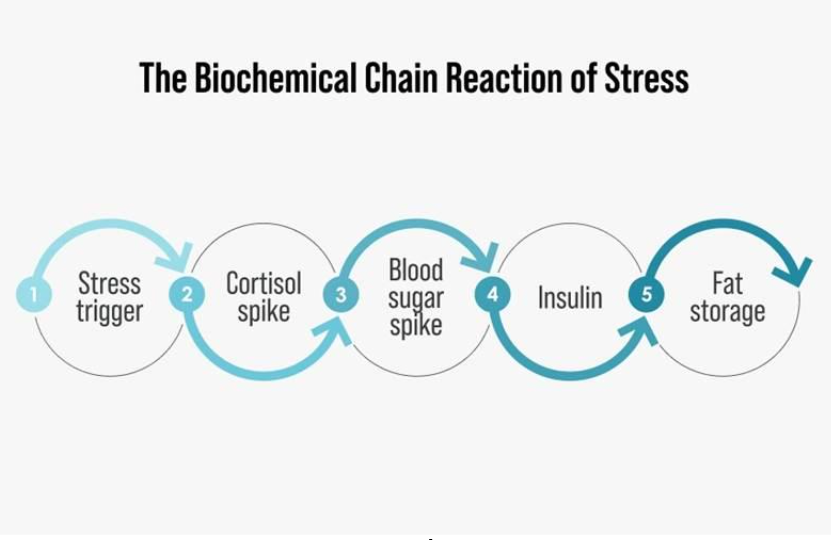
To understand why stress, not willpower, drives belly fat after 40, we need to understand a simple but powerful physiological sequence. Stress triggers a rise in cortisol, which increases blood sugar, leads to insulin release, and promotes fat storage. This chain reaction happens every day in modern life, often without us realising it.
Stress isn’t just emotional. The body responds to mental overload, caregiving, poor sleep, restrictive dieting, excessive exercise, inflammation, illness, and hormonal fluctuations in very similar ways. All of these activate the hypothalamic pituitary adrenal axis and increase cortisol.
Cortisol is not a “bad” hormone. It is essential for survival. But when cortisol remains elevated for long periods, as it often does in midlife, it fundamentally changes metabolism.
Cortisol raises blood sugar, even without food
One of cortisol’s key roles is to ensure that glucose is available in the bloodstream. From an evolutionary perspective, this makes sense. If the body perceives a threat, it wants immediate fuel for the brain and muscles.
Cortisol increases glucose production in the liver and reduces glucose uptake into muscle and fat tissue. Importantly, this rise in blood sugar can occur even if you haven’t eaten. This is a crucial, and often misunderstood, point.
Many women assume blood sugar spikes only come from carbohydrates. In reality, chronic stress alone can raise glucose levels repeatedly throughout the day. When women understand this, something shifts. Their lived experience finally makes sense.
Insulin: Essential, protective, and easily overstimulated
Whenever blood glucose rises, insulin is released to move glucose out of the bloodstream and into cells. Insulin is life-saving. Without it, glucose becomes toxic. However, when insulin is released frequently, problems emerge.
Over time, cells become less responsive to insulin’s signal. This is insulin resistance. The pancreas compensates by producing more insulin, leading to chronically elevated insulin levels.
Here is the critical point most diets ignore, as long as insulin remains high, fat loss is biologically blocked. No amount of calorie cutting can override this hormonal reality. This is why willpower-based dieting fails so many women after 40.
Why belly fat is so stubborn
Visceral fat, the fat stored around the abdomen and internal organs, is metabolically active and highly sensitive to cortisol. It contains more cortisol receptors than fat stored elsewhere in the body.
Under chronic stress, the body preferentially stores fat centrally. Belly fat is not a moral failing. It is a stress adaptive survival response.
Visceral fat also worsens insulin resistance and inflammation, creating a self-reinforcing loop of stress, insulin, and fat storage. This is why belly fat is often the last area to respond, and why it is closely linked to cardiometabolic risk.
Why dieting backfires after 40
Many women respond to midlife weight gain by doing what has always worked before, eating less and exercising more. But after 40, this approach often backfires.
Perimenopause and menopause bring hormonal changes that increase cortisol sensitivity, reduce muscle mass more easily, and impair recovery from stress. Sleep is often disrupted, further driving insulin resistance and appetite dysregulation.
When women restrict calories, skip meals, or over-exercise, the body interprets this as another stressor layered onto an already overwhelmed system.
The result is predictable, metabolic slowdown, rising cortisol, worsening insulin resistance, increased cravings, fatigue, and emotional eating. This is not a failure of discipline. It is physiology doing exactly what it was designed to do.
Insulin resistance: The root issue hiding in plain sight
Insulin resistance affects far more than blood sugar. It underlies fatigue, brain fog, inflammation, cardiovascular risk, hormonal disruption, and weight gain, particularly around the abdomen.
Many women with insulin resistance are told their blood tests are “normal” and are dismissed, despite feeling anything but well. When the focus remains on weight alone, the real issue is missed. Improving metabolic health, not chasing weight loss, is the key to long-term wellbeing.
What about fasting?
Intermittent fasting can be a powerful tool, but only when the foundation is right. In women over 40, fasting layered onto poor sleep, chronic stress, low protein intake, and hormonal instability can increase cortisol rather than improve insulin sensitivity. The goal is not to stack stressors. It is to create metabolic safety.
Shifting the narrative: From willpower to support
When women understand that stress, not willpower, drives belly fat after 40, everything changes. The focus shifts from punishment to support. From restriction to nourishment. From control to collaboration with the body.
Sustainable fat loss begins when the body feels safe, supported by adequate protein, preserved muscle, stable blood sugar, restorative sleep, and nervous system regulation.
Muscle, in particular, is critical. It is the largest site of glucose disposal in the body. Loss of muscle accelerates insulin resistance and metabolic decline, especially in menopause. Stress regulation is not optional. It is a biological necessity.
The take-home message
If you are a woman over 40 struggling with stubborn belly fat despite doing everything “right”, your body is not broken. It is responding exactly as designed to chronic stress, hormonal shifts, and metabolic overload.
Understanding this biology is deeply liberating. It allows women to step out of self-blame and into clarity, compassion, and smarter care. When we stop blaming willpower and start respecting physiology, real healing begins.
Ready to take the next step?
If this article resonated with you, you’re not alone. At Whole Food Revolution, we support women over 40 who are tired of blaming themselves for bodies that are simply responding to stress, hormones, and modern life. Our work focuses on restoring metabolic health through science-based nutrition, lifestyle change, mindset support, and compassion, not restriction or guilt.
If you’d like guidance that helps you work with your body rather than against it, we invite you to get in touch. Visit here to explore our resources, programs, and community, or reach out to learn how we can support you on your next step toward sustainable health. Because when women understand their biology, they can finally stop fighting their bodies and start healing them.
Read more from Nelum Dharmapriya
Nelum Dharmapriya, Doctor & Health Coach
Dr Nelum Dharmapriya is a Brisbane-based GP with 30 years’ experience in women’s health and metabolic wellbeing. Founder of Whole Food Revolution, she empowers women 40+ to reclaim energy and confidence through the three pillars of science, lifestyle, and mindset.







