

Where Does Your Inner Critic Show Up? Most People Never Look
Debora Gemmell is the Mentor for People Meant for More. With more than 25 years of experience, she is the founder of Debora Gemmell Coaching and the author of "Me, My Thoughts and I", thought drops for confidence and imposter syndrome. She is recognized three times over as one of Toronto's top coaches.

Last week, I sat in a room full of accomplished businesswomen at the City of Toronto's Small Business Conference. On the panel were experienced founders and operators, and the discussion covered the usual ground, funding, marketing, growth, and operations. Solid, practical advice. But the most revealing moment of the session came when the floor opened for questions.
Six women asked questions. Three of them were about the same thing. How to manage your mindset. What to do when you're stuck, and one woman flat out asked what to do when imposter syndrome keeps sidelining you.
There it was. In a room full of talented, capable professionals with real ambitions and the skills to get there, the loudest unspoken topic was the battle happening inside. No one on the panel had addressed it, and the moment questions were allowed, it surfaced immediately.
It doesn't have to stay hidden. But first, it helps to understand what's actually going on and where.
What is the inner critic, really?
The inner critic is the voice that questions whether you belong where you are. It reviews your performance, predicts your failures, and compares you to everyone in the room. It sounds like authority. It often speaks in your own voice, which is what makes it convincing.
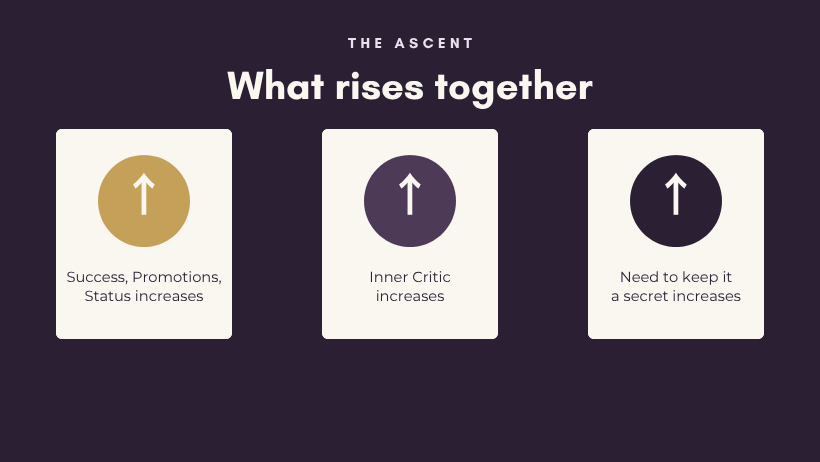
Here's the part worth knowing. Success, promotions, and status rise together with two quieter companions, the inner critic and the need to keep it all a secret. Climbing doesn't quiet the critic. It gives it more material. More responsibilities to second-guess, more rooms to feel unworthy in, and more expectations to fall short of. The higher you climb, the greater the cover-up.
Some of my clients carry an added weight on top of it, guilt. By every outside measure, their life is working. Beautiful home. Family. Senior role. From the outside, they look like the person everyone else is trying to become. Inside, they're running out of steam trying to hide the battle because appearing confident is a must when you're the one everyone looks to.
They arrive at my door drained, exhausted, and frustrated, ready to find a better way. Ready to stop performing confidence and start living it.
The rooms where it shows up
Most people think of the inner critic as something that shows up at work, before a big meeting or a difficult decision. Work is certainly one of its favourite stages. But it rarely stays there.
Pay attention and you'll find it almost everywhere.
At work, in the meeting where you had a different idea but didn't raise your hand.
At home, with family, where you replay conversations and judge how you showed up.
In your community, when you hold back from contributing because someone might disagree.
With exercise, when you skip the workout and the voice piles on about discipline.
With food, when late-night snacking has less to do with hunger and more to do with the day you had.
With boundaries, when you say yes to something you wanted to decline and secretly resent having to do it.
Then there's the middle of the night. Three in the morning, when the house is quiet and the critic finally has your full attention. If you've ever lain awake replaying something you said, you know that room well.
The critic doesn't limit itself to the boardroom. It follows you into every room of your life. Most people never notice this because they assume it's just who they are rather than a pattern they can see and change.
Why nobody talks about it
Back to that panel discussion. The reason no one addressed the human side of running a business isn't that the panellists didn't experience it. Chances are they were in the producing and doing phase. That's the stage where you keep everything moving so fast that you believe you can outrun the inner critic.
There are many ways people try to manage that voice. Overproducing. Overachieving. Overextending. Those were definitely my go-to moves during my thirty-year corporate career. All of it was an attempt to manage my fierce inner critic.
In a way, it worked. Great success only just kept the critic's voice softer. Enough to keep going. For years, that was enough. Until it stopped working, and things had to change.
Meanwhile, the cost stays hidden. The critic drains energy that could go to creativity, decisive action, and the progressive steps that actually move a business or a career forward. It slows people down and wears them out quietly while they smile through it.
One of the most freeing discoveries a capable professional can make is that everyone else in the room is fighting some version of the same fight. The panel that morning proved it. Three of six questions. In public. In a room designed for business tactics.
It doesn't have to be this way
The woman who asked about imposter syndrome was speaking for everyone in that room. Talented people sidelining themselves, not because they lack ability, but because an internal voice keeps rewriting the story of who they are.
The direction she received back was the common one. Push through. Just do it, and that advice works fine for some people. But for anyone struggling with an inner critic, "just do it" often makes things worse. It adds a layer of failure on top of the doubt. Now you're stuck, and you're stuck about being stuck.
Because a pattern is at work, and when you address the pattern instead of powering through it, something changes. The struggle loosens its grip. You stop spending your energy on the cover-up, and you get to spend it on what you actually care about.
Addressing the pattern brings the freedom to lead boldly and live fully. That's the real shift. Confidence doesn't come from the mask. It comes from knowing your critic, understanding its patterns, and learning to live from something steadier underneath it. The people you admire who seem effortlessly confident? Some of them genuinely are. Many of them have simply done the work of moving from performed confidence to lived confidence, and the difference shows in their energy, their ease, and their presence.
If you recognized yourself anywhere in this article, in the meeting room, the kitchen at midnight, or at three in the morning, wake up. That recognition is the first real step.
How to start noticing yours
The way through isn't to argue with the critic or shout it down. It starts with something far simpler, noticing.
For the next week, try this. Pick one room, and I'd suggest starting with whichever one made you wince while reading this article. When you're in it, catch the critic in the act. Notice what it says, when it speaks up, and what you do in response. Do you go quiet? Do you overprepare? Do you reach for the fridge at ten at night?
You're not doing this to fix anything yet. You're doing it to see the pattern clearly. The critic works best in the dark, operating unseen and unquestioned. The moment you can spot it, name it, and predict where it will show up next, it loses a surprising amount of its grip.
Noticing is not a small step. It's the foundation. You can't change a pattern you can't see, and most people have never once been asked to look.
Your call to action: Notice what you notice
Here's my invitation for the week ahead. Notice what rooms your inner critic shows up in. Work. Family. Community. Exercise. Food. Boundaries. Yes, the three-in-the-morning wake-up.
Notice what you notice. That's all. No fixing, no fighting, no judging yourself for having the voice in the first place. Just a quiet tally of where it appears and what it says when it gets there.
If one room surprised you, or one line in this article felt like it was written about you, I'd love to hear about it. Share your observations in the comments or send me a message. It stays between us, and it tells me what to write about next.
You've spent years listening to the critic. This week, listen for where it shows up instead. That's how the pattern starts to lose its grip.
Read more from Debora Gemmell
Debora Gemmell, Leadership Coach for Executives and Rising Stars
Debora Gemmell is a leadership coach for high-achieving professionals ready to enjoy their success, not just prove it. She helps driven leaders quiet the inner critic no one else can see, so they can stop performing confidence and start living it, grounded, confident, and free. Her belief is simple: no high-performer should have to succeed while quietly falling apart. Lead boldly. Live fully.







