

Where AI Helps Customer Strategy and Where It Doesn't
Updated: 14 hours ago
Written by Tom Peace, CEO & Founder of Sway Outcomes
Tom Peace is the CEO and founder of Sway Outcomes, a global customer engagement consultancy, and the former leader of The Loyalty People. He has advised brands including Sally Beauty, Wingstop, Vans, The North Face, and Saudi German Health.

AI can now research a brand, segment its customers, and draft a loyalty proposition before your coffee goes cold. That doesn't mean it should be making the decisions. Here's where AI genuinely earns its place in customer strategy, where people still win, and how to build a process that gets the best of both.
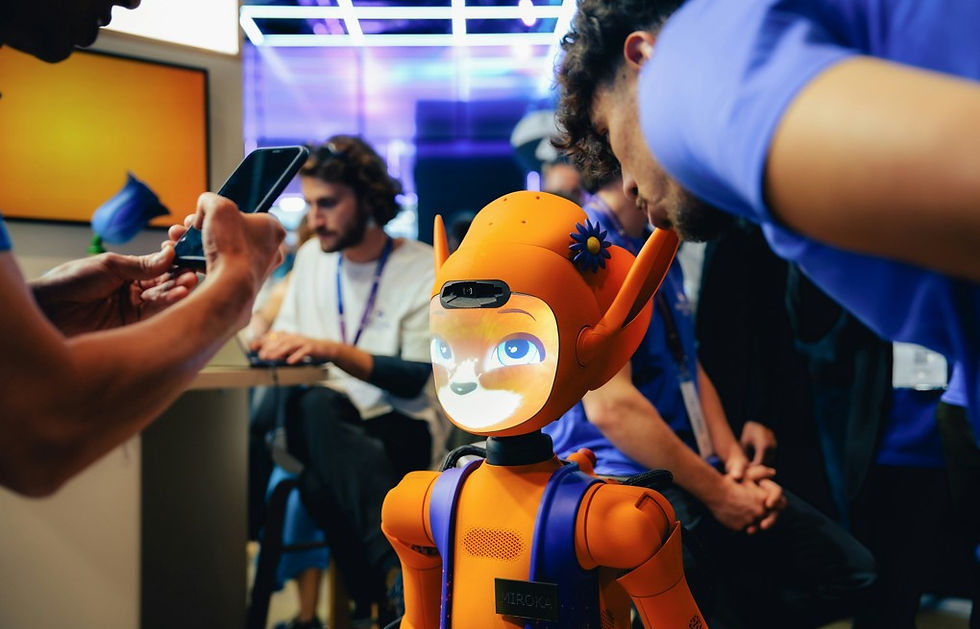
Can AI really do customer strategy?
Over the last few weeks, I've written about how AI is changing the way brands diagnose and improve customer engagement. This week, I want to close that run with the obvious question.
If AI is this good, what's left for the humans? The best evidence we have says quite a lot.
In 2023, researchers from Harvard Business School and Boston Consulting Group ran a field experiment with 758 BCG consultants, published as Navigating the Jagged Technological Frontier. On tasks within AI's capabilities, consultants using AI completed 12.2% more tasks, 25.1% more quickly, with more than 40% higher quality than a control group. But on a task chosen to sit outside those capabilities, consultants using AI were 19 percentage points less likely to produce correct solutions than those working without it.
The researchers called this a jagged frontier. AI is brilliant at some tasks and confidently wrong at others that look just as easy. It doesn't tell you which is which. That's the real challenge in customer strategy. Not whether to use AI, but knowing where the edge is.
At Sway Outcomes, we have developed AI agents and trained them to use our six-level maturity model to analyse a brand's customer strategy. We understand where AI needs to stop, and expertise needs to kick in! If you're curious about where AI could speed up your own customer strategy, email me here, and we'll send you a free Customer Engagement Accelerator (CEA) report on your brand.
Where AI genuinely wins
1. Research at scale
Outside-in research used to take weeks. Reading reviews, app store comments, competitor programme terms, annual reports, and social chatter. AI does it in hours, and it doesn't lose concentration on page 400 of the reviews.
In our CEA work, this is where AI does most of the heavy lifting. It gathers evidence on a brand across all six levels of our maturity model far faster than a team could.
2. Spotting patterns
Give AI a few thousand customer comments, and it will pull out the themes. Delivery complaints clustering in one region. A reward nobody ever mentions. A competitor that keeps coming up in conversation. People tend to find what they expected to find. AI has no favourite theory to defend.
3. Drafting and iterating
First drafts of customer journeys, email copy, proposition options, and survey questions. AI gets you from a blank page to something worth arguing about very quickly. That's the real value. Not the draft itself, but how fast it gets you to a better conversation.
4. Personalisation at scale
This is Level 6 of our model. Predicting who's drifting, choosing the next best offer, and tailoring content across thousands of customers at once. No team can do that by hand.
Done well, it's the difference between a programme that talks to "members" and one that talks to people.
Where human judgement wins
1. Choosing the right question
AI answers the question you ask. It rarely tells you you're asking the wrong one. "How do we increase points redemption?" might be completely the wrong brief if the real problem is that customers don't value the rewards. Framing the problem is still the most valuable hour in any strategy project.
2. Reading culture and politics
Every recommendation lands in an organisation with history. The customer relationship management (CRM) team that's been burned before. The finance director who hates discounting. The store teams who'll quietly ignore anything they weren't consulted on. AI can't read the room, and strategy that ignores the room doesn't get implemented.
3. Creativity and emotion
AI is very good at average. It learns from what's already been done, so it drifts towards the middle. The ideas that make customers feel something–a surprise, a thoughtful gesture, a bit of personality– still tend to come from people who understand how customers feel. Loyalty is an outcome, not a mechanic, and emotion is a big part of that outcome.
4. Ethics and trust
A model might be able to spot that a customer is struggling financially or going through a big life change. That doesn't mean you should act on it the way the model suggests. Someone has to decide what's fair, what's creepy, and what's off limits. That's a values call, not a data call.
5. Checking the output
This is the one most teams skip. AI writes with total confidence, whether it's right or not.
The University of Melbourne and KPMG surveyed more than 48,000 people across 47 countries for their 2025 global study on trust, attitudes, and use of AI. In the study's workplace findings, 66% said they rely on AI output without evaluating its accuracy, and 56% are making mistakes in their work because of AI.
Pause on that. That's a lot of people not checking. Somebody with real experience has to verify the facts, test the logic, and ask the simple question: does this actually make sense for this brand?
Customers are watching too
Customers have their own views on AI, and they're cautious. The same University of Melbourne and KPMG study found that only 46% of people globally are willing to trust AI systems. Salesforce's State of the AI Connected Customer report, based on a 2024 survey of over 15,000 consumers in 18 countries, found that nearly 75% of consumers want to know if they're communicating with an AI agent.
So customers aren't against AI. They just want to know when it's being used and to know a person is there if it goes wrong.
That has practical consequences. Be open about where AI is used. Make it easy to reach a human, and never let an automated decision do something to a customer that you wouldn't be happy to explain to their face.
Trust takes years to build, and one bad automated message can dent it. I talked about why that relationship matters so much in my interview on why customers stay and what brands often get wrong.
Building a human-in-the-loop process
The answer is a clear split of who does what. Here's how I'd set it up. Start by sorting your decisions into three groups. Things AI can do on its own, like testing subject lines. Things AI can recommend but a person signs off on, like segment strategy or offer design. Things that stay human, like pricing, the use of sensitive data, and anything that changes how a customer is treated.
Then follow a simple rhythm for every piece of strategy work:
People frame the question. Agree on the problem before anyone opens an AI tool.
AI gathers and drafts. Let it do the volume work, research, patterns, and options.
People verify. Name one person who owns the output and checks every claim against its source.
People decide. The final call sits with someone who understands the brand, the customers, and the organisation.
One more habit. Test your AI tools on something you already know the answer to. You'll quickly learn where your own jagged frontier sits.
This is exactly how we run the CEA at Sway. AI does the research heavy lifting in days rather than months. Experienced people check every finding and make the judgement calls. Neither would be as good alone.
Frequently asked questions
Will AI replace customer strategy consultants? Not the judgement part. AI is already replacing much of the manual research and first-draft work, which makes strategy faster and cheaper. But choosing the right question, reading the organisation, and making ethical calls still need experienced people.
How do you check if AI output is accurate? Ask the AI to cite where each fact came from, then check the important ones against the original source. Test it on questions you already know the answer to, and always have a named person who owns the output before it's used.
Do customers trust brands that use AI? Many are cautious. Only 46% of people globally say they're willing to trust AI systems, and most consumers want to know when they're dealing with AI. Being open about where you use it and offering an easy route to a human goes a long way.
Use AI, keep judgement
AI is the best research assistant customer strategy has ever had. It's a poor decision-maker. Use it for speed and scale, and keep people firmly in charge of the questions, the checking, and the final call.
If you'd like an outside view, my team at Sway Outcomes runs a free Customer Engagement Accelerator (CEA). It's this balance in practice: AI researches your brand from the outside, then our team verifies the findings and scores you across all six levels of customer engagement maturity.
To get your free CEA report, email me here or message me on LinkedIn.
Visit my website for more info!
Read more from Tom Peace
Tom Peace, CEO & Founder of Sway Outcomes
Tom Peace is a customer engagement strategist who helps brands turn transactions into lasting relationships. Under his leadership, The Loyalty People became a globally recognised brand within the loyalty industry, with a rapidly growing and highly engaged following. He went on to found Sway Outcomes, a consultancy that goes beyond loyalty programme strategy to cover every aspect of customer engagement. Its maturity model has six levels and shows brands exactly where they stand and what to do next. By combining deep sector expertise with diagnostics enabled by artificial intelligence (AI), Tom delivers strategic clarity in weeks rather than months for brands such as Sally Beauty, Wingstop, Vans, The North Face, and Saudi German Health.







