What A Bicycle Made For Two Taught Me About Letting Go
Updated: Sep 28, 2021
Written by: Deirdre Morrison, Executive Contributor
Executive Contributors at Brainz Magazine are handpicked and invited to contribute because of their knowledge and valuable insight within their area of expertise.

Have you ever ridden a tandem? You know, one of those funny-looking bicycles for two cyclists?
I did recently. On a number of levels, it was an amazing experience, and one that I’d strongly recommend as an exercise in self-awareness.
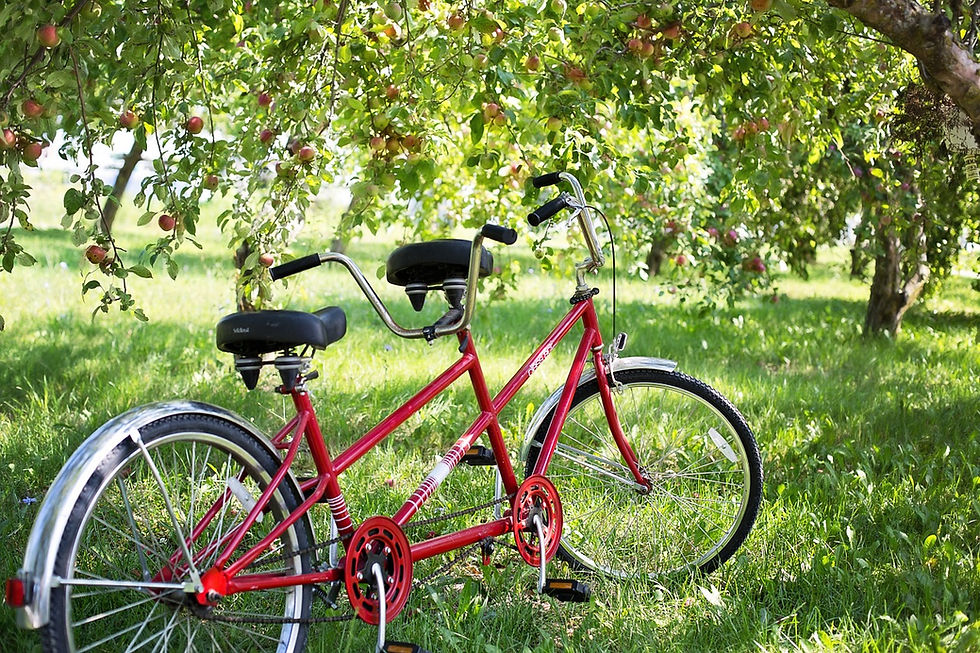
As I rode down a muddy trail on the back of the bicycle made for two, I realised that riding a tandem is a great metaphor for life, love, business, and in many ways, the inner workings of our brains.
Riding a tandem, as I was told before setting off, is all about communication. The owner told me she wouldn’t be at all surprised if I ended up in tears, or fell off within the first few minutes. But off we set, regardless.
Technically speaking, I was the stoker. That’s the person who sits at the back. The person at the front is the pilot. It’s widely agreed that the rear is where all the work gets done. But to be absolutely fair, the front takes the bulk of the responsibility.
Give me the grunt work anytime over the idea that we might both crash and injure ourselves if I forgot to communicate something to my partner, or misjudged a turn.
So each has a role, and they are not the same. They both carry weight, and they really need to understand each other.
Communication, as I mentioned, is the key. But that’s not a one way street either. The stoker needs to help the pilot refine the information they communicate - let them know what information would be useful to have.
But as I sat on the back, giving it all my little legs could give it, something dawned on me.
I realised that I was trying to take control of a journey I couldn’t see. I was trying to steer the bike without knowing where it was headed.
I was, infact, working against my pilot. The urge to be autonomous, to determine where I was going, even when I couldn’t see what was ahead of me, was so strongly wired into me, that I actually ran the risk of scuppering the whole adventure.
I noticed that I was grasping the (pretty pointless) handle bars too firmly, as I tried to ‘steer’ the bike. I realised that that I was probably making it harder work for my partner than it needed to be.
I needed to trust that the pilot had things in hand, and let go.
Let go.
It was a bit of a light bulb moment.
I consciously loosened my grip.
I trusted that this person sitting in front could see where we were going, and knew how to get us there.
I took my hands off the bars altogether, and gave up that need to control something that was, essentially, beyond my control.
And you know what?
All of a sudden, it became a more pleasant experience. I could focus on what I was supposed to do - pedal! I could look around and enjoy the scenery. I could enjoy the smiles on the faces of everyone we passed.
And those smiles were so warm and genuine. Seeing a tandem go by just seems to make people happy. And I’m still not sure if it’s about the novelty, the silliness or some underlying recognition that this is an activity that requires the sort of integrated approach and mutually supporting roles that we could all benefit from having, and being, with others AND within ourselves.
We need to communicate effectively to ensure we’re moving in the right direction, as efficiently as possible.
We need to do our bit, but also trust that others are doing theirs. Without trust, we’re just making it harder for ourselves.
We are all stokers AND pilots. We are all the power AND the direction.
It’s never one or other - we need both to get to where we’re going.
Deirdre Morrison, Executive Contributor Brainz Magazine
Deirdre Morrison is the founder of The Ambition Incubator platform and podcast. Her mission is to deliver practical tools from the field of neuroscience to help entrepreneurs and leaders be happier, healthier, more effective and successful in all the areas of their lives that matter to them.
Deirdre is a proponent of life-long learning, an interest that ultimately led her to study applied neuroscience.
She works with individual clients and runs group programmes, including The Ambition Incubator Collective, which specifically helps women who have taken a child-care career break to pull off the post-parenting pivot often necessary to reboot their careers.
Her other interests include the Japanese sword art of Kendo, road cycling, and reading. She runs free weekly development groups based on dynamic co-readings of business classics.