Unfinished Lives & Why Some People Carry Memory More Strongly
Updated: Apr 14
Stephanie Smit, also known as Giek, is a visionary artist and reincarnation researcher. She bridges art, mysticism, and esoteric science to uncover past lives, guide spiritual awakenings, and help others align with their soul purpose.

Over the years, in my work researching recurring identity patterns across time, often explored through frameworks such as reincarnation, archetypal continuity, and memory-based perception, one observation has consistently returned. Not everyone carries memory in the same way.
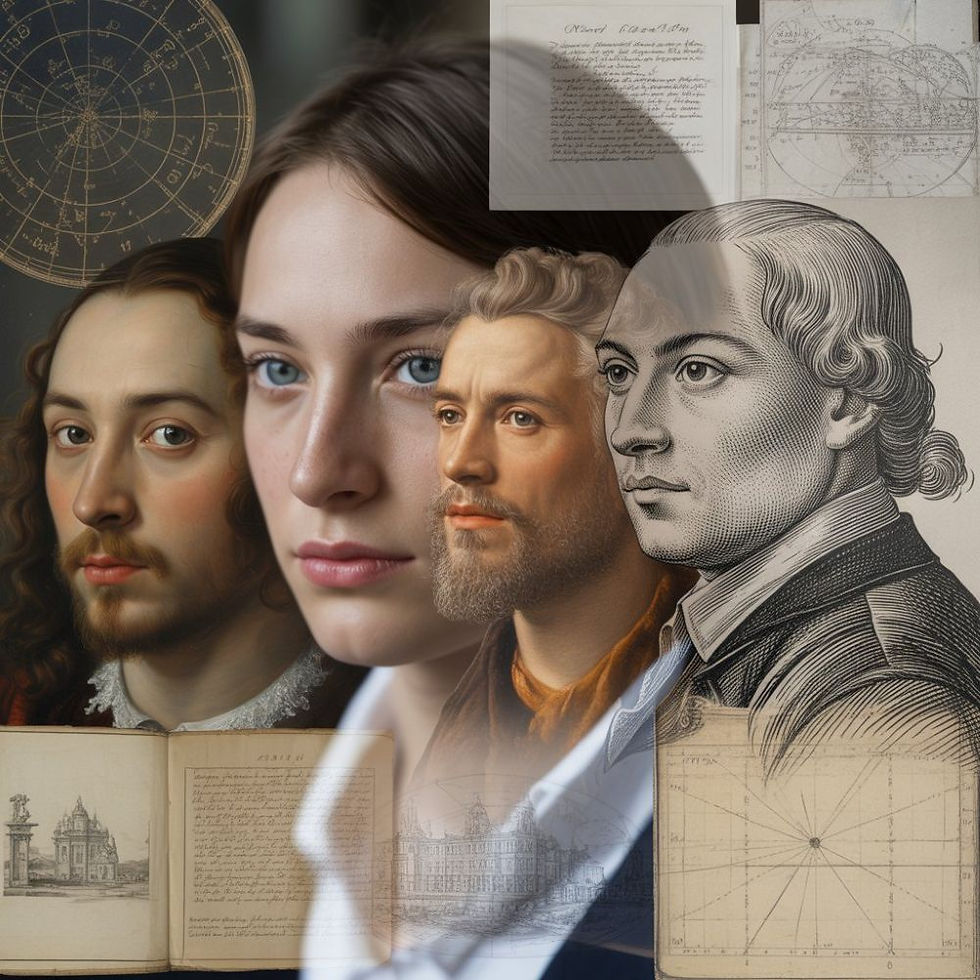
Some people move through life relatively unburdened by the past. Others seem to carry something denser, a kind of unresolved intensity that shapes how they relate to their talents, their visibility, and their direction. Interestingly, this often appears in individuals who are highly talented, perceptive, or unusually driven.
A pattern begins to emerge, the bigger the life, the more intense the after-pattern. This pattern does not depend on a fixed belief in reincarnation to be meaningful. Whether interpreted psychologically, archetypally, or spiritually, the structure itself is observable.
What I mean by “unfinished lives”
By “unfinished lives,” I am referring to patterns of interrupted momentum. These may include creative trajectories that were cut short, public lives that collapsed at their peak, or individuals who were silenced, exiled, or abruptly removed from their path. In historical biographies, we repeatedly encounter lives that build toward expression and recognition, only to end before that expression stabilizes.
What remains is not necessarily a memory in the conventional sense, but a kind of unresolved direction. A movement toward something that was not fully completed.
When this pattern reappears, it does not always show up as a clear narrative. More often, it manifests as tension, a pull toward expression combined with an equally strong resistance to it.
Trauma as momentum that doesn’t dissolve
In many cases, this unresolved pattern carries a traumatic charge. It tends to manifest as an underlying expectation that visibility is dangerous, expansion leads to loss, or success cannot be sustained.
Across my research, certain types of endings seem to correlate with stronger continuation patterns:
Sudden or premature death
Public humiliation or persecution
Betrayal by institutions or audiences
Fame followed by collapse
Punishment for visibility or expression
When these kinds of experiences remain unresolved, they can reappear as subtle behavioral patterns in a later life context.
I often work with individuals who are technically ready to move forward. They have the skill, the vision, the opportunity, yet something in them pulls back at the moment of expansion.
This can take many forms. It may appear as a fear of being seen, as subtle self-sabotage at key moments, or as a difficulty sustaining success once it begins. In other cases, it shows up through recurring cycles of instability financially, relationally, or both, often accompanied by a persistent, unspoken expectation that things will eventually fall apart.
Rather than viewing this as a lack of discipline or confidence, it can be more accurate to understand it as unresolved momentum, a pattern that has not yet found completion.
Why certain talents keep returning
Alongside these patterns of tension, there is often something else, continuity of talent. Some individuals display a strong familiarity with specific forms of expression, even without extensive training. Others feel an immediate connection to certain disciplines, historical periods, or creative languages.
This is not simply about skill acquisition. It is about recognition. A sense that something is already known.
In this context, the more productive question is not “Was I this person?” but rather, what structure of talent keeps re-emerging?
When approached this way, identity becomes less important than pattern. The focus shifts from claiming a past to understanding a continuity. I explore this distinction more extensively in an earlier article on what we are really remembering, where past-life memory is approached through archetypal and collective frameworks rather than fixed identity.
Why some people carry memory more strongly
Not everyone experiences these patterns with the same intensity. From a research perspective, several factors seem to increase the strength of recurrence:
The scale or intensity of prior expression
Abrupt interruption of a developing trajectory
A strong public or archetypal role
Emotional charge attached to creative output
Repeated interaction within similar relational or cultural environments
Put simply, the stronger the imprint, the stronger the echo. This does not make the pattern more “true,” but it does make it more noticeable, both internally and externally.
The fear of success pattern
One of the most consistent manifestations of this dynamic is what could be described as a fear of success. This does not operate at the level of effort or ambition, but in the relationship to visibility itself, in how expansion is experienced internally.
Highly capable individuals may find themselves underplaying their abilities, hesitating at the point of exposure, or recreating struggle even when stability is within reach. In some cases, they withdraw just as recognition begins to build, as if something in them resists being fully seen.
From a psychological perspective, this can be understood as conditioning. From a pattern-based perspective, it reflects a deeper association between visibility and risk.
When earlier trajectories link expression to instability, whether through isolation, collapse, or punishment expansion, it no longer registers as purely positive. It becomes charged.
The result is a kind of internal contradiction, a strong drive to express, paired with an equally strong impulse to contain that expression.
Can these patterns be integrated?
If these patterns are understood as unfinished movements rather than fixed identities, they can also be approached as something that can be completed.
In practice, this may involve recognizing recurring behavioral and emotional structures, working with regression or memory-based techniques, and identifying timing patterns that influence expansion and contraction. It can also include consciously finishing what was previously interrupted, often through creative output, and reframing visibility as something that can be stable rather than destabilizing.
I explore this process of identifying and reworking deeper subconscious patterns in more detail in a previous article on reprogramming the subconscious, where past-life imprints are approached as structures that can be consciously shifted.
The goal is not to confirm a past, but to stabilize the present. When the underlying pattern is seen clearly, it becomes possible to move forward without repeating the same cycle.
What returns is not the person
What seems to return is a combination of identity and direction, a movement toward expression that has not yet reached completion.
When that movement remains unconscious, it can destabilize. When it is recognized and integrated, it can become a source of clarity and strength. In that sense, recurring talent is both a gift and an invitation.
Not to repeat the past, but to finish what was left unresolved. And perhaps that is why, for some people, memory feels stronger. Not because more is remembered, but because more is still in motion.
In some cases, these patterns are not even carried individually, but appear across multiple people simultaneously. This is something I explore further in an article on shared past-life memory and collective patterns.
Continuing the exploration
For those who wish to explore these themes more deeply, I offer sessions focused on identifying recurring patterns, creative blocks, and underlying structures that shape how talent and expression unfold over time.
Readers interested in the broader research context can explore my ongoing work and projects, including Reality Cult and IWasJimMorrison.com, where I examine questions of memory, identity, and continuity through both artistic and investigative approaches. Updates and further developments are also shared through my newsletter.
My artistic practice extends this research into performance and creative experimentation, approaching these patterns as something that can be worked with, expressed, and integrated through embodied and symbolic processes.
For additional perspectives and practical tools, you can also explore my other Brainz Magazine articles, where I further unpack subconscious patterns, recurring identity structures, and the dynamics that shape how we move through our lives.
Each of these explorations forms part of a broader inquiry into how patterns repeat, evolve, and can ultimately be brought into conscious expression.
Stephanie Smit, Reincarnation Researcher, Multidisciplinary Artist, and Spiritual Guide
Stephanie Smit (Giek) is a visionary, multidisciplinary artist and independent reincarnation researcher. Through her work, she bridges experimental art, esoteric science, and intuitive guidance to help others uncover past lives and activate soul remembrance. She has uncovered over 250 past lives for clients using a unique method combining astrology, tarot, and Akashic insight. Her projects have been showcased at major museums and festivals across Europe, including the Van Gogh Museum and Harvard Divinity School. She also develops sacred performances, poetic lectures, and zero-waste fashion inspired by her visions. Giek's mission is to awaken spiritual sovereignty and co-create a New World rooted in divine creativity and karmic truth.