The Retirement Wave is Here and What Selling Your Practice to a New Doctor Really Looks Like
Written by Quintin Gunn, Chief Strategic Officer
Quintin Gunn is a Chief Strategic Officer (CSO) at Help My Medical Practice and draws on more than 25 years of experience in healthcare consulting and practice growth. He helps underperforming medical practices become more patient-focused, profitable, and operationally efficient.

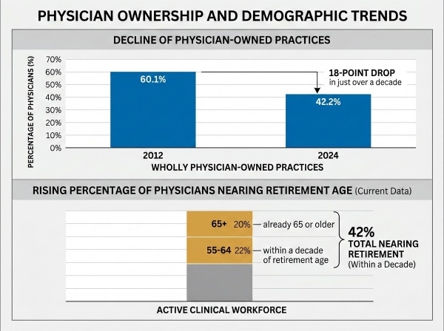
Nearly half of the physicians currently seeing patients in the United States are close enough to retirement that the decision about what happens to their practice is no longer theoretical. It's active. Physicians aged 65 and older now make up roughly 20% of the active clinical workforce, and another 22% are between 55 and 64, meaning more than four in ten practicing physicians are within a decade of traditional retirement age.[1] The Association of American Medical Colleges (AAMC) puts it plainly: more than a third of the currently active physician workforce is likely to retire within the next ten years.[2]

That demographic reality is colliding with a second trend: private practice itself is disappearing. Only 42.2% of physicians worked in a wholly physician-owned practice in 2024, down from 60.1% in 2012, an 18-point drop in just over a decade.[3] The share of physicians who hold any ownership stake at all fell from 53.2% to 35.4% over the same period.[3] Every year, fewer practices are physician-owned, and the physicians who still own theirs are getting older.
If you own a practice today, this is the environment you're planning an exit inside of: a large wave of colleagues retiring at the same time, a shrinking pool of privately owned practices, and increasingly aggressive buyers circling every listing that comes to market.
The retirement wave, by the numbers
The scale of this transition is easy to state and hard to overstate:
20% of active physicians are already 65 or older, and another 22% are between 55 and 64, putting more than 4 in 10 practicing physicians within a decade of retirement age.[1]
The AAMC projects a U.S. physician shortage of 13,500 to 86,000 doctors by 2036, driven largely by this retirement curve.[2]
Nearly 39% of active physicians say they plan to retire early, and a 2024 Medical Group Management Association (MGMA) survey found 27% of medical groups had already lost a physician to early retirement tied to burnout.[1]
Physician-owned private practice fell from 60.1% (2012) to 42.2% (2024) of all physicians, and ownership stakes fell from 53.2% to 35.4% over the same period.[3]
Among physicians under 45, ownership dropped from 44.3% to 31.7% between 2012 and 2022, a much steeper decline than among physicians nearing retirement.[3]
Why so few practices have an exit plan
Knowing the wave is coming and being ready for it are two different things. Survey after survey shows the same gap:
Sixty-nine percent of physician organizations report they don't have a succession plan in place for physician retirements.[4]
Only 16% of administrators report having a formal, written physician succession plan, even though they rate the importance of having one at 7.5 out of 10.[4]
In an MGMA member survey, 52% of practices said they had no succession plan of any kind at the time they were asked, and only about 37% had one specifically for physician owners.[1]
Without a plan, the timeline that specialty guides recommend, starting five to ten years ahead of a planned ownership transition, or at minimum a year ahead of any sale,[5] quietly disappears. Practices that wait until retirement is imminent end up negotiating from a weaker position, with fewer buyers to choose from and less time to make the practice look its best on paper.

Who's actually buying practices right now?
The buyer landscape has shifted dramatically, and it's worth understanding before you decide who you want to sell to.
Corporate entities, private equity firms, and insurers now own more physician practices than hospitals do. As of early 2026, corporate ownership (33.2% of practices) has overtaken hospital ownership (30.6%) for the first time.[6]
In 2024, 6.5% of physicians worked in private equity-owned practices, up from 4.5% in 2022 [3].
Since 2024, hospitals have acquired roughly 5,800 physician practices, and corporate buyers have acquired more than 8,000.[6]
Physician practice deals captured a record 46% share of first-quarter 2026 healthcare mergers and acquisitions (M&A) volume, up from 37% a year earlier, and deal counts grew 18% year over year, making physician groups the most active subsector in health services M&A.[6]
Healthcare-focused private equity investment hit an estimated $191 billion globally in 2025, a new record.[7]

Meanwhile, on the physician side, appetite for ownership hasn't disappeared, it's just being squeezed out. In one survey, 37% of physicians said they'd be interested in ownership opportunities even though they don't currently hold one, and physicians overwhelmingly (52% vs. 22%) believe ownership is decreasing across the profession.[8] Younger physicians in particular are showing renewed interest in physician-led settings: nearly 25% of physicians in health-system-led organizations are considering a change of employer, and 37% of those say they want to move to a physician-owned practice.[7]
The case for selling to a new doctor instead of a corporate buyer
Given how aggressively private equity and hospital systems are buying, why would you sell to an individual physician or small group instead?
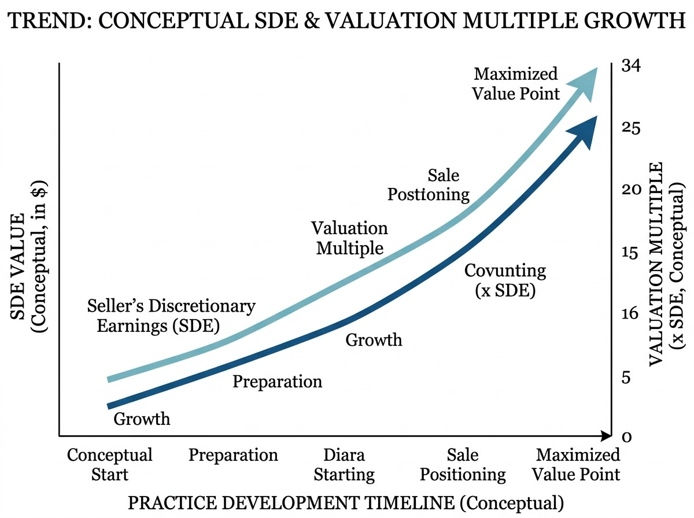
Faster, simpler transitions. A practice sale case study comparing two similar-sized practices found that an associate-driven sale, selling to a physician already working inside the practice, closed in 3 to 6 months, versus 18 to 24 months for a doctor-centered practice sold to an outside buyer, and still commanded a higher valuation multiple (3.6x Seller's Discretionary Earnings (SDE) vs. 2.8x SDE).[9]
Patient continuity and legacy. Selling to a new doctor who intends to practice medicine in your community, rather than a financial buyer optimizing for portfolio returns, keeps your patient relationships, your staff, and your practice's reputation intact. That continuity is often the deciding factor for physicians who built a practice around a specific community.
Less regulatory complexity. Sales between physicians typically involve more straightforward fair market value (FMV) determinations, since anti-kickback and Stark Law concerns are heightened whenever a sale price could be read as compensation for referrals.[10]
A ready pipeline of interested buyers. With ownership opportunities shrinking industry-wide, motivated young and mid-career physicians who want to run their own practice are actively looking. They just need to find practices that are positioned, priced, and marketed for them to find.

How valuation works when you sell to a physician buyer
Most independent practices are valued using Seller's Discretionary Earnings (SDE) net profit, plus owner salary, personal expenses run through the business, depreciation, and one-time costs multiplied by an industry-specific multiple, commonly 4.0x to 8.0x for practices under $5 million in revenue.[11] Practices with an established patient panel, favorable payer mix, and more than one physician tend to land at the higher end of that range.
By specialty, buyers are currently paying (in earnings before interest, taxes, depreciation, and amortization (EBITDA) multiples):
Specialty | Add-on / smaller practice multiple | Platform-scale multiple |
Primary care (family/internal medicine, pediatrics) | 3x to 6x | 8x to 12x |
Orthopedics and sports medicine | 6x to 9x | 9x to 13x |
Cardiology | 8x to 12x | 12x to 15x |
Obstetrics and gynecology (Ob/Gyn) and women's health | 5x to 8x | 10x to 14x |
Ophthalmology (including retina) | 7x to 11x | 12x to 20x |
Oncology and urology | 8x to 12x | 14x to 19x |
Valuation methodology generally follows one of three approaches: the income approach (discounted future cash flow, the most common method), the cost approach (tangible plus intangible assets, including goodwill), and the market approach (comparable local sales) [5]. Whichever method is used, the sale price must reflect fair market value. Federal anti-kickback and self-referral rules require this, especially when the retiring physician will continue seeing patients post-sale.[10]
Most practice sales, physician-to-physician or otherwise, take 7 to 10 months from initial valuation to close, moving through confidential valuation, buyer marketing, negotiation and due diligence, and finally closing and transition.[11]
Preparing your practice to attract a physician buyer
The practices that sell fastest, and for the strongest multiple, share a few things in common before they ever go to market:
Clean, separated financials. Buyers need to see practice performance independent of the current owner's personal compensation and expenses. Financial statements that clearly isolate SDE make due diligence faster and valuation more defensible.
Documented payer contracts and reimbursement rates. A practice with strong, well-documented commercial payer relationships consistently commands a higher multiple than one with an unclear or heavily Medicare-weighted payer mix.
An associate or transition track already in motion. Practices where a younger physician is already integrated into patient care close faster and at higher multiples than practices requiring a buyer to build trust with an entirely new patient panel from scratch.
A visible digital presence. A prospective physician buyer will research your practice online before ever picking up the phone, the same way a patient would. A strong web presence, current patient reviews, and clear online information about the practice's services and reputation directly support the valuation story you're telling a buyer.
Organized legal and compliance documentation. Articles of incorporation, payer contracts, employment agreements, leases, and a compliance plan should be assembled well before a buyer ever asks for them.[10]

The window is open, for now
The physician retirement wave isn't a future event. It's already underway, and it's reshaping who owns American medical practices faster than most owners have planned for. Practices that start preparing now, cleaning up financials, building a visible reputation, and creating a real pathway for a physician successor, are the ones capturing higher multiples and faster, smoother transitions. Practices that wait are increasingly finding themselves negotiating against corporate buyers on someone else's terms.
If you're a practice owner thinking about your own timeline, the earlier you start positioning your practice, the more control you keep over who it goes to next and what happens to the patients and staff you've built it around.

Read more from Quintin Gunn
Quintin Gunn, Chief Strategic Officer
With over 25 years of Practice Development and Medical Marketing experience in the healthcare industry, and formerly with Social Media Solutions For Doctors. Quintin has helped with the growth and profitability of many practice groups in multiple specialties, such as Aesthetics, Med Spas, Cosmetic, Orthopedic, Sports Medicine, Integrative Health, Primary Care, Osteopathic, Ophthalmology, Brain and Spine, Regenerative Medicine, Anti-Aging and/or Age Management, along with Weight Loss and Chiropractic. Helping doctors and medical practices sell more than 5 million in patient treatments and medical services through practice development.
Sources:
[1] MGMA
[2] AAMC
[3] AMA
[7] Bain & Company
[11] John Salony M&A