Before You Were Born, Your Body Was Already Listening
Updated: Sep 3
Nadija is a multi-award-winning trauma and empowerment specialist with a double diploma in hypnotherapy, mind coaching, and online therapy. She is also a Reiki Master and a grief educator, and she has been trained by international grief specialist and best-selling author David Kessler. Nadija is also an end-of-life doula.

What if your story began before you had a voice? Before your first breath, before your first cry, before your first memory? We often speak about trauma as something that happens after birth. The childhood we survived, the relationship that broke us, the abuse, neglect, violence, abandonment, or loss that changed us. But human development begins earlier than most of us realise. It begins in the womb.
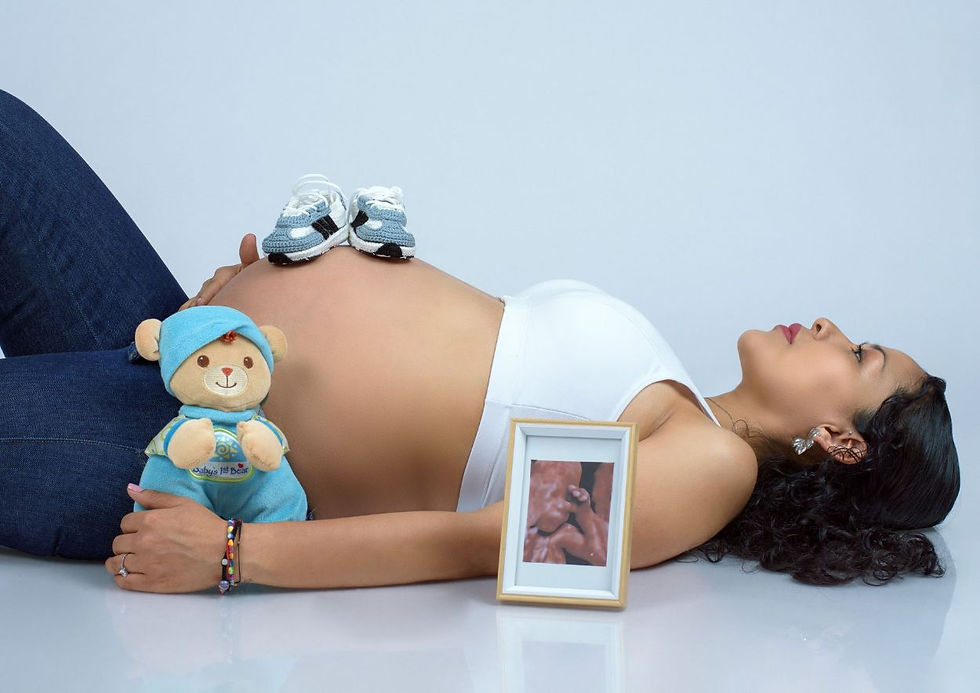
Research increasingly shows that the prenatal environment can influence aspects of foetal and infant brain development, stress response systems, and biological regulation.
This does not mean an unborn baby consciously remembers every argument, every tear, or every difficult day. It does not mean that a mother experiencing anxiety during pregnancy has automatically “traumatised” her baby.
It certainly does not mean mothers should carry another burden of guilt. It means something much more nuanced, the developing human being is biologically sensitive to its environment.
The womb is our first environment
The womb is not simply where we grow. It is our first biological environment.
Through the placenta, the developing foetus is connected to the mother's physiological environment while its brain and nervous system develop.
Scientists study systems such as the hypothalamic pituitary adrenal (HPA) axis, which plays an important role in the body's stress response.
Stress itself is not inherently harmful. Our bodies are designed to respond to challenges. But severe and prolonged stress is different.
Research has found associations between significant maternal stress, anxiety, and depression during pregnancy and differences in aspects of foetal and infant brain development, including areas involved in emotion and stress regulation.
Scientists are also exploring epigenetics, how environmental experiences can influence how certain genes are expressed without changing our DNA itself. Research has found associations between prenatal stress and epigenetic changes involving genes connected with stress regulation, although this science is still developing.
But let us be very clear, association does not equal destiny.
Genetics, nutrition, birth, relationships, childhood experiences, and the environment after birth all matter. The prenatal environment is one part of a much bigger story.
Your body can learn before your mind can remember
When I speak about prenatal trauma, I am not suggesting that a foetus has the same conscious psychological experience of trauma as an adult.
We are talking about biological adaptation. The developing nervous system responds to signals from its environment.
The body does not need conscious language to adapt. It learns through biology. It learns through patterns. Some of that biological learning begins before birth.
But here is what matters most, your beginning is information. It is not a life sentence.
This is where I want to protect mothers
There is a danger in talking about prenatal stress without talking about maternal guilt.
A pregnant woman may hear that stress can influence development and immediately ask, “Did I damage my baby?”
No. That is not the message.
Pregnancy is not nine months of emotional perfection. Women experience grief, fear, financial pressure, relationship difficulties, illness, trauma, and loss.
Sometimes women are simply surviving.
Instead of telling pregnant women to “stay positive,” perhaps we should ask, “What support does this woman need?”
If maternal wellbeing matters to prenatal development, the answer is not to blame mothers. The answer is to support them.
Give them safety. Give them compassion. Listen to them. Believe them. Help them.
Supporting the mother is part of creating healthier beginnings.
Trauma is not only what happened after birth
This is the conversation I believe we need to have.
When someone tells me, “I do not understand why I am always on high alert,” “I do not understand why I struggle to trust people,” or “I do not understand why I cannot relax,” there may not be one simple explanation.
Sometimes the answer is in childhood. Sometimes adulthood. Sometimes biology, temperament, or genetics. Sometimes significant prenatal adversity may be part of a much larger developmental story.
Human development is a continuum, before birth, birth, infancy, childhood, adolescence, and adulthood.
Every stage matters. But none of them tells the entire story.
We are more complex than what happened to us.
This is where I want to bring you back to empowerment. If our earliest environments can influence us, our later environments can influence us too. If the brain can adapt to adversity, it can also adapt to safety. If the nervous system can learn hypervigilance, it can learn regulation. If the body can learn survival, it can learn that survival is no longer necessary.
We are not frozen in time. Neuroplasticity reminds us that the brain remains capable of change. You can learn, heal, regulate, build healthier relationships, challenge inherited patterns, and become the person who breaks the cycle.
Your beginning is not your destiny
Maybe your mother experienced profound stress while pregnant with you. Maybe she was grieving. Maybe she was frightened. Maybe she was living through circumstances you will never fully know.
Please hear me, you do not have to spend your life blaming her.
Understanding is not blaming. Understanding gives us context, and context can create compassion.
Perhaps your body learned vigilance before you ever understood what vigilance was. Perhaps you became someone who needs control because uncertainty feels unsafe. Perhaps there is a reason.
But a reason is not a sentence.
Your past may explain you. It does not have to imprison you.
Breaking cycles does not require us to hate the generations before us. Sometimes it requires us to understand them and then consciously choose something different.
You are here now
Maybe your story began before your first breath. Maybe your body encountered signals of stress before your conscious mind existed. Maybe some of your earliest adaptations were formed in an environment you never chose.
But listen carefully, you are here now, and that matters.
You can learn, heal, regulate, build safe relationships, choose differently, become the safe adult you once needed, and create a different emotional environment for the next generation.
You can stop asking, “What is wrong with me?” and begin asking, “What happened, what did my body learn, and what is it ready to learn now?”
That question changes everything.
Because healing is not about pretending the past didn’t happen. Healing is about refusing to let the past have the final word.
Your story may have started before you had words
But you are holding the pen now, science is teaching us that the prenatal environment matters. Trauma research is teaching us that the nervous system matters. Neuroscience is teaching us that the brain can change.
Human experience keeps reminding us, we are capable of transformation.
Your beginning matters. Your history matters. Your biology matters. Your experiences matter. But none of them get to decide who you become.
You are not broken because your nervous system learned to survive. You are not weak because you react to things others seem able to handle. You are not doomed because your story began with circumstances you did not choose.
Your body was always trying to protect you, and now, with awareness, compassion, and the right support, you can begin teaching it something new, safety, trust, connection, and possibility.
Your story may have started before you had words. But you are holding the pen now, and you get to write what comes next.
Read more from Nadija Bajrami
Nadija Bajrami, Strategic Hypnotherapist, Mind Coach
French by birth, Nadija lived in Scotland for seven years and travelled the world. After recovering from some serious health issues, Nadija had a wake-up call and came to Ireland to find her path. She has been living in Dublin since 2017. Nadija works mostly online worldwide and shares her time between Ireland, France, and Switzerland. Nadija is a multi-award-winning trauma and empowerment specialist with a double diploma in hypnotherapy, mind coaching, and online therapy. She is also a Reiki Master and a grief educator, and she has been trained by international grief specialist and best-selling author David Kessler. Nadija is also an end-of-life doula. She is dedicated to helping her clients get empowered, supercharge their confidence and self-esteem, overcome their limiting beliefs, and manage anxiety and trauma responses. She also helps people on their grief and healing journeys through her therapy, coaching, grief education and support programmes, and spiritual work.