The Hidden Trauma of Animals Used for Human Entertainment
Updated: 3 hours ago
Dr. Louise Hurst is a Somatic Trauma-Informed Coach and Narcissistic Abuse Specialist whose work sits at the intersection of neuroscience, embodiment, and lived experience. With a PhD in Neuroscience and 16 years in healthcare communications, she brings scientific depth and emotional attunement to her coaching sessions.

I recently returned from a trip to Rome, where I visited the Colosseum, a remarkable historic structure that has stood the test of time for nearly two thousand years. The Colosseum had long been on my travel bucket list. Yet, as I listened to the tour guide describe the inauguration of the amphitheatre by Emperor Titus, during which 5,000 animals were slaughtered in a single day, I felt a growing sense of unease.
As the sun poured through the large arches designed for the giraffes, lions, tigers, and bears, the feelings of injustice and death associated with this “great” historic place felt so tangible. Unfortunately, using exotic animals for entertainment is not a relic of the past. It remains part of the human experience in many countries around the world today.
Where my conservation story began
I started my academic career with a desire to become a conservationist. I grew up watching David Attenborough and went on to study zoology at the University of Manchester, later specialising in animal behaviour and neuroscience for my master’s degree. Today, I work as a medical writer and somatic trauma-informed coach specialising in narcissistic abuse. However, my passion for conservation and the protection of endangered species has never left me, and I now volunteer at a local wildlife sanctuary that rescues animals that have had a traumatic start to life.
Complex post-traumatic stress disorder and emotional pain in animals
As a society, we still struggle to understand that human trauma occurs in many settings, not only among war veterans. Trauma can arise from bullying, job loss, and divorce. Complex post-traumatic stress disorder (C-PTSD) can develop in relationships through repeated abuse, neglect, and betrayal. Yet, research into PTSD and animal behaviour is only now beginning to gather pace.
A recent study found that 82% of working donkeys in brick kilns display behaviours consistent with C-PTSD, including withdrawal, hypervigilance, and shutdown states. What looks like “stoicism” is often a form of learned helplessness, a survival response to inescapable stress and repeated abuse [1].
Concurrently, a 2026 review examining the loss of social bonds in nonhuman animals shows that separation triggers complex emotional, physiological, and behavioural changes, including grief-like responses and separation-related distress that can lead to prolonged affective stress [2]. This demonstrates that we cannot dismiss animal suffering as anthropomorphism. The emotional impact of loss is biologically real.
These animals all have mammalian brains wired similarly to our own. They need attachment, play, safety, and enrichment. They experience pain, fear, and confusion. Their nervous systems respond to trauma in ways that mirror ours, including heightened vigilance, dissociation, avoidance, and shutdown.
As the authors of the kiln study note, “failing to see those emotional parallels isn’t scientific objectivity, it’s empathic failure” [1].
Circus big cats
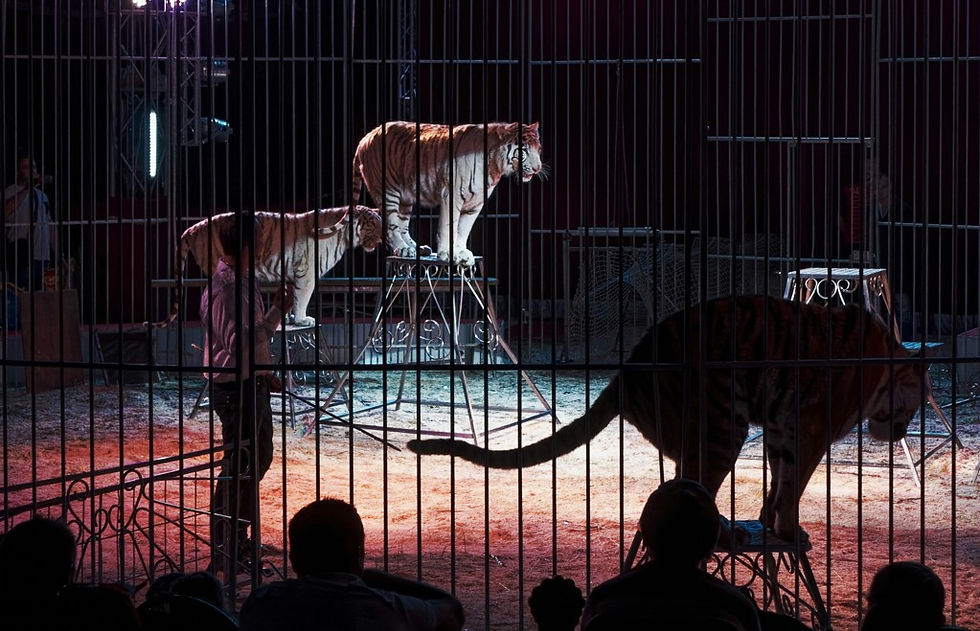
Across the US and Europe, big cats are still used in circuses for entertainment. These animals are forced to live in cramped cages, with their only respite being the brief performances they are made to endure.
Semi-nocturnal and solitary by nature, circus tigers are compelled to act against their instincts, performing during the day, in groups, under bright lights and amid loud noise. This often leads to fights, injuries, and chronic stress. Many circus big cats suffer deep psychological trauma. They are separated from their mothers too early, punished during training, made to perform with fire, or deprived of food as a form of control [3].
Restaurant bears
Eurasian brown bears (Ursus arctos arctos) were used in Ancient Rome for fighting in the arenas and are still used today for entertainment in countries such as Azerbaijan. Known as “restaurant bears,” they are kept in cages beside restaurants and used to entertain customers, living lives defined by confinement, deprivation, and human exploitation. To capture the cubs, poachers often kill the mother. The frightened cubs may initially flee, only to return to her body and be captured. Unless rescued, many restaurant bears will live under the human spotlight, unable to hibernate or display natural behaviours such as digging and foraging because of the concrete prisons in which they live [4].
The cost of denial
Circuses across Europe and the US still use big cats in their performances. Eurasian brown bears continue to be taken from their mothers and sold into the restaurant trade, where they are kept in cages for entertainment.
Denial keeps us comfortable for a while, but eventually, we must face the reality that humanity’s appetite for entertainment has reduced intelligent, sensitive animals to objects of dominance and control. Made to perform for human pleasure, they endure pain, deprivation, and long-lasting physical and psychological harm.
Taking action doesn't have to be loud. Choosing not to attend circuses that use animals is one small way we can help ensure this cruelty becomes a thing of the past.
When we walk through the Colosseum, we look back at animal suffering as part of a less enlightened age. Yet, across the world, animals continue to experience trauma for human entertainment. If we accept that these animals are capable of fear, attachment, grief, and psychological suffering, then our responsibility is clear. History should remain in the past.
For Zoppa (2012 to 2026), a beautiful and dignified tigress who touched my heart.
Read more from Dr. Louise Hurst
Dr. Louise Hurst, Somatic Trauma-Informed Coach
Dr. Louise Hurst is a Somatic Trauma-Informed Coach and Narcissistic Abuse Specialist. With a PhD in Neuroscience and 16 years in healthcare communications, she brings scientific depth and emotional attunement to her work. Her lived experiences of narcissistic abuse - both professionally and privately - led her to become a coach dedicated to helping others heal. Through her own therapeutic journey, she learned that trauma can't be processed effectively without including the body. She is the founder of Beauty for Ashes Coaching and Henka Medical Communications Ltd. Her mission: Helping survivors thrive after abuse.
References:
[1] Taylor, K., Harrison, A., and Capaldo, T. 2025. Stoicism or Defeat? The Psychological Impact of the Kiln Environment on Working Donkeys and Mules. Animals. 15(11):1525