

The Hidden Space Between Growth and Stability
Lauren Lea Fenn-Ellis, founder and CEO of OBM Associates, leads a globally trusted business management agency. Named one of the Top 10 Disruptive Entrepreneurs, she helps founders scale with clarity, strategy, and operational excellence.

Most businesses I work with haven’t stalled because they can’t grow. They stall because they grew faster than they matured. From the outside, everything looks impressive. Revenue’s climbing. The team’s bigger than last year. You’re booked out months in advance.

On paper? You’re winning. But behind the scenes. The Slack pings never stop. You’re approving things you shouldn’t still be approving. Your calendar is full, but not freeing.
This is the gap. The gap is the lag between growth and maturity. It's what happens when growth outpaces operational maturity. The lag between what your revenue suggests and what your structure can actually sustain.
And it doesn't show up in just one place, it surfaces at every level of the business.
At the founder level, it shows up as identity strain, loss of control, and exhaustion.
At the team level, as confusion, dependency, and inefficiency.
At the organisational level, as fragility, rework, and bottlenecks.
At the strategic level, as vision without execution and scaling without resilience.
Most founders feel all four at once. They just don't have a name for what they're experiencing. This framework gives you that name. And more importantly, it gives you a place to start.
Over years of working with founders at this exact inflection point, I've identified six gaps that show up consistently, in roughly this order, and usually in combination. Together, they form a diagnostic framework I use to audit any growing business. The goal is to find where structure hasn't caught up with ambition yet. Because once you can see it clearly, it's always fixable.
The framework: Six gaps between growth and stability
1. The gap between vision and execution
This is often the first gap to open, and the easiest to misdiagnose. The strategy is clear. The ambition is articulated. The plan exists, usually in a deck, a document, or a very well-run off-site retreat. The leadership team is aligned. Everyone leaves the room energised.
And then not much changes. Three months later, the same initiatives are relaunching. The same priorities are being restated. Momentum resets again, and the quarter begins to feel like a loop.
Vision lives in documents. Execution lives in the operating rhythm. When those two things are not connected by structure, by clear ownership, operational cadence, and decisions that actually stick, strategy becomes a recurring event rather than a compounding force. You end up spending enormous energy regenerating alignment that should already exist. Strategy cycles repeat. The same initiatives relaunch. Momentum resets every quarter.
Closing this gap means building the operating infrastructure that makes the right things happen consistently, without the founder having to be the engine behind every initiative.
In practice, that looks like a business where:
Strategic priorities translate into clear quarterly objectives.
Each objective has a single owner, not shared responsibility, in a project management tool.
Leadership teams meet on a predictable cadence to review progress and unblock decisions.
Metrics are visible, so performance isn’t dependent on intuition or updates in Slack.
Execution stops relying on energy and starts relying on structure. Momentum becomes something the business generates collectively, rather than something the founder has to constantly recreate.
2. The gap between growth and strain
Growth is visible. Strain is invisible. This is what makes the second gap so dangerous. You can see the revenue climbing. You can see the team expanding. What you cannot see, at least not until it is already costing you, is the strain accumulating underneath.
Strain shows up as decision fatigue. As emotional reactivity in leadership. As shortened time horizons, where you stop planning quarters and start managing weeks. As approval bottlenecks increase rather than decrease. As reactive hiring, bringing people in to fight fires rather than build capacity.
From the outside, this looks like a busy, growing business. Internally, it signals something more significant. The business has outgrown its absorption capacity.
A mature business absorbs growth. When new clients arrive, new revenue lands, and new team members join, the systems, structure, and leadership layer hold the weight without buckling.
An immature business amplifies growth into stress. Every new win creates a new pressure point. The bigger it gets, the more fragile it feels. The diagnostic question to ask is, when growth increases, does strain decrease?
In a structurally sound business, it should. More revenue, properly absorbed, should mean more breathing room. If that is not your experience, structure is lagging behind momentum. This is an architectural problem, and it is entirely solvable.
3. The gap between hiring and leadership
There is a point in most growing businesses where the founder thinks, If I just hire, this will get easier. Sometimes it does. Often it does not.
Hiring multiplies complexity. More people mean more communication loops, more opinions, more emotional dynamics, more decisions. When leadership style does not evolve at the same pace as headcount, the business gets noisier rather than smoother.
In the early days, founder-centred control works. You decide, you approve, you fix, you carry. It is fast, efficient, and it wins clients. But it does not scale. At some point, the business needs you to stop being the central nervous system.
That transition requires clear roles rather than the shared ambiguity of "we all kind of handle it." It requires defined ownership, boundaries around who decides what, and a team that can move without waiting for Slack consensus.
Without that shift, your team grows, but dependency stays. Your calendar gets fuller, and the business keeps waiting for you to unblock it. You are leading a team on the outside and carrying it on the inside.
The shift from founder to leader requires structural change in how decisions are made, how accountability is held, and how the business communicates with itself. This is an architectural problem, and it is entirely solvable.
In practice, a business that absorbs growth well usually looks like this:
New clients can be onboarded through a defined (usually automated) process rather than being improvised each time.
The team knows where decisions sit without escalating everything to the founder.
Systems handle predictable work, allowing people to focus on tailoring and improvement.
Workflows remain stable even when new hires join or volume increases.
Reporting and data tell a consistent story rather than conflicting, depending on the source.
As revenue grows, leadership gains more strategic space rather than losing it.
When these signals are present, growth compounds instead of creating pressure. When they’re missing, every new win adds weight to a structure that hasn’t fully caught up yet.
4. The gap between automation and architecture
At some point, every scaling business needs automation. Tools are added. Workflows are built. Integrations are set up. And for a while, it feels like progress.
Then things start breaking quietly.
A workflow fires incorrectly and no one notices for three weeks.
Two teams are working from different versions of the same data.
A new hire builds a manual workaround because the system does not quite work for their role.
Reports tell different stories depending on which dashboard you are looking at.
Founder trust in the backend slowly erodes.
This is what happens when automation outpaces architecture. Automation creates speed. Architecture creates structure. When you build speed on top of an unstable structure, the result is fragility that runs faster.
Architecture asks the foundational questions.
How do systems talk to each other?
Where does data actually live?
What is the single source of truth?
What happens when one tool fails?
In practice, these are operational questions, and they need to be answered before the next tool is added to the stack. A business with a strong operational architecture can automate confidently because the foundations are clear. Without it, every new automation introduces new risk.
5. The gap between revenue and resilience
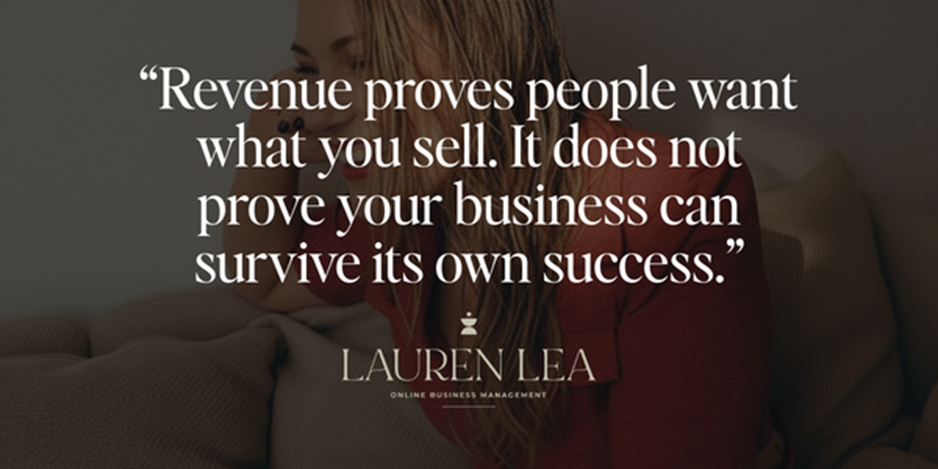
High-growth businesses regularly treat these as the same thing. They are not. Revenue tells you that people want what you sell. It does not tell you whether the business can absorb a difficult quarter, whether the team can function if a key person leaves, or whether a founder stepping back for 30 days would cause the whole operation to wobble.
Resilience is built from a different set of components.
Cash flow buffers that give the business options rather than just obligations.
Operational redundancy so that one point of failure does not become a crisis.
Delegated authority so that decisions move without the founder as the gatekeeper.
Process documentation so that knowledge lives in systems rather than individuals.
Cultural alignment so that the team shares values and direction without constant recalibration.
What this looks like in practice is a business where:
A key team member leaving does not halt progress because responsibilities are documented and shared.
Leadership can step away temporarily without decisions grinding to a halt.
A difficult quarter triggers adjustments, not panic.
New hires can become productive quickly because the business knows how it operates.
Operational knowledge is embedded in systems rather than locked in people’s heads.
Growth increases organisational stability rather than exposing new vulnerabilities.
When revenue doubles without a corresponding increase in resilience, risk multiplies alongside it. Founder stress multiplies. Dependency multiplies. The business gets bigger and more brittle simultaneously.
The founders who build lasting businesses think about organisational survivability. Whether the business can absorb shocks, sustain growth, and function at a high level without them as the constant stabilising force.
Related read: The Structure Behind Sustainable Leadership
This is the gap that separates businesses that grow from businesses that endure.
6. The gap between founder identity and CEO identity
This is the gap most people do not expect. And often the one that holds everything else in place. The skills that built the business, the hands-on problem solving, the personal client relationships, the instinct to just do it yourself, are different from the skills that scale it.
The founder adds value by doing. The CEO adds value by building the conditions in which others can do, decide, and lead.
That shift changes how you spend your time, how you measure your contribution, what you choose to delegate, and what you choose to hold. It changes your relationship with control and with trust.
Without it, all five of the gaps above will keep reopening. You can build the systems, hire the team, and document the processes. But when the founder is still operating as the bottleneck, even when structurally they don’t need to be, the business will continue to orbit around them.
This is identity work as much as operational work. And it is one of the most important transitions I help founders navigate.
That’s exactly why I created The Art of Letting Go FREE RESOURCE to support founders through this identity shift, not just the operational one. Because until you change how you see your role, the business can’t fully change around you.
So what do you do with the gap?
First, stop confusing revenue with stability. Revenue tells you people are buying. It doesn’t tell you the business is built to last.
Second, audit for maturity, not just momentum. Not “How fast are we growing?” But “Can we actually hold this?”
Ask yourself:
If sales doubled tomorrow, would the systems cope?
If you stepped away for 30 days, would decisions still move?
If you hired three more people, would clarity increase - or fracture?
Scaling is about strengthening what’s carrying the weight. Here’s the reframe most founders need: You don’t close the gap by slowing growth. You close it by building underneath it.
Infrastructure. Leadership evolution. Operational discipline. This is the unsexy part of scaling! If this resonated, growth isn’t your problem. Dependency is.
I regularly write about leadership, structure, and what it actually takes to build a business that doesn’t depend on you to breathe. If you’re serious about scaling without becoming the bottleneck, subscribe to my newsletter and get actionable tips and inspiration to help you build a business that runs without you.
Read more from Lauren Lea Fenn-Ellis
Lauren Lea Fenn-Ellis, Agency Founder and Fractional COO
Lauren Lea Fenn-Ellis is the founder and CEO of OBM Associates, a globally trusted business management agency supporting high-growth entrepreneurs. With nearly two decades of operational leadership experience, Lauren and her team partner with visionary founders to scale intentionally through strategic systems, high-performing teams, and operations designed for clarity, efficiency, and scale. Named one of the Top 10 Disruptive Entrepreneurs, her work turns operational friction into focused momentum. For founders who are ready to step out of the day-to-day and into confident, sustainable leadership, OBM Associates builds the structure that sets them free.


