

How to Cope with Scanxiety and Why Cancer Scans Trigger Fear and What Helps
Drawing on her own healing journey through cancer, Sarah Hurst is a coach and creator of the Mind Medicine Movement™. She helps people calm the nervous system, reconnect with themselves, and take back their power to heal body, mind, and soul.

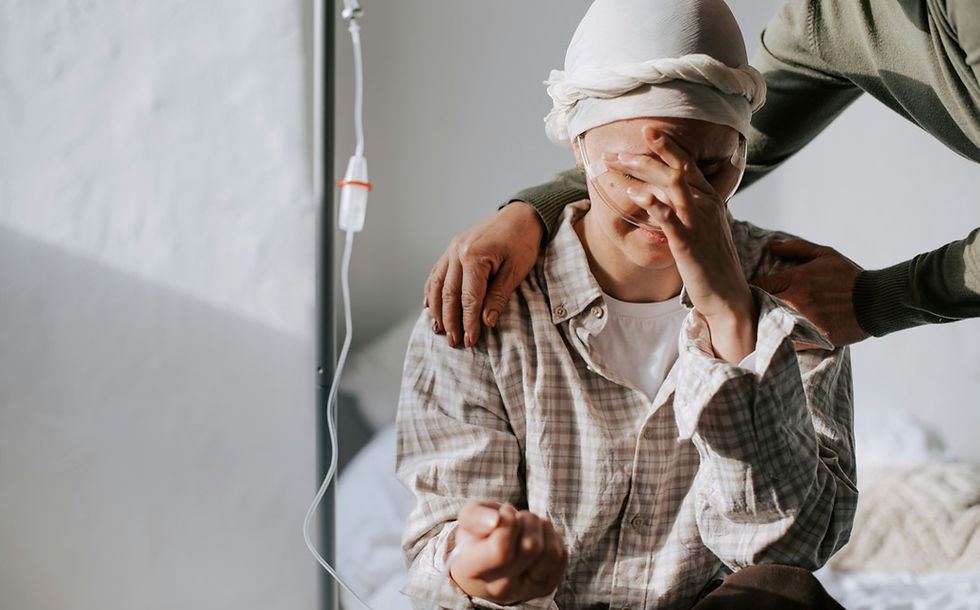
There is a particular kind of anxiety that can arrive before a cancer scan. You may feel relatively steady for weeks or months, then suddenly find your thoughts racing, your body tense, and every unfamiliar sensation carrying more meaning than it did before. This experience is often called scanxiety, and understanding why it happens can make it easier to meet the fear with compassion rather than feeling you should somehow be coping better.
What is scanxiety?
Scanxiety is the anxiety or distress that can arise before, during, or while waiting for the results of medical scans. The word is informal, but the experience is very real and widely recognised within cancer care.
The National Cancer Institute acknowledges that follow-up tests and scans can create significant anxiety, particularly because they can reactivate fears that cancer may have returned. Macmillan Cancer Support has reported that up to two-thirds of people experience scanxiety before cancer scans.
For some people, it begins days beforehand. For others, the anxiety builds several weeks before the appointment without them immediately understanding why they are feeling unsettled.
You might notice disrupted sleep, irritability, racing thoughts, difficulty concentrating, or a growing urge to check your body for symptoms. You may find yourself imagining conversations with your oncologist that have not happened, mentally preparing for bad news, or searching online for reassurance.
None of this means you are negative, weak, or failing at recovery. You have lived through an experience that taught you that scans can carry enormous consequences, so it makes sense that your mind and body pay attention when another one approaches.
Why scans trigger fear
Before cancer, a medical appointment may have been simply a medical appointment. After diagnosis, that innocence changes.
A scan becomes connected with uncertainty. It may remind you of the moment cancer was first found, the wait for staging results, the fear of recurrence, or a previous occasion when a routine check brought unexpected news.
This is partly why scanxiety can feel so physical. In my article Why Your Body Still Reacts After Stress or Trauma, I explored how the nervous system learns associations from experience. A hospital smell, waiting room, scanner, or appointment letter can become linked with previous fear, allowing the body to react before the rational mind has caught up.
The National Cancer Institute also recognises that people affected by cancer may develop conditioned responses to reminders of treatment, including anxiety in response to medical settings, sights, and smells. This does not automatically mean somebody has post-traumatic stress disorder. It means our nervous system is very good at learning from experiences that once mattered to our safety.
When your heart begins beating faster before a scan, your body is not trying to sabotage you. It is responding to something it has learned is important.
Waiting feels different
Sometimes having the scan is not the hardest part. Waiting for the results can feel far worse. There is little to do and very little to control. The scan has happened, but the answer has not yet arrived, which leaves an uncomfortable gap where imagination can take over.
The mind dislikes uncertainty. It wants to fill the empty space with an answer, and when you have already experienced cancer, it has some frightening material available.
A small ache suddenly feels suspicious. Fatigue becomes evidence. You replay the radiographer's facial expression and wonder whether they noticed something. You may analyse how quickly the appointment finished or convince yourself that a delay in receiving results must mean something. This is the mind trying to create certainty where none currently exists.
Unfortunately, worrying harder cannot give us the answer any sooner. Recognising that does not instantly stop the thoughts, but it can help us separate what we know from what fear is predicting.
A useful question is: What are the facts available to me today? Not the possibilities. Not the worst-case scenarios. Just the facts you genuinely have in this moment.
Don't fight the fear
One of the things I learned through my own experience of cancer is that fighting fear often makes it louder. We can easily create a second layer of distress by telling ourselves we should be calmer. Perhaps we have been doing meditation, mindset work, or nervous system practices and think we ought to be handling scans better by now. But emotional healing does not mean fear never returns.
You can have done enormous inner work and still feel anxious before a scan. You can trust your body more than you once did and still notice fear when you enter a hospital. You can be hopeful and frightened at exactly the same time.
The aim is not to become so evolved that cancer can no longer scare you. The aim is to develop ways of meeting that fear so that it does not completely take over the days surrounding the scan.
This is one of the reasons I prefer hope to forced positivity. As I explored in Why Hope Is More Powerful Than Positive Thinking, hope does not require us to pretend everything will be fine. It allows us to acknowledge uncertainty while remaining connected to possibility.
Give fear a container
Scanxiety has a way of spreading. A scan on Friday can somehow begin occupying Tuesday, Wednesday, Thursday, and perhaps the whole week before.
One way to work with this is to deliberately give the worry some boundaries. Instead of trying never to think about the scan, you might decide to give yourself ten or fifteen minutes to write down everything you are frightened of. Let the thoughts exist on the page rather than asking your mind to hold them continuously.
You can also write down questions you want to ask your medical team. This helps separate concerns that require an answer from fears that currently cannot be resolved.
When the thoughts return later, you do not need to battle them. You can acknowledge them and remind yourself, I've already given this some space today. I don't need to solve it again right now.
This is not about suppressing fear. It is about allowing fear to have a place without giving it the entire house.
Use the body first
When scanxiety is strong, trying to reason yourself calm may not be enough. The body may already be responding to threat, which is why grounding and sensory practices can be useful.
You do not need an elaborate technique. Begin by orienting yourself to where you actually are. Feel your feet touching the floor. Notice the chair supporting your weight. Let your eyes move around the room and take in something ordinary.
One of the grounding practices I use is my Four Corners of Calm. Look around you and notice four different things. With the first, silently remind yourself, I am safe. With the second, I am supported. With the third, I am steady. With the fourth, I am here. Then take a slower breath and allow your attention to return to the present moment.
The words are simple, but that is the point. When anxiety has pulled us into an imagined future, grounding helps us return to what is happening now.
As I explored in The Nervous System and Healing, calm is not about forcing the nervous system into submission. It is about giving it repeated experiences of safety and presence.
Choose what you control
Cancer can make us painfully aware of how much we cannot control. Scans bring that reality particularly close. There are, however, small areas where choice still exists.
You can decide who comes with you. You can ask when and how you are likely to receive your results. You can prepare questions in advance rather than relying on yourself to remember everything while anxious. You can plan something gentle for afterward rather than expecting yourself to return immediately to normal life.
You can also decide how much information you consume while waiting. For some people, researching every possible symptom creates reassurance. For many others, it feeds the fear.
Pay attention to what happens in your body after you search online. Do you genuinely feel more informed, or do you simply find another possibility to worry about?
Taking back power does not mean controlling the outcome. Sometimes it means recognising where choice still exists within uncertainty.
Protect the waiting time
There can be a temptation to put life on hold until the results arrive. We tell ourselves we will relax after the scan, book something after the appointment, or make plans once we know everything is okay.
This is understandable, but if you have regular monitoring, life can gradually become divided into the periods before and after scans.
The days in between still belong to you. That does not mean filling them with distractions or pretending you are not worried. It means allowing ordinary life to continue alongside the uncertainty.
Have dinner with somebody you enjoy being with. Walk somewhere you love. Watch something that makes you laugh. Keep an appointment you were looking forward to if you have the energy for it.
Look for glimmers, not as a way of denying fear, but as reminders that fear is not the only experience available today. Cancer may have made the future feel uncertain, but uncertainty does not have to take the present as well.
After the results
Even good scan results do not always produce the emotional response we expect. Sometimes there is enormous relief. Sometimes there are tears. Sometimes you simply feel exhausted. After days or weeks of tension, the body may need time to come down from the experience. Try not to rush past that.
A clear scan does not mean the fear you felt beforehand was unnecessary or silly. It means you have new information now. Allow yourself to receive it.
If the news is difficult, the same principle applies in a very different way. You do not need to process your entire future in the first conversation. Listen to what your medical team is telling you, ask what happens next, and allow support around you.
A frightening result is not the moment to demand that you become positive. It is the moment to come back to the next piece of information, the next decision, and the next step.
When anxiety takes over
Some anxiety around scans is understandable, but there are times when additional support is important. Macmillan advises speaking with your GP, cancer doctor, or specialist nurse if anxiety is affecting daily life. Professional psychological support can also be valuable when fear becomes persistent, leads to panic, severely disrupts sleep, or causes you to avoid necessary medical appointments.
Asking for help is not evidence that you are coping badly. Cancer places extraordinary demands on emotional wellbeing as well as the body, and support deserves to be part of cancer care.
If you are struggling significantly, your medical team can help you access appropriate services. Complementary practices such as meditation, massage, breathwork, and grounding can sit alongside that care, but they should not replace professional mental health support when it is needed.
Steady through the scan
I wish there were a technique that could remove scanxiety completely. There isn't, and I am not sure that should be the goal. The scan matters, so some fear may always make sense. What can change is your relationship with that fear.
You can notice the mind travelling into the future and gently bring it back. You can recognise the body's response without interpreting it as proof that something is wrong. You can create boundaries around worry, make conscious choices about what supports you, and allow another person to hold some of the uncertainty with you.
Most importantly, you can remember that you only need to live the moment you are actually in. If your scan is next Friday, you do not have to live Friday today.
Today, you can breathe. Today, you can notice what is here. Today, you can let life contain something other than cancer. When Friday arrives, you can meet Friday then.
If you are living with cancer, navigating scans, or finding that fear of recurrence is taking up too much space, you can explore my coaching and the Mind Medicine Movement™. You do not have to become fearless to take back your power. Sometimes the first step is learning how to feel fear without allowing it to take today away from you.
Read more from Sarah Hurst
Sarah Hurst, Coach & Creator of the Mind Medicine Movement™
After walking her own path through cancer, Sarah Hurst discovered that true healing isn’t just physical, it’s emotional, spiritual, and deeply personal. She went on to create the Mind Medicine Movement™, helping others calm their nervous systems, rediscover purpose, and reconnect with themselves through her SIPS™ framework: Slow Down, Identity, Purpose, Self-Love. Today, Sarah supports people living with or beyond cancer and anyone seeking calm, clarity, and wellness through her coaching, meditation, and touch therapy practice in Hove, East Sussex. She also offers an online coaching service.







