

God, the Creator, Versus Charles Darwin, the Evolutionist
Updated: Jun 30
Written by Timeout Taumua, Award-Winning Author
On behalf of Brainz Magazine, let us introduce, Timeout A. Taumua, a multi-award-winning author of The Magnificence of the 3, an expository book about the scientific nature of the Bible. The book and the author had been dubbed by some prominent editorial reviewers as "a rare work constructed by a rare being" and "a rare book by a rare person".

The longstanding debate between Darwinian evolution and biblical creationism can be blamed on a longstanding assumption within parts of Christianity, that the biblical record is not a scientific document. The ramification is an unintended assumption that God does not understand science.[1] This view portrays God as a supernatural Creator beyond scientific explanation, rather than as the author of the very laws that govern creation.

As scientific knowledge advances, intelligent design advocates, such as chemist James Tour and philosopher of science Stephen C. Meyer, have argued that scientific evidence is consistent with an intelligently designed universe. Yet much of such work remains inaccessible to many churches, where science is often viewed as an adversary against the Christian God.
God and earthly messengers
Historically, however, the Bible presents a pattern of God communicating through human messengers. For example, Abraham, Moses, David, Jonah, Peter, and Paul served as intermediaries, while Israel was chosen as a nation of priests to teach the world about God and the Commandments.
I propose that science fulfills a similar role today. Scientists are modern messengers of discovery, revealing the complexity of creation as knowledge expands. Rather than threatening faith, science may deepen our understanding of Scripture and may help explain some of the stories relegated to legends rather than facts.
In The Magnificence of the 3, I argue that Charles Darwin, the father of the theory of evolution by natural selection, might have been the only one who understood Genesis, as his theory paralleled biblical creation. Darwin proposed that individuals best adapted to their environment are more likely to pass their traits to future generations through natural selection.[2]
Genesis as a scientific record
The first ten chapters of Genesis can be interpreted as describing progressive neurological and behavioral development. When I combined neurologist Paul D. MacLean’s “triune brain theory” with Darwin’s evolution, it finally made sense why Adam and Eve were “naked without shame” in Genesis 2:25 (NKJV), and why they “covered their nakedness” when their eyes were opened in Genesis 3:7 (NKJV). The scenes preserve the depiction of the first stage of human neurological evolution.
The triune brain theory proposes that the human brain developed in three evolutionary stages, the reptilian brain, the mammalian or emotional brain, and the neocortex, or the smart modern brain.[3] Each unit has its own characteristics. For example, the reptilian brain is responsible for autonomic functions, such as controlling heart rate, breathing, and blood pressure. Its four basic survival attributes are identified as the four “Fs”, fighting, fleeing, feeding, and reproduction. It is preoccupied with survival by passing genes forward. Our fight or flight survival response is a trait attributed to this unit.[4] According to the theory, this brain unit developed in reptiles, and mammals share it with birds and even fish.[5]
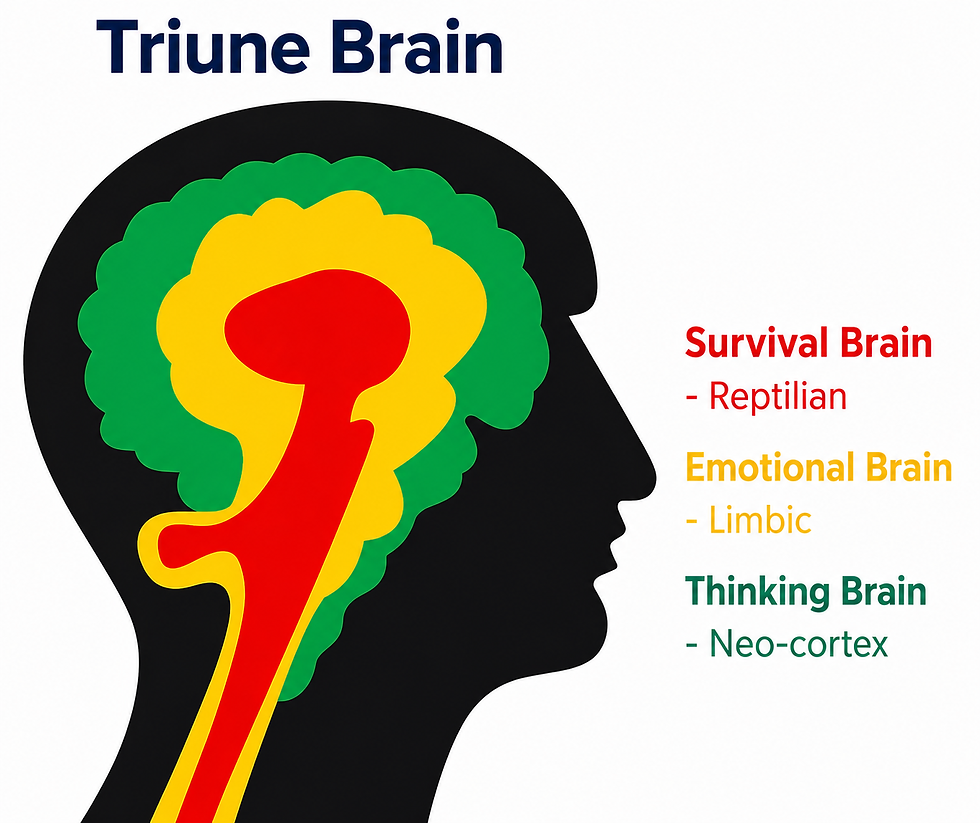
The meaning of stories and the behaviors of the pre flood generation can be explained by the characteristics of the reptilian brain. Several passages illustrate this perspective:
Genesis 2:25 describes Adam and Eve as naked without shame, a depiction of the neurological state preserved by animals today. What that means is that they were no different from the animals of the field.
Genesis 3:2 to 7 records the serpent's conversation with Eve. I interpret this as a marker for evidentiary purposes, stating that both Eve and the snake could converse with one another because they were equipped with the same brain unit, the reptilian brain.
Genesis 3:6 to 7 records the first of evolution’s “survival of the fittest” scenes, when Adam and Eve chose to go for knowledge and separated themselves from animals neurologically, marked by their awareness of their nakedness and their decision to cover themselves. This scene depicted the neurological evolution of man, the Bible’s separation point from beasts that evolutionists are still searching for today.
Genesis 4:12 to 26. For murdering his brother, God gave Adam’s oldest son, Cain, an unknown mark. Immediately afterward, God recorded Cain’s five generations of descendants before Adam’s third child was born. I propose that the DNA of Darwin’s common ancestor with the chimpanzee that we carry today came from Cain’s wife. If Cain were only equipped with a reptilian brain, mating with a chimpanzee would be within reason, considering the reptilian brain's aggressive sexual drive to pass genes on.
Genesis 6:1 to 8 describes widespread violence and sexual aggression before the flood, the four Fs, characteristics and traits of the aggressive reptilian brain, preoccupied with survival by preserving genes.
Genesis 6:9 introduces Noah as "just," "perfect," and one who "walked with God." I interpret these magnificence of the three qualities as a biblical example of natural selection, paralleling Darwin's concept of “survival of the fittest.”
Darwin's theory and the triune brain model became the interpretive keys that, in my view, unlocked the deeper meaning of Genesis. They suggest that the opening chapters preserve more than spiritual lessons, they may also symbolically describe humanity's earliest neurological and behavioral development.
My book explores these ideas further, including the proposal that Cain's story is a parable preserving clues about humanity's earliest origins. Whether readers accept these conclusions or not, I hope they encourage a fresh examination of familiar biblical passages through the lens of scientific inquiry.[6]
Conclusion
Have you ever considered this claim from the Book of Job, Job 28:28 (NKJV): "Behold, the fear of the Lord, that is wisdom..."? Although simple on its face, the verse was the first to link an emotion with wisdom and was far ahead of its time. Today, neuroscience and psychology recognize that emotions play a fundamental role in learning, decision making, and the formation of knowledge. This is another example of Scripture embedding a scientific principle that is now confirmed as a scientific fact.[7]
Declining church attendance among younger generations in the United States should prompt serious reflection. If churches were viewed through the lens of organizational leadership, their long term sustainability would demand strategic attention.[8] Europe offers a cautionary example, where many historic church buildings have been repurposed as pubs, restaurants, and entertainment venues.[9] If this trend is to be reversed, mainstream denominations may need to reconsider how they present God and creation to younger generations seeking answers in science rather than in violent religious doctrines.
If a religious leader claims the Bible is not a scientific record, is that conclusion based on the limits of Scripture or on the limits of our own understanding? Viewing science as a reflection of God's creation, revealed through the work of scientific thinkers, is consistent with the biblical pattern of God working through human intermediaries to reveal biblical creation myths.
If religious communities continue to display the violent instincts that I associate with the reptilian stage of development, the question is no longer whether the Church or science is correct, but whether scientific discovery can illuminate Scripture in ways that deepen our understanding of human nature. If it can, the result may not only be a stronger faith, but a peaceful world where children can be protected against faith based reptilian murderers.
“As the idea of blind faith loses popularity, writers like Tāumua become crucially important in filling the vacuum that was once exclusively the domain of churches.” From Readers’ Favorite book review of The Magnificence of the 3.
Read more from Timeout Taumua
Timeout Taumua, Award-Winning Author
Timeout decided to join our community to share the scientific meaning of biblical stories that God revealed to him, such as the identities of the Ark of the Covenant, the Garden of Eden, the Tree of Knowledge, the Tree of Life, and others, including parabolic tales depicting the splitting of the atom. In light of the 25 book awards and the nature of our community, these discoveries should be of interest to some of us, if not all.
References:
[1] Does Science Agree With the Bible?, n.d.
[2] Scoville, 2019
[3] The Concept of the “Triune Brain,” n.d.
[4] Our Three Brains, The Reptilian Brain, n.d.
[5] According to information, evolutionists have debunked the theory for various reasons. However, the triune brain theory is consistent with God’s design. For example, the human brain automatically divides into three separate units in the sixth week of gestation. (Lindberb, 2020). As the brain (Garden of Eden) is a fundamental element of creation, it had to be designed as the magnificence of the three. So God is with MacLean.
[6] Taumua (2023), pp. 342 to 398
[7] Siegel Itzkovich, 2015
[8] O'Reilly, 2025
[9] Paz, 2023



