Fusing AI and Blockchain – How Mohamed Dabladji is Engineering the Next Era of Global Capital Markets
Updated: Apr 13
Written by: Steve Beyatte
Capital markets are defined by their borders. A retail investor in Southeast Asia and a wealth manager in New York look at the same large-cap equities but interact with entirely different financial realities. The infrastructure dictating who can buy what is heavily fragmented, relying on a patchwork of local brokers, clearinghouses, and custodial banks. This geographic siloing creates a tiered system of wealth generation where access is dictated by jurisdiction rather than demand.
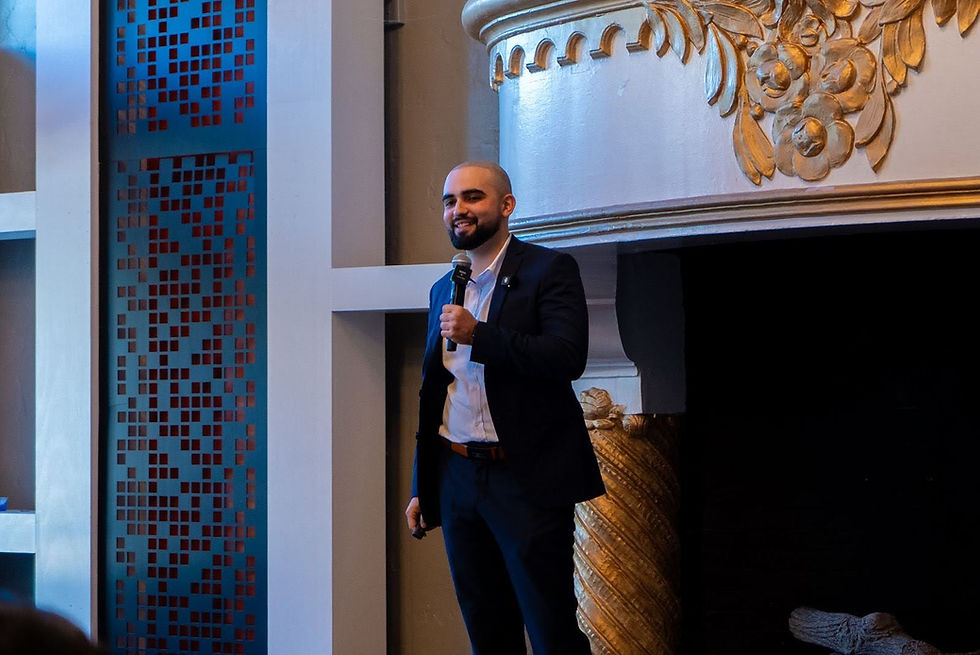
Mohamed Dabladji is out to prove that this legacy architecture is obsolete. As the Founder and CEO of EquitX, he is building an open financial protocol designed to render traditional brokerage infrastructure irrelevant. The platform enables global investors to gain synthetic exposure to major public equities through a blockchain-based collateral system, bypassing the need for traditional share ownership.
The industry is paying close attention to this structural shift. EquitX recently secured strategic backing from venture capitalist Tim Draper following its selection for the highly competitive Embark program in Silicon Valley. This institutional nod comes alongside foundational support from the Stellar Development Foundation, which is known for its expertise in cross-border financial services.
The company is now approaching a critical inflection point. EquitX has defined an aggressive growth roadmap for its simulated Testnet phase, targeting 20,000 active early adopters and a projected transaction volume of 80M XLM. The protocol is positioning itself to absorb the massive latent demand for US and European large-cap exposure in emerging economies.
With the platform preparing to scale, we sat down with Dabladji to discuss his transition from institutional banking to decentralized engineering, the limitations of traditional tokenization, and why he believes the future of investing will bypass the traditional brokerage entirely.
Brainz: You spent years managing corporate finance and innovation initiatives at BNP Paribas. What prompted the shift from a major European bank to building decentralized infrastructure?
Mohamed Dabladji: Working inside a major financial institution gives you a clear view of the internal mechanics of global capital flows. You see exactly where the friction lies. The legacy systems governing cross-border investment cannot be incrementally improved because they are built on outdated jurisdictional silos. I realized that to solve the global accessibility crisis in public equities, we had to bypass the existing infrastructure entirely. EquitX was founded to build a new programmable financial layer capable of expanding market participation globally, without asking users to navigate local brokerage monopolies.
Brainz: Your background involves complex risk structuring. How does that institutional experience translate into designing smart contracts for synthetic assets?
MD: Institutional finance relies on strict parameters for solvency and capital allocation. When you move to decentralized infrastructure, those principles do not disappear. They simply need to be translated into immutable code. At EquitX, I personally lead the financial and protocol architecture. We designed the economic model governing collateralization, liquidation mechanisms, and stability pools to ensure the solvency of our synthetic assets. We are taking the rigorous risk-management principles used in corporate banking and embedding them directly into the smart contract systems. This ensures credibility with both crypto-native participants and traditional finance observers.
Brainz: A core thesis of EquitX is that equity exposure will increasingly separate from legal ownership structures. Why is that distinction so important for global access?
MD: The concept of ownership is becoming a bottleneck for financial access. Holding a physical or digital certificate of a stock requires a massive, slow-moving custodial apparatus. That apparatus is expensive to maintain and geographically restricted. By shifting the focus to programmable financial exposure, we allow users to capture the economic benefits of an asset's price movement without the friction of custody. This structural shift from ownership-based finance toward exposure-based infrastructure is what allows us to scale globally. By leveraging our AI-driven risk and execution engine to manage all backend market complexity, EquitX empowers B2B partners to launch synthetic US equity products in weeks rather than years, turning regulatory friction into a turnkey revenue stream.
Brainz: You have set ambitious targets for the initial adoption phase, including 80 million XLM in projected transaction volume. How do your backers, like Tim Draper and the Stellar Development Foundation, factor into reaching that scale?
MD: Handling that level of volume requires rigorous economic security and the right underlying network. The Stellar Development Foundation provides the technical rails optimized for high-throughput financial applications. The backing from Tim Draper and the Embark program provides crucial institutional validation. They understand that we are deploying highly sophisticated financial engineering to solve a real-world accessibility problem. Their support aligns our technological development with long-term financial adoption trends, giving us the leverage needed to scale our user base securely.
Brainz: Traditional brokerages rely on centralized committees to decide which assets are available to their users. How does EquitX handle asset onboarding as the protocol expands?
MD: We designed the protocol around governance-driven asset onboarding. Instead of a closed boardroom deciding what users can trade, the protocol's community will eventually propose and vote on new synthetic equities to be supported by the platform. This scalable expansion model ensures the protocol can rapidly adapt to global demand. Beyond direct retail access, our core B2B strategy positions EquitX as an underlying infrastructure layer. We are enabling regional FinTechs and neo-banks in emerging markets to plug into our smart contracts via API, allowing them to offer synthetic US equity exposure to their own clients without the compliance and custodial friction of legacy banking.
Brainz: Looking at the broader landscape of capital markets, what is the end goal for this type of programmable infrastructure?
MD: The goal is to prove that traditional brokerage infrastructure is geographically obsolete. Future capital markets will operate as open financial protocols. We are providing a structural solution to a global problem by rewiring the underlying architecture of how exposure is generated and distributed. The technology is finally mature enough to separate the economic value of an equity from the legacy legal frameworks that have historically restricted its access.