

From Ukraine to the USA – Vitalii Zalitok's Furniture Business Journey
Updated: May 14
The U.S. furniture market is one of the largest in the world. Custom furniture manufacturing represents a distinct segment of that market, accounting for approximately 20-25% of total furniture industry revenue. It is also one of the most demanding segments, driven by increasingly discerning clients who are turning away from mass-market products in favor of unique, individually designed pieces across a wide range of styles and finishes.
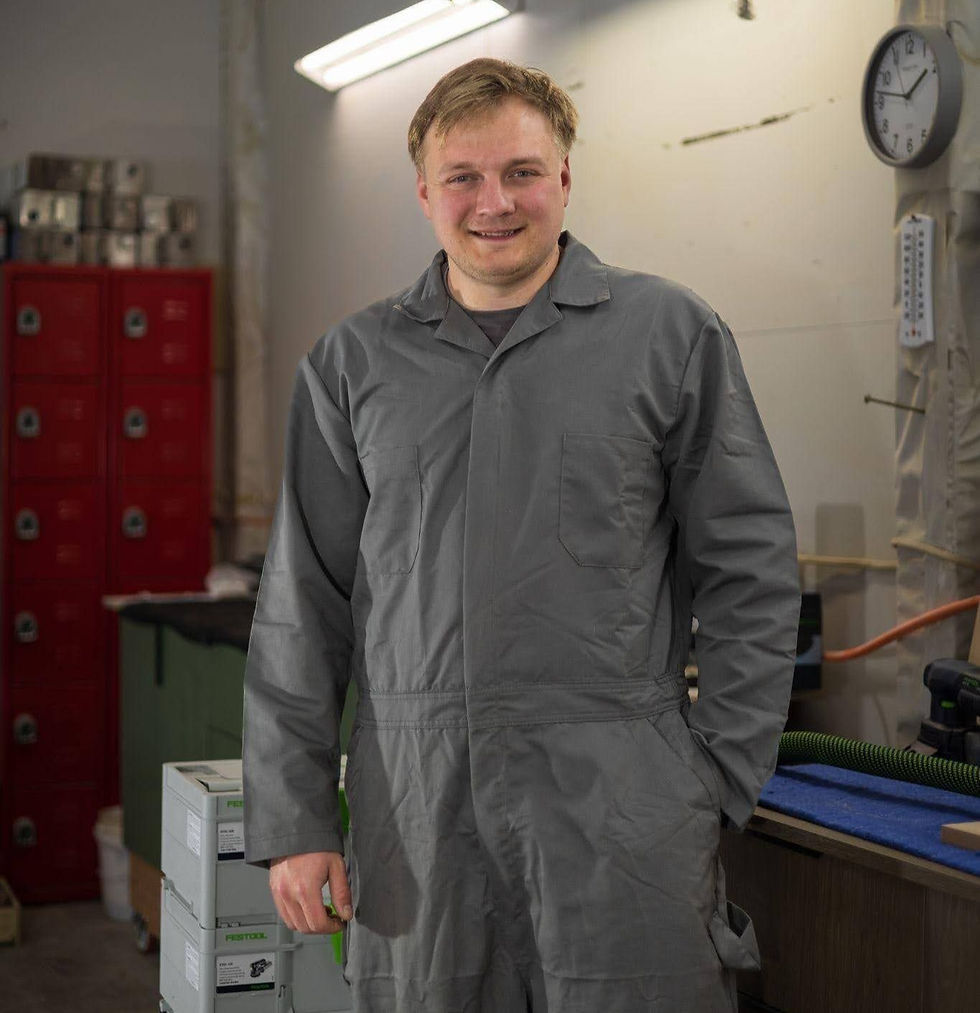
Ukrainian Vitalii Zalitok is a craftsman and entrepreneur in custom furniture manufacturing, who understands the full production process inside and out, from initial concept to final installation. His background includes owning and operating a custom furniture studio in Ukraine, hundreds of completed projects, and extensive expertise in managing every stage of production from the first client call to the final on-site installation. Today, he continues his work in the United States. The American market presented him with challenges, yet it has also benefited from experience.
The differences between the two countries in their approach to furniture manufacturing are striking. Vitalii Zalitok has managed to bring together practices from the Ukrainian market and the American approach to custom production, about which he shared with us, highlighting specific techniques and innovations that enhance efficiency and design quality in furniture manufacturing.
American market demands
The custom furniture industry in the United States is creative and artistically driven, but it operates within a framework of exacting quality standards. Building a reputation in this market requires more than skilled execution; it calls for the ability to reproduce the same level of quality consistently, project after project. Construction companies developing residential communities and working with vendors as high-volume contractors cannot afford to partner with manufacturers who "usually deliver nice work." What matters is finding a contractor who does it right every time.
Mr. Zalitok notes that this approach to production and contract relationships was new and unfamiliar when he first arrived in the U.S. "In Ukraine, the homeowner themselves is looking for the manufacturer to produce custom cabinetry, decorative elements, or interior finishes for their space, but each company develops its own internal quality standards. There are no industry-wide standards as such. You solve problems as they come, relying on your experience," he explains.
The difference may seem subtle, but in practice it fundamentally changes how a project is managed. Small details create large outcomes, from the way craftsmen read technical drawings to how gaps, joints, and tolerances are verified before installation.
Clients: Similar or different?
Another important distinction lies in client expectations. Private homeowners seek complete individuality: for them, every detail must be unique and one-of-a-kind. Contractors and large-scale builders, on the other hand, think in terms of scale and repeatability.
Both types demand different skills and approaches from the manufacturer. The ability to shift between individual attention to detail and systematic reproducibility of results has become one of the core competencies that Vitalii Zalitok has refined to a high level in the American market.
Inside american production
A significant part of Vitalii’s work involves complex custom projects, for example, commissions where standard industry approaches don't apply and where design solutions include unconventional floor plans, unusual materials, or highly specific developer requirements. His entrepreneurial experience in Ukraine proved to be a direct competitive advantage in the United States: the ability to quickly assess a situation and find a way forward in non-standard circumstances is less common among local craftsmen.
The practical flexibility of Ukrainian manufacturing, represented by the capacity to improvise, find unconventional solutions, and move forward without an established precedent, remained Vitalii’s foundational skill in the American market. “I was surprised by how demanding American clients are when it comes to documentation, compliance with state regulations, and attention to detail. In fact, they won’t tolerate even the slightest deviation from well-established rules. That’s why I adapted my approach to what the market demands: rigorous documentation for every detail and a thorough comparison of all aspects of the project with legal standards," Vitalii comments.

Universality of a craftsman's skills
Technical skills in furniture manufacturing can be acquired in any country. What sets Vitalii apart from his peers are the documented methodologies he developed and refined during his years running a furniture enterprise in the Kyiv region of Ukraine: a final quality inspection checklist and a proprietary stage-by-stage production control system.
The final inspection checklist developed by Mr. Zalitok covers five sequential blocks: surface cleaning prior to evaluation, visual inspection against fixed criteria, functional testing of all moving components, verification of parts completeness, and packaging inspection before transport. Each block addresses a distinct risk area and is executed independently of the preceding one. This level of structured documentation is not common in standard U.S. custom furniture practice.
"I noticed that American craftsmen follow the rules without deviation, sometimes way too rigidly," Vitalii observes. "There isn't always the space or the incentive to take initiative and improve the conditions of one's own working conditions. From my point of view, I see that clients and developers demand innovation: new design solutions, new approaches to material finishing, and new options in furniture catalogs that will catch a homeowner's eye and make them place an order."
Vitalii Zalitok at a custom furniture company in the United States, where his primary responsibility is to inspect the quality of furniture before it is shipped to customers. Vitalii adjusts cabinet fronts, ensures that the gaps are correctly aligned, and checks the finished product for defects. In this role, he is able to incorporate his own quality assessment methods into the work. At the same time, Mr. Zalitok develops his own business. For his own company, he has chosen a focused specialization: painting, staining, and lacquering of wood furniture. Finishing work is one of the most technically complex processes in the industry and one of the most underserved in terms of qualified practitioners, he notes. His company has already completed a number of residential finishing projects — a meaningful start for an enterprise registered just four months ago.
“As the company’s founder and CEO, I’ve chosen to focus on the two most profitable sectors within this niche market: private clients, for whom furniture is an investment in aesthetics, and design firms and furniture workshops,” Vitalii explains. “It’s a partnership where they manufacture the frames but outsource the ‘final touches’.”
One of the most notable achievements in the first four months of the company's work was the complete finishing of a modern-style library for a private home: "We worked with solid oak, using a multi-coat staining technique with a deep matte finish. The natural texture of the wood created the atmosphere of a well-appointed traditional library, but despite its similarity to natural wood, the material is highly resistant to UV rays and other forms of damage.”
A path forward for the american market
At MODA Woodworking, Vitalii contributed to the company's growth and introduced a new product – aluminum facades with glass inserts. At the same time, he also trained his colleagues to work according to his methods. “The entire staff applies the quality standards I brought with me from Ukraine when delivering projects. I taught the engineers how to manufacture shelves with greater precision, apply coatings correctly, and perform proper gluing. Overall, my practices have become the standard across the company,” he adds.
Mr. Zalitok identifies the specific changes in production approach that the whole American furniture industry, in his opinion, can adapt in order to become more efficient.
Invest more in the preparation stage. In American manufacturing, project details left unresolved before work begins reliably lead to delays or rework down the line. Investing time in a thorough review of drawings and specifications at the outset reduces total execution time and lowers the risk of costly errors.
Consistency matters more than brilliance. The American market, particularly construction clients, values consistent quality on a large scale more than a single outstanding result. Vitalii's advice to furniture companies is to develop their own work protocols and stick to them in every project.
The finishing stage is the most important one. In the American client's perception, the quality of a piece of furniture is defined by what they see at the moment of handover. Investment in rigorous final quality control is the highest-return point in the entire production chain and the one most directly tied to long-term reputation.
Many specialists possess either technical craftsman skills or managerial experience. Less commonly, both are combined – and rarer still is the experience of a business owner who was personally responsible for the entire production cycle and developed his own documented operational systems as a result. Vitalii Zalitok offers the American market rare expertise, proprietary methodologies for improving furniture quality, and a forward-looking approach to handling non-standard situations. Although the technical foundation of his profession is well-known,Vitalii Zalitok applies it with a level of consistency and structure that aligns well with what American clients and construction companies look for.



