Disability Advocacy At The Pharmacy
Updated: Mar 26, 2025
Written by: Dave Bahr, Diversity Equity And Inclusion Panel

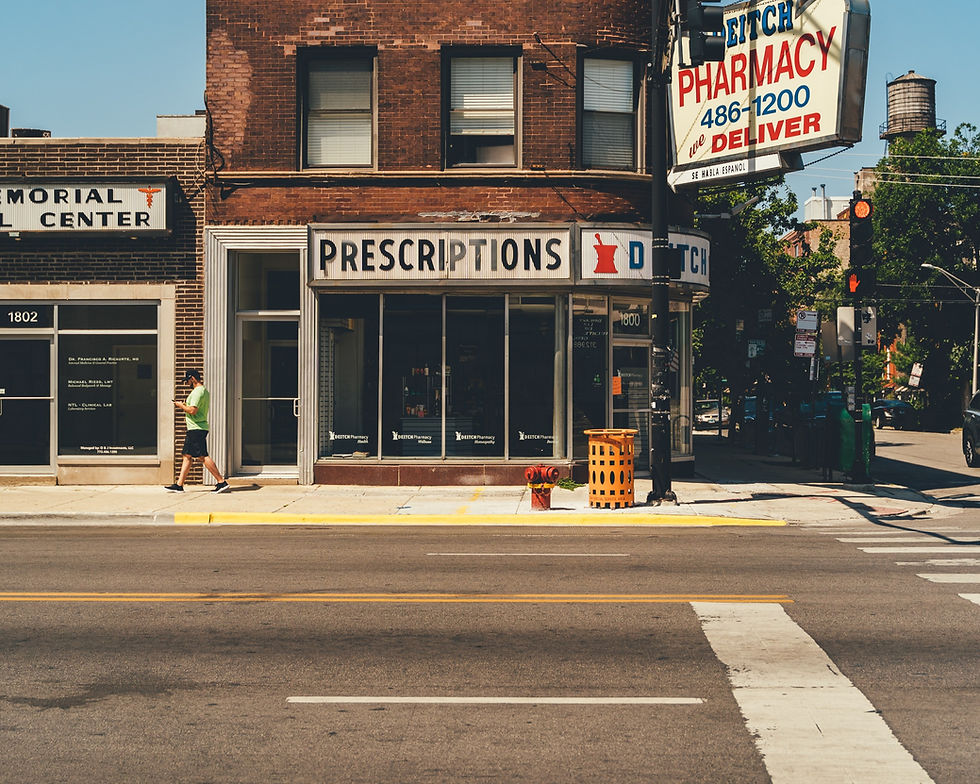
Cover photo alt text: Picture of the outside of a general, brick-walled pharmacy. It sits on the corner of a town street, three stories tall with two big signs that say "pharmacy" and "prescriptions". It's sunny and daylight in the picture.
The other day, I was at my local drugstore getting a Flu shot. I've been there before for similar reasons, so everything was pretty standard. However, when the woman administering the shot came to fetch me, it quickly became apparent that she was slightly unsure of how to help me as a totally blind customer. This isn't unusual, but she did something that day that really made me think—in a good way. So, I want to share that experience with you as a great example of how asking the right questions is a lot simpler than you might think.
As with most pharmacies I've been in, this one had a little room off to the side where they administer things like Flu shots and COVID vaccines. I had been in that same room before, so I knew the layout. The employee began by asking me a great opening question—"Do you want to take my arm?"—so she could guide me over to the room, which was a good start.
Unfortunately, after guiding me over to the little room, she followed her initial question by doing something I usually don't like people doing. She said, "There's a chair right in front of you," and then physically moved my cane towards it herself without asking me or waiting for my response.
I'm sure that some of you may be asking, "What's the big deal about that?" Well, the tools we use as people with disabilities are like extensions of our bodies. So when you grab them without our consent, it feels like you're taking away from our bodily autonomy.
And typically, when things like these happen, I respond with something like, "Just so you know, you really shouldn't grab someone's cane when showing them where something is. By doing so, you're basically controlling my eyes without me having any say over it." But... I knew it was just an instinctual move on the woman's part and she was nowhere near the first person to do so.
So, I brushed it off and moved on with the Flu shot process. The usual small talk ensued; I even looked away as the needle went in, even though I couldn't see the thing anyway. Another instinctual human response? Just a force of habit? Who knows.
When she finished up with the shot, I asked if I could get some help to the front door. While I can normally navigate into the store fairly simply, sometimes getting out of it can be a challenge, especially if there are holiday displays in the middle of the aisles—sometimes I miss those with the cane going in and find them going out. Fellow cane users will certainly know the feeling.
Anyway, the woman agreed and then asked the question I hoped she'd ask: "Do you want my arm, or do you want to guide yourself and follow my voice? How do you want to do this?" This has to be my favorite phrase ever!
How do you want to do this? So. Simple.
Often I'll have people answer my request for help with, "Sure, here, I'll guide you," and then they grab my arm. That feels way too much like getting dragged along—definitely not the way to do it. But, the arm grabbing has to be some kind of instinctual response for how often it happens. While I have yet to understand why that happens, the right way will always be for me to take your arm. Again, it goes back to the bodily autonomy thing.
In the case of the woman in the pharmacy, though, I politely said, "If I could have your arm, that would be great, please." And we walked at a normal pace from that little room in the back up to the front door, missing all the possible displays and obstructions that I might otherwise have knocked over. I thanked her for the guide and went on my way.
Why is this so important? Why am I writing about it? Because it made an impression on me. I couldn't help thinking, "Yes, the simplest questions are the ones to ask!" How can I help? Would you like my arm? How do you want to do this? Instead of making assumptions, just ask.
I walked away from the pharmacy with a smile. This is what I want to talk about during my public speaking and advocacy—the things that sound so simple that they almost seem ridiculous, yet create such a huge impact for people with disabilities.
In closing, I want to say: Don't be afraid to ask simple questions, don't make it so complex.
How do you want to do this?
Dave Bahr, Diversity Equity And Inclusion Panel
Dave Bahr is an author, speaker, and comedian focused on demystifying the public's perception of interacting with people with disabilities. As founder of In-Sightful Living, Dave works as an accessibility consultant, aiding organizations to enhance their systems, environments, events, and cultures to support people with disabilities. Blind from birth, he teaches that having a disability is not a hindrance but an asset. His book, Prave: the Adventures of the Blind and the Brittle, is an Amazon 1 bestseller and has received awards from the Colorado Independent Publishers Association. His coaching program Stop Look and Listen is a new and innovative approach to helping people perceive their strengths through deep focus and concentrated analysis. Dave enjoys listening to and discussing music and taking in baseball games on the radio when not advocating or coaching.