

Designing for Growth and How Drums4Health is Taking Fitness Further
Written by Tamsin Ward, Founder of Drums4Health
Tamsin Ward is the founder of Drums4Health, an innovative rhythm-based movement programme designed to support physical health, brain health and emotional wellbeing. Drums4Health exists to move the body and wake up the brain through rhythm-based movement that supports physical wellbeing, brain health and community connection.

Entrepreneurship in fitness starts with understanding what prevents people from taking part. For Drums4Health founder Tamsin Ward, that meant developing both an inclusive activity and the equipment needed to take it into more communities.
A fitness business can have an engaging programme, enthusiastic participants and a clear purpose. But if its equipment is difficult to transport, expensive to store or unsuitable for different users, growth becomes harder.
This has been an important consideration in building Drums4Health. Combining rhythm, movement and social connection, the programme is designed to help people enjoy being active, whether seated or standing. Making that experience available more widely meant thinking beyond what happens during a session.
It meant asking: how do we get it to the people who would welcome it?
Building the equipment around the purpose
My background in music, specialist education and fitness has shaped how I approach that question. I have worked with people whose needs do not fit neatly into a standard class format. Adaptability has to be part of the design from the beginning.
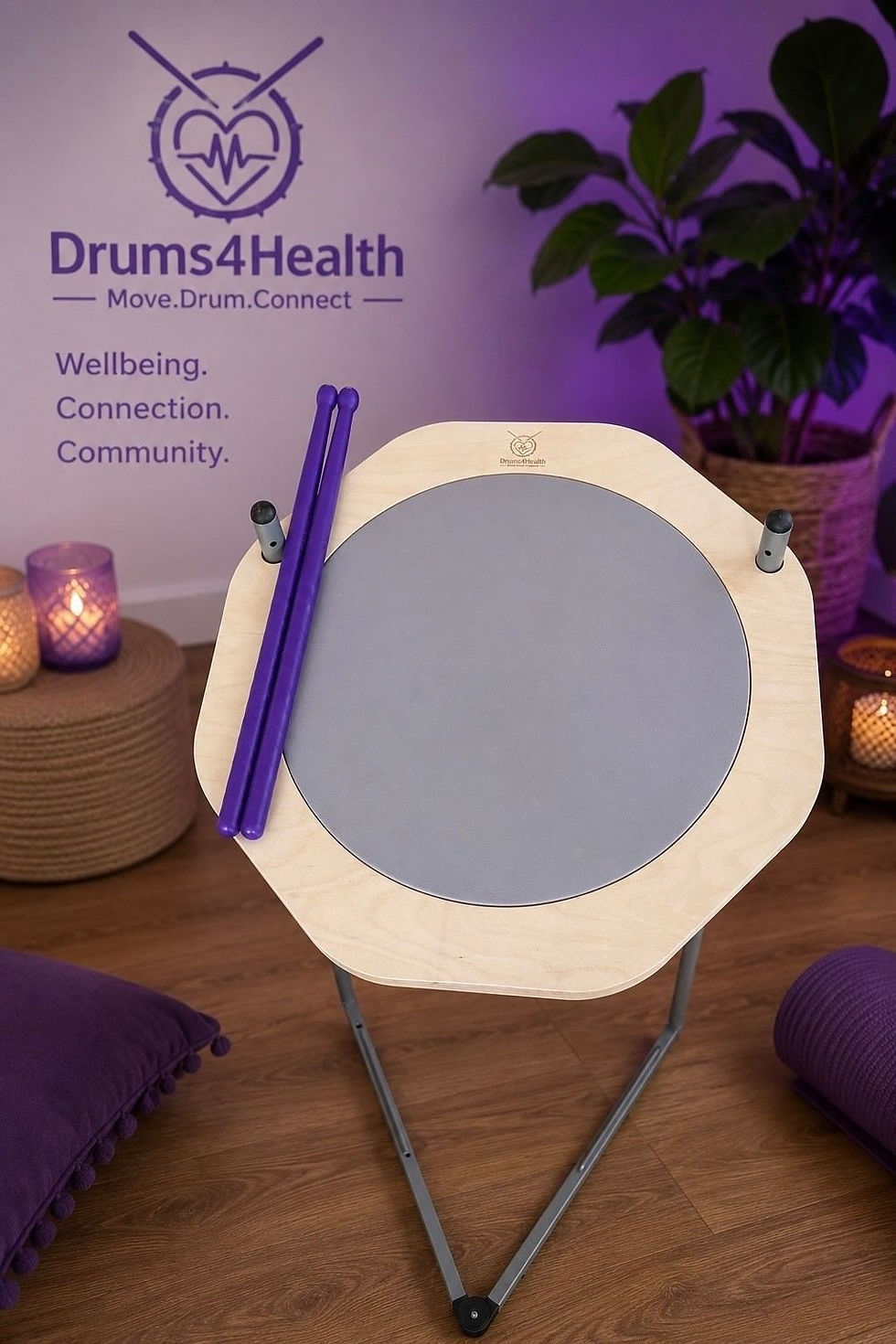
Drums4Health manufactures its own purpose-designed wellbeing drums. Their height-adjustable, folding stands support seated and standing participation, while their portability and practical storage make them suitable for use across different venues.
These details influence what the business can achieve. Equipment that can travel enables an instructor to deliver sessions in several locations. Equipment that stores conveniently makes it easier for a community venue or organisation to accommodate a programme.
Developing our own drums has therefore become central to our entrepreneurial approach. The product supports the experience, and its design supports the growth of the business.
Making wellbeing more than a once-a-week activity
One of the most encouraging developments has been seeing people invest in their own Drums4Health drums, allowing them to continue practising between organised sessions.
This is something I feel particularly passionate about. Too often, wellbeing activities are limited to an hour a week. While that hour can be enormously valuable, I wanted to create something that could become part of everyday life.
Having a drum at home gives participants the opportunity to revisit rhythmic patterns, practise movement sequences and develop their coordination and confidence in their own time. They can build upon what they have learnt in class rather than starting again each week.
It also gives people greater ownership of their wellbeing. They are not simply attending an activity; they are developing a skill, enjoying music and discovering something they can continue independently.
From an entrepreneurial perspective, this has opened another important opportunity. Our drums are not simply equipment for instructors or organisations. They can become personal wellbeing tools, helping people stay connected to the programme between sessions and making regular rhythm and movement more accessible.
Bringing rhythm and movement into education
Another exciting area of growth has been the increasing use of Drums4Health in schools, including specialist and mainstream education.
With nearly three decades of experience in education, including leadership within specialist settings, I have always believed that learning should engage the whole person. Children do not all learn, communicate or respond to traditional activities in the same way.
Drums4Health provides an alternative approach to developing physical literacy by combining rhythm, coordinated movement, spatial awareness, balance and sequencing in an engaging musical experience.
Rather than focusing solely on conventional sports or exercise, pupils can explore movement through rhythm, develop coordination and body awareness, and experience the satisfaction of learning and creating rhythmic sequences.
The programme also offers opportunities to support attention, engagement, listening, memory and collaborative learning.
Schools are exploring Drums4Health as part of physical education, enrichment, music, regulation and wider wellbeing provision. Some are using rhythm and movement to help pupils engage positively at the beginning of the school day.
Our purpose-designed drums are particularly suited to educational environments because they are robust, adaptable and easy to store. Through training and ongoing support, school staff can incorporate the programme into their own provision rather than relying entirely on external visits.
For me, this is another example of how thoughtful equipment design can create wider opportunities for participation, learning and movement.
Taking fitness into rural communities
Living and working in Devon has made the practical importance of location clear to me. A class may be relatively close on a map yet difficult to reach without a car, reliable public transport or someone available to help.
For some people, attending a familiar local venue is a much more realistic possibility than travelling to a leisure centre.
Portable equipment gives Drums4Health greater flexibility to work in village halls, community centres, schools and care settings. It allows us to explore opportunities in rural and more isolated communities where a permanent fitness facility may be some distance away.
There is still work involved: finding suitable venues, building local relationships and making sessions financially sustainable. But transportable equipment removes one practical obstacle and opens up more possibilities.
Creating an experience people want to repeat
Access also depends on how people feel when they arrive.
At Drums4Health, participants move to music, learn rhythmic patterns and develop sequences together. There is room for different abilities, seated participation and individual adaptation.
The drum provides a shared focus. People have something to play, a rhythm to follow and an opportunity to contribute. My aim is to create an experience that encourages people to return because they enjoy taking part.
Importantly, participants are not simply following a workout. They are developing musical and movement skills that can be practised, remembered and built upon over time.
That matters commercially as well as socially. A growing fitness business needs a programme that works in practice and builds lasting relationships with participants and partners.
Growing through people and partnerships
Manufacturing our own equipment also supports our training and licensing model. Other instructors and organisations can learn the approach and take it into their own communities, supported by suitable drums, resources and ongoing guidance.
This creates a route to growth beyond the sessions I can personally deliver. Local instructors bring knowledge of their communities, while organisations can explore how rhythm and movement fit their existing provision.
As that network develops, maintaining quality and supporting confident, adaptable delivery remain essential.
For me, entrepreneurship means paying attention to the practical details that determine whether an idea can travel. A folding stand, an adjustable height or an easier storage solution can influence where a programme goes and who gets to experience it.
But it also means recognising that an idea can have a much greater impact when people are given the tools to continue independently.
The ambition for Drums4Health is not simply to create more fitness classes. It is to make rhythm and movement an accessible, enjoyable and sustainable part of everyday life, in homes, schools, community settings and wellbeing organisations.
By designing and manufacturing our own equipment, we are creating opportunities for people to move, learn, drum and connect, wherever they are.
Move. Drum. Connect.
Read more from Tamsin Ward
Tamsin Ward, Founder of Drums4Health
Tamsin Ward is a former music teacher and headteacher, a qualified Personal Trainer, and holds a Master’s in Education. She founded Drums4Health to harness the combined power of movement and rhythm in supporting physical and brain health. With regular classes growing rapidly in popularity, Drums4Health is now expanding across the UK as an innovative and inclusive approach to wellbeing. You can contact her directly here.







