Decision Fatigue and Decluttering
Danica Carson, creator of Hack Decks™, specializes in creating simple and effective ways to help others live their lives with less stress and more enjoyment. Focusing on pain points such as getting organized, becoming a mother, going off to college, and coming up with fresh ways to connect, Hack Decks™ provides a shortcut to a happier, easier life.

Do you ever feel exhausted, discouraged, or even frustrated when decluttering? When you’re sorting through your “stuff,” do you typically make it through half a pile and then suddenly lose steam, and maybe even hope? Sounds to me like you’re experiencing decision fatigue.
What exactly is decision fatigue?
To understand decision fatigue, you need to understand a little about the brain.
At the risk of oversimplifying, a key player in decision-making is your prefrontal cortex (the area of your brain just behind your forehead). It’s also responsible for skills such as planning, social functioning, and other complex mental tasks. It can get exhausted when it’s overloaded or overwhelmed.
The prefrontal cortex also tends to become less active when another part of your brain, the amygdala, takes over. It’s a process called the amygdala hijack. In a nutshell, it means that during a stressful situation, your amygdala jumps in with your fight, flight, or freeze response and overrides your prefrontal cortex’s logical thinking, which includes your decision-making ability. “Amygdala hijack” happens when your brain reacts to psychological stress as if it's physical danger.
How does this impact decluttering?
Decluttering is just a series of decisions that you need to make about your “stuff.” Most likely, you have a lot of “stuff” and decisions to make. If you reach decision fatigue while decluttering, you’ll probably find it extra hard, if not nearly impossible, to continue.
Symptoms of decluttering decision fatigue include:
Feeling mentally drained before you make it through a room, closet, or category (KonMari® Method)
Experiencing brain fog
Feeling frustrated more easily and a little “testy”
Becoming discouraged, which leads to feeling bad about yourself for “failing” to declutter, which in turn makes you feel less motivated to declutter in the future, turning into a vicious cycle
Have you ever heard of neuroplasticity?
Neuroplasticity can be viewed as a general umbrella term that refers to the brain's ability to modify, change, and adapt both structure and function throughout life and in response to experience. Your brain is constantly “rewiring” itself, and over time, you can become more resilient to decision fatigue.
Ten ways to reduce decision fatigue while decluttering
To help you move forward, here are ten ways to reduce decision fatigue while decluttering.
Preplan
In preparation for decluttering, decide the night before which area or category you’d like to declutter. Some people follow the KonMari Method® of decluttering, and that decision, if you follow the program, tells you the order in which you’ll declutter. When you get to komono, however, you will need to choose a place to begin and continue your decluttering journey. If you’re not following the KonMari Method®, then you will need to choose the best place to begin the following day’s work.
Pick the right time of day to declutter, this is typically in the morning
Unless there is a good reason not to begin in the morning, it’s best to start then. The more decisions you need to make, the more fatigued your brain becomes. If you wait until the evening to tackle a big category (like clothing, for instance), you may be too tired to get the job done. Also, if you’re decluttering following the KonMari Method®, you’ll need a space to put all the clothing, which is typically on the bed. If you decide to put it there, where will you sleep?
If you do your decluttering when you have more mental energy, you will experience less frustration. Get up thirty minutes earlier than you typically do so you have the mental energy to be clear-headed and mindful.
Designate an official decluttering area
If you have the available space, use a guest bedroom as your decluttering area. That way, when gathering all your things (like clothing), they won’t end up on your bed; they’ll be in a room that you’ve associated with decluttering. It will make the process easier because you won’t go tripping over things in your room if you have allocated space outside your normal living area.
It also helps if there is a door to the room that you can close so you have fewer, if any, distractions. Make sure you have good lighting, a comfortable place to work, and a few tissues if you’re going to be decluttering things with a lot of emotional attachment. Also, bring a timer into that room with you so you can apply the Time Blocking Principle. It will help you move through the decluttering process more quickly.
Since you will be making decisions about your things, reduce decisions in other parts of your life
Some CEOs wear a “uniform”, we saw this with Steve Jobs and his black turtlenecks. Rather than making a fashion statement, he and others like him put their mental energy toward their daily business decisions instead of their clothing choices.
Other ways to reduce decisions are:
Eat the same thing each day for lunch
Create a capsule wardrobe
Assign a specific day each week to go through your inbox
Grocery shop only one day of the week
Tidy or declutter by category (KonMari Method®), which is an effective strategy
One principle of the KonMari Method® that truly makes sense is to “tidy” by category. The word “tidy” can easily be replaced with the word declutter. If you follow Marie Kondo’s method, you go in the order of clothing, books, papers, komono (miscellaneous items), and sentimental items. It makes sense. As you move through the system, you save the hardest for last, which helps you refine your decision-making skillset. By the time you get there, you are already good at making decisions and knowing what you love. At least, that is the thought process behind the method.
When tidying a category, the first principle is to gather all the items for that category from all over your home instead of tidying by room. What this does is allow you to group, which is a good way to approach decluttering. When you see the enormity of the clothes pile, for example, you see how much you own, and it, in theory, is supposed to motivate you to reduce what you have. It is also designed to help you first work on items that are closest to your heart and your being, as clothing is worn directly on the body. As you refine your skills, you become more in tune with what you love and what you can let go of. This, too, reduces the mental energy you must spend to get through each category.
Take frequent breaks to refuel (just not too many)
People lose steam quickly when they declutter. At The Uncluttered Life, Inc., we have watched adult men say they’ve had enough after ten minutes of decluttering. If you’ve reached the point where you’re mentally drained and are trying to push through and declutter anyway, it is only going to frustrate or discourage you. Take some time to grab a snack, a bottle of water, or a fifteen-minute nap. Be aware of what caused the decision fatigue so you can learn from it. Then you can head it off at the pass in the future.
After a few experiences of decision fatigue, you may see patterns. You can use those patterns and insights to formulate a decluttering plan that’s less fatiguing for you. Maybe it means decluttering a smaller category of stuff next time, changing your environment, or going to bed earlier the night before.
Don’t multitask while decluttering
It’s important to stay focused when decluttering. That means not checking your phone every two seconds, stopping to send an email, or cleaning while you go. Leave that for later. While decluttering, the only other task worth your time is making lists of things that need to be done that you find accidentally during the decluttering process.
Examples include reordering medicine that you find has expired when cleaning out a medicine cabinet, or seeing that you need new shoelaces when decluttering clothing. Then, when you’re finished with your decluttering project, you’ll have a to-do list of things that need to be completed. Don’t keep the list in your head; it takes up too much mental energy.
Hang the “do not disturb” sign
As with multitasking, when you are disturbed while decluttering, your brain must keep refocusing its attention, and this takes mental energy. Giving away mental energy can be incredibly draining. Turn off your phone or at least put it on vibrate. Ask others in your home for time without interruption. If you have a small child or a child who needs your attention, hire a babysitter, or find a quiet place in your home with few distractions.
Get extra sleep
The very best way to recharge your brain is with extra sleep. It allows it to be still and process. A lack of sleep can also cause the amygdala to have a heightened fight, flight, or freeze response to negative stimuli, like sorting through clutter or “tidying.” The prefrontal cortex, where decisions are made, also doesn’t perform as well when it’s tired.
Remember why you’re doing this decluttering
It’s important to set your intention at the beginning, which is to envision the lifestyle you want to create. Do this before you start the decluttering and organizing process. That step is key in helping you stay motivated and helps you know what you need to discard. Setting an intention keeps you motivated even when your willpower and stamina give out.
The Uncluttered Life has a solution: Declutter Deck®
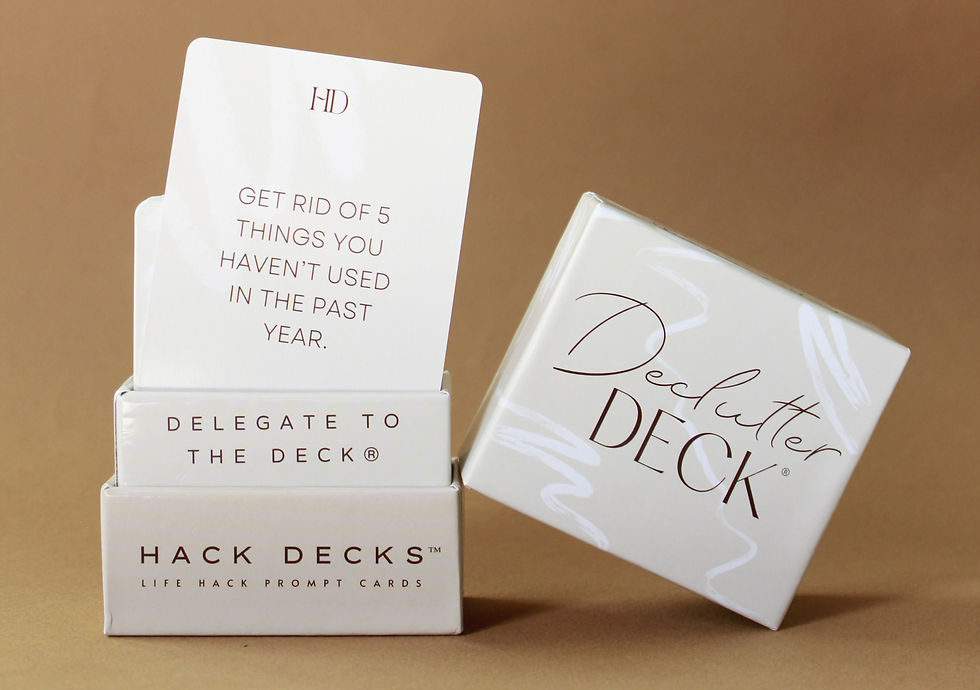
Declutter Decks® are your solution to decision fatigue. Declutter Decks® are organizing prompt cards that help you get and stay organized at home. By breaking down decluttering into bite-sized pieces, you will eventually declutter and organize your entire home.
Produced under the trade name Life Hack Decks®, these cards are powerful micro-prompt motivational card decks that make your life easier while reducing stress in your day. Declutter Decks® instructional decluttering decks simplify ineffective routines and help you go from stuck and overwhelmed to inspired and empowered.
What are decluttering cards?
Decluttering cards are typically focused on less-than-an-hour tasks or suggest doing a very specific number of things, like “throw away ten things that are broken.” You may, for example, draw a card that says, “clean out your junk drawer for thirty minutes.” By setting a timer for each organizing prompt, you not only keep yourself on track but also reduce the number of decisions you need to make.
Having a length of time to perform a task reduces your indecisiveness and improves your decision-making skillset. You don’t have forever to decide whether you want to keep your junk drawer odds and ends, which moves you more quickly along the path to completion. It is a great tool to help those with ADHD as well.
See for yourself! Order your Declutter Deck® today and see how you can reduce decision fatigue during the decluttering process. $19.95 per pack of 52 cards.
Read more from Danica Carson
Danica Carson, Co-Owner and Creator of Hack Decks™
Danica Carson is the Co-Owner and Creator of Hack Decks™, a line of prompt cards designed to simplify life and reduce stress. Hack Decks™ is owned by The Uncluttered Life, Inc., a boutique organizing company based in Dallas-Fort Worth specializing in optimization, efficiency, and home function. The flagship product, Declutter Deck®, was created as an exclusive tool for clients to get and stay organized in all aspects of the home.