A New Kind of Investment – From Shipping Container to Business Asset
Twenty years ago, a shipping container meant one thing: a box that moved cargo from port to port, then got scrapped once its working life was over. Today, more and more companies look at that same steel structure through a different lens – as a flexible building block capable of solving problems that once required months of traditional construction.
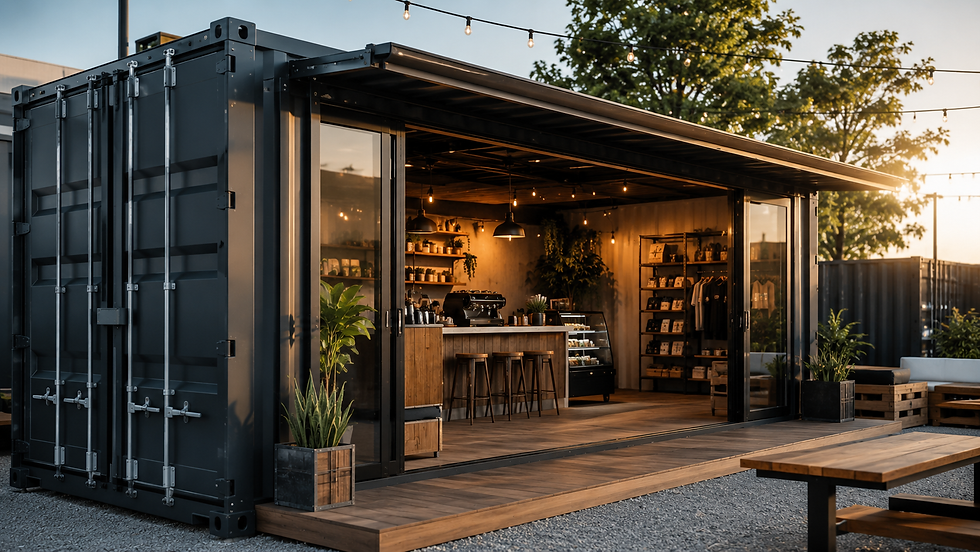
This isn't a passing trend. It's a logical outcome of how the very idea of "infrastructure" is changing for businesses operating under tight budgets, market uncertainty, and the need to test new locations and formats quickly. The shift says as much about how companies think as it does about steel and welding – it reflects a broader move toward treating physical space the way software teams treat code: modular, versioned, and easy to redeploy.
A brief history of an idea that took decades to mature
The container itself is not a new invention – standardized intermodal units have been moving global trade since the mid-twentieth century. What's new is the second act. For most of their history, containers that reached the end of active shipping service were simply retired: sold for scrap, left in storage yards, or occasionally repurposed in isolated, ad hoc ways by individuals rather than businesses.
The shift toward treating containers as a legitimate category of business infrastructure is much more recent, and it tracks closely with three broader trends: rising real estate and construction costs in urban centers, growing pressure on companies to reduce build waste, and a general cultural comfort with modular, prefabricated design that grew out of adjacent industries like modular housing and pop-up retail. Put together, these trends created demand for a building method that could compress timelines without compromising durability – and an existing global supply of surplus steel boxes was sitting there, ready to meet it.
Why business is rethinking familiar solutions
Traditional construction follows a long cycle: design, permitting, sourcing materials, erecting a frame, finishing the interior. Every stage carries a risk of delay and rising cost. A modular approach flips that logic: build a fully functional unit first, then deliver and place it wherever it's needed.
Several reasons explain why this principle keeps gaining ground:
Speed: A ready-to-use unit can be delivered in weeks rather than months.
Budget predictability: Less exposure to weather delays, labor shortages, or material supply disruptions.
Mobility: A unit can move as the business evolves, instead of being tied to one location forever.
Durability: A structure built to survive ocean storms holds up well on land too.
A smaller environmental footprint. Reusing a steel shell means less construction waste and fewer new raw materials.
Lower entry risk: Because the capital outlay is smaller than a permanent build, companies can test an idea without locking themselves into a long-term liability.
For a startup testing a hypothesis and for a large company scaling a network of locations, the logic is essentially the same: fewer capital commitments, more flexibility.
Five directions where the idea already works
Modularity lets the same basic volume become an entirely different kind of space, depending on what's actually needed:
Temporary retail points and kiosks – for seasonal markets, food vendors, or brand activations.
Secure on-site storage – tools, materials, or equipment kept safe at a construction site.
Insulated workshops and small production spaces – for light manufacturing or craft work.
On-site administrative and working spaces – when a team needs a genuine workspace right at the location.
Event and hospitality spaces – bars, ticket booths, lounge areas at festivals and large events.
In every one of these cases, it's not an empty box – it's a fully fitted-out unit: insulated, wired, ventilated, with doors and windows designed around specific codes and needs.
Beyond these five, a growing number of niche applications are emerging: emergency response units deployed after natural disasters, agricultural processing stations placed close to fields, temporary classrooms for growing school districts, and even small-format data or server rooms that benefit from the container's inherent security and weather resistance. The common thread across all of them is the same – a need for a functional, code-compliant space that can appear quickly and disappear just as easily when it's no longer required.
How an empty volume becomes a working asset
Turning a basic structure into a functional space isn't a matter of "cut a door and paint it." The process runs through several distinct stages.
It starts with an assessment of structural requirements: load capacity, insulation needs, how the space will be used day to day. An office meant to operate through winter needs a very different specification than a summer festival kiosk. This stage also has to account for less obvious factors – soil conditions at the delivery site, wind exposure, and whether the unit will be stacked or used as a standalone structure.
Next comes the adaptation stage: openings are cut for doors and windows, the frame is reinforced where needed, insulation is added, and electrical – and, where required, plumbing – systems are installed. This is the stage where a generic volume becomes a specialised containers solution, engineered around a specific task rather than an average scenario.
After that comes the finishing stage: flooring, wall paneling, lighting, and furniture on the inside; cladding, branding, and protective coatings on the outside. Finally, the unit is delivered and placed on site – typically without the extensive groundwork, permitting, or foundation work that traditional construction requires.
Comparing container builds to other modular methods
Containers are only one branch of a wider modular construction movement, and it's worth understanding where they fit. Prefabricated timber-frame modules, for instance, often offer more interior flexibility and can be easier to insulate for extreme cold. Precast concrete modules deliver excellent soundproofing and are common in multi-story modular apartment projects. Where containers distinguish themselves is in their combination of structural rigidity, stackability, and inherent portability – a container unit is designed from the outset to be lifted, stacked, and transported without additional bracing, which is not always true of other modular systems.
The trade-off is interior volume: a standard container's width is fixed by international shipping standards, which can feel restrictive compared to a purpose-built modular frame. Businesses evaluating options usually weigh this constraint against the speed and cost advantages before deciding which modular method fits their specific use case.
The economics behind the modular approach
Traditional construction costs have kept climbing in recent years, and project timelines increasingly slip due to labor shortages or material supply disruptions. Against that backdrop, modular solutions offer businesses something traditional construction can't easily promise: a noticeably shorter build cycle with less waste generated along the way.
There's a second financial argument too: residual value. A mobile unit can be relocated, resold, or repurposed once it's no longer needed at a given location. A fixed building simply doesn't offer that kind of flexibility. This has knock-on effects on accounting and financing decisions as well – because the asset is mobile and can be resold, some companies find it easier to depreciate or finance compared to a structure permanently fixed to land they may not own outright.
There's also a less obvious cost advantage: predictability of scope. Traditional builds are prone to scope creep – unexpected site conditions, design changes mid-project, or permitting delays that push a budget well past initial estimates. Because a modular unit is largely built in a controlled environment before it ever reaches the site, much of that variability is engineered out before the first delivery truck arrives.
Sustainability beyond the marketing talking point
It's easy to describe container reuse as "sustainable" without unpacking what that actually means in practice. The environmental case rests on a few concrete mechanisms rather than a general feeling of eco-friendliness:
Embodied carbon avoidance. Reusing an existing steel structure avoids the emissions associated with manufacturing new structural steel from scratch.
Reduced on-site waste. Off-site fabrication generates offcuts and waste in a controlled facility where materials can be recycled far more efficiently than construction debris scattered across an active job site.
End-of-life flexibility. Because the unit can be relocated or repurposed rather than demolished, its useful life extends well beyond a single project or tenancy.
None of this makes container conversion automatically "green" in every case – a poorly insulated unit that requires excessive heating or cooling can offset much of the embodied-carbon advantage. The sustainability case depends heavily on getting the insulation, ventilation, and climate design right at the conversion stage, not simply on the fact that steel is being reused.
Workforce and operational considerations
For businesses considering a container-based workspace, the human factors matter as much as the structural ones. Acoustic insulation, natural light, and ventilation all affect how comfortable a converted unit feels for people spending eight hours a day inside it – factors that are easy to overlook when the focus is purely on speed and cost. Companies that treat the interior fit-out with the same seriousness as a permanent office tend to see far better long-term satisfaction from teams using the space, while those that cut corners on finishing often find themselves retrofitting within a year or two.
Operationally, mobility itself introduces a planning consideration: a unit that can move easily also needs a clear decommissioning and relocation plan built into the original project scope, so that moving it later doesn't become its own unplanned project.
What to consider before investing
Before moving in this direction, it's worth weighing a few practical factors:
Local zoning rules and permitting requirements vary significantly by municipality.
Climate conditions shape insulation and ventilation requirements.
The intended lifespan of the project – a short-term activation versus a long-term facility – affects the right build choice.
Site access for delivery and placement of the unit.
Long-term maintenance needs, including corrosion protection in humid or coastal climates.
Whether the project might need to scale – some designs allow multiple units to be joined into larger footprints later, while others are built as standalone spaces from the start.
An experienced partner will account for these details at the design stage, which saves both time and budget further down the line.
Where the idea is likely headed
As construction costs continue to rise in many markets and businesses place a higher premium on flexibility, it's reasonable to expect modular and container-based building methods to keep expanding beyond their current niches. Advances in insulation materials, off-grid power integration, and smarter climate control are steadily narrowing the comfort gap between a converted container and a purpose-built structure, while the core advantages – speed, mobility, and lower embodied cost – remain structurally difficult for traditional construction to match.
Closing thought
A tool once built purely for international sea freight has quietly become one of the more practical answers to modern business infrastructure challenges. On-site administrative needs are a good illustration of the pattern: where a team once had no choice but to wait for a permanent structure, mobile office containers now show how the same combination of speed and mobility discussed throughout this piece plays out in a single, everyday use case. The steel box's second life as a business asset is still unfolding, as more industries find practical value in a structure that was never designed to stay in one place.