4 Yoga Wheel Exercises for Back Pain From Sitting at a Desk
Jana Schwalb, MBA, is an international neuro-regeneration expert, author, and founder of Neurovitae® and Vitale.spa. Backed by 15 years in the wellness industry and 10 years of clinical research, she licenses luxury longevity hotel programs globally and runs high-end private somatic practices via Move Alchemy in Chur, Switzerland.

By three in the afternoon, most office teams sit the same way: head forward, shoulders rolled in, upper back curved. Four in ten people in Switzerland report back pain in any given month. I have spent ten years teaching with a yoga wheel and documented my observations in a case series of 19 clients. Here is what I have seen, what the research supports, and how you can start tonight.
What does sitting all day do to your back?
In the Swiss Health Survey, 40% of respondents reported pain in their back or lower back in the previous four weeks, according to the Federal Office of Public Health. Research has never found one perfect sitting posture. The problem is time without variety.
During a long working day, the spine stays flexed for hours. The chest muscles shorten, the muscles between the shoulder blades work overtime to hold the head up, and the hip flexors stay folded. By evening, many people cannot fully straighten their upper back, even when they try. Most of my clients describe it the same way: a band of tension between the shoulder blades, a stiff neck, and a lower back that complains when they stand up after a long meeting.
Does exercise really help back pain?
Yes, and the evidence is solid. Three findings matter here:
Exercise prevents back pain. An analysis of pooled results from controlled trials on exercise and low back pain found that exercise alone lowered the risk of a new episode by about a third.
Rolling the muscles over a firm prop improves mobility in the short term. An analysis of pooled results from studies on foam rolling and range of motion found gains similar to those from stretching.
Yoga helps modestly with chronic back pain. A Cochrane review of yoga for chronic low back pain found small improvements in back function, similar to those seen with other back exercises.
What is a yoga wheel and how does it work?
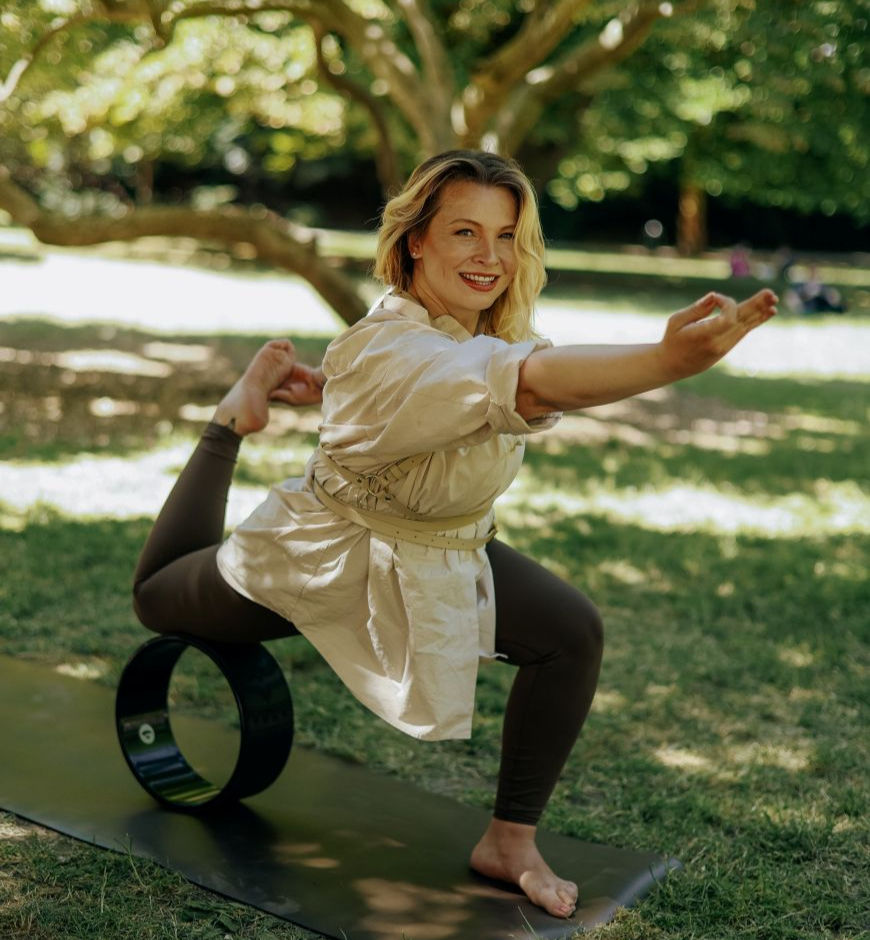
A yoga wheel is a hollow ring about 32 centimetres across, strong enough to carry your body weight. Because it rolls in one direction only, the movement is predictable and easy to dose.
I built the Wheel Yoga® method around two phases in 2014. First, you roll over the wheel to release the back and open the chest, controlling the pressure yourself. Then the same wheel becomes an unstable base for balance and trunk control. Every position is taught at three levels: simplify it, vary it, or make it harder. That is why someone aged 61 who has never exercised and a competitive cyclist can share the same class. If you want the bigger picture of how movement fits into healthy ageing, read my article on how to extend your healthspan beyond wearables.
What 19 clients showed me over ten years
I used the same protocol to record observations from two groups of clients. The first group met in a Prague studio from 2016 to 2017 and included eleven people aged 8 to 73, from a fitness coach to a lawyer who boxed. The second group met in Mariánské Lázně in 2026 and included eight working adults aged 22 to 61, most of them in offices.
The second group is the one every human resources (HR) manager should look at. It included a finance director who cycled every weekend and slept badly, a marketing director with neck pain and a rounded upper back, an accountant aged 61 who had never exercised, and a sales representative whose shoulders had drifted forward for years.
What I recorded:
All 17 people who came with pain or stiffness reported relief. In the office group, it came within one to three weeks.
Posture changed visibly. Their shoulders sat further back, and their upper backs straightened when they stood.
The accountant with no exercise history practised without problems and gained strength and balance.
Two people reported more than I expected. The finance director said he slept noticeably better after the first week, and a woman who came with anxiety said she felt calmer. Two people are two people, so I treat these reports as a question for the next study.
One man, aged 73, did not start. He had severe scoliosis, had undergone repeated hip surgery, and could not hold his spine in a neutral position. That case taught me the most important rule of the method: check first.
What the results do and do not prove
These are my observations as the teacher, without a control group and without validated pain scales. People who get better in a class may also be resting more, moving more, or simply recovering. So I will not tell you the wheel cured anyone. The pattern held across ten years, two towns and very different people, which is why I made the full report available as a public preprint of the observational case series. The next step is a controlled study with office teams.
Take 20 seconds for a safety check before you start
You need a mat and a yoga wheel rated to support at least 300 kg. Many wheels sold online are decorative and have never been tested under load, so check the rating before you lie on one.
Lie on your back with your knees bent. Let your lower back rest in its natural curve and breathe calmly. Now lift one foot a few centimetres. If your pelvis tips, your back hurts, or you cannot find a relaxed neutral position, skip the wheel for now and see a physiotherapist. The same applies if you have recently had spine or hip surgery or if you have severe scoliosis, osteoporosis or an acute injury.
4 yoga wheel exercises for back pain from sitting
Chest opener to reverse desk posture: Sit on the mat in front of the wheel with your feet on the floor. Lean back so the wheel touches the upper part of your back. Keep it away from your neck. Let your chest open towards the ceiling and take five slow breaths. If your neck feels unsupported, rest your head in your hands.
Mobilisation for a stiff upper back: Lie back over the wheel so it sits under your upper back, and support your head with your hands. Push gently with your feet and move the wheel a few centimetres at a time along your upper back. Pause on the stiff spots and breathe. Keep the wheel away from your neck and lower back.
Release for the lower back with feet on the wheel: Lie on your back and place the soles of both feet on the wheel with your knees together. Let your knees sway a few centimetres slowly to one side and back, then to the other, eight times. Keep the movement small and let your lower back stay heavy on the mat.
Two minutes of breathing to calm down: Lie on your back and rest your calves on the wheel with your knees slightly above heart level. Let your arms relax by your sides. Breathe in through your nose for four counts and out for six. Every Wheel Yoga® class ends in a relaxation position like this one. Stop any exercise if you feel sharp pain, tingling or numbness.
How employers can use the yoga wheel at work
Standing desks and ergonomic chairs fix the furniture. The body still needs to move against the shape of sitting a few times a week. Fellow contributors have written well about turning a sedentary workplace into an active one and about the benefits of an office massage programme. A wheel session sits between the two. It’s active like exercise and offers relief like massage, with each employee controlling the pressure.
What works in practice:
Run a session for 45 to 60 minutes once a week in a meeting room. There’s no need for changing rooms or sports clothing.
Keep each session to 15 people or fewer and use the short safety check for each person.
Measure it. Before the first session and again after eight weeks, ask team members to rate their pain from 0 to 10 and time how long they can stand on one leg. Then you have your own data.
I use the same principles in the movement programmes I design for spa hotels. I describe those programmes in my article on how to elevate hotel wellness with Neurovitae®.
Bring a Wheel Reset session to your team
I run Wheel Reset sessions for companies in Graubünden in German and English, and I train movement professionals in the Wheel Yoga® method. Book a free 30-minute trial session for your team here, or write to schwalb@vitale.spa.
Read more from Jana Schwalb
Jana Schwalb, Neuro-Wellness Visionary & Founder
Jana Schwalb, MBA, is an international neuro-regeneration expert and published author with 15 years of experience in the wellness sector. Since 2016, she has dedicated over a decade to clinical and somatic research, specializing in how sensory and movement patterns reset brain performance. As the founder of Neurovitae® and Vitale.spa, Jana licenses premium turnkey longevity programs and provides architectural wellness consulting for luxury European hotels. Additionally, she translates these advanced scientific principles into private, boutique somatic coaching via Move Alchemy, based in Chur, Switzerland.