10 Minutes on a Rebounder is Equal to 30 Minutes of Cardio for Lymphatic and Immune System Health
Dave Scrivens is a lymphologist with 20+ years of experience. The lymphatic system is critical to your overall health and well-being. A Lymphologist teaches his clients the physical, mental, and nutritional properties required to either reverse or keep their bodies disease-free in today's toxic world.

In 1980, NASA strapped monitors onto eight young men, put them on a treadmill, then had them jump on a trampoline. Given that it was a lab setting, it was very likely a smaller, more controlled apparatus than a backyard trampoline, practically speaking, with the same basic mechanics behind what is sold today as a rebounder.
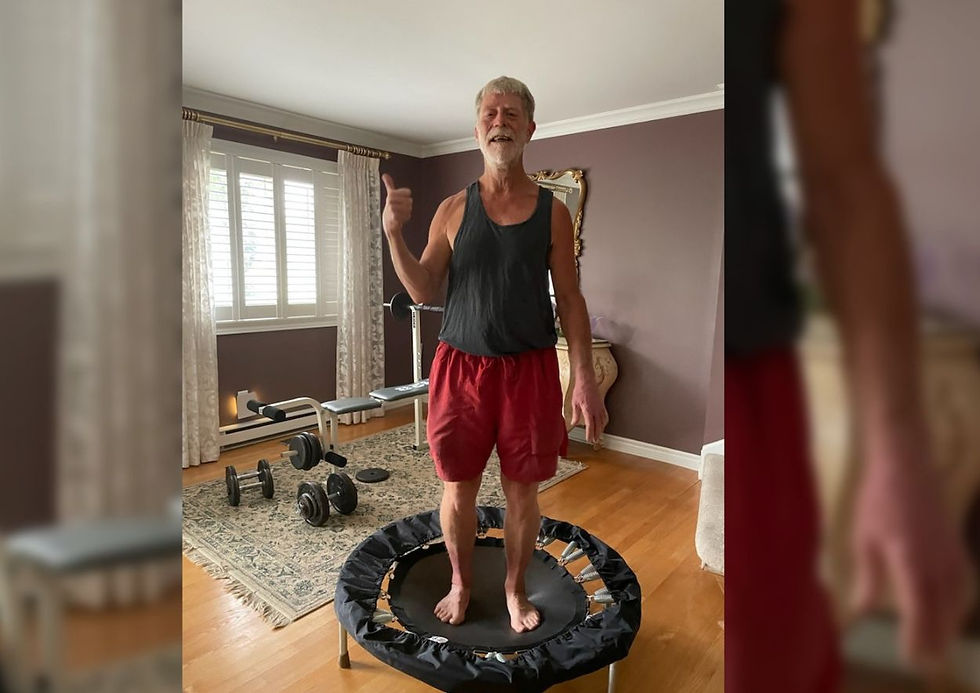
The study itself never uses that word, since the branding did not really exist yet in 1980, but the physics being measured, vertical bounce, acceleration, deceleration, and gravitational load, are the same mechanics a rebounder uses now. That is why, decades later, this NASA data is still cited as foundational science behind rebounder training. The experiment's logic holds up whether you call the device a trampoline or a rebounder because the body does not know the difference; it only knows the forces acting on it.
What they found surprised everyone in the room: for the same heart rate and the same oxygen use, the body was doing significantly more work while bouncing than while running, with the researchers measuring the biggest gap at around 68%.
Let that sit for a second. Not "trampolines are fun." Not "bouncing burns calories." The government's own space agency accidentally discovered one of the most efficient exercises on the planet, and that efficiency matters for more than just your workout. When your body does more work using less oxygen and less cardiovascular strain, it is not left as depleted afterward, which is part of why I, other naturopaths and wellness experts, and my own clients consistently report this same bonus: more energy carrying through the rest of the day, not just during the bounce itself.
Is rebounding a good exercise?
Short answer: yes, and not for the reason most people think. The magic of rebounding is not just cardio output; it is how little your body pays for that output. Running pounds your joints. Rebounding barely does. That trade-off is the whole story.
Is bouncing on a trampoline a good exercise? Is it the same as a rebounder?
Quick but important distinction: a backyard trampoline and a rebounder are not the same tool. A full-size trampoline gives you a big, unstable bounce with a hard catch at the bottom. A proper rebounder, spring-loaded or bungee-corded, usually 36 to 40 inches, gives you a small, controlled bounce that is gentle enough for a 75-year-old and intense enough for pro athlete training. When people talk about the health benefits of "bouncing," they almost always mean the rebounder, not the backyard trampoline.
Rebounding exercise benefits for cardio, stamina, and energy
Here is the part that actually matters for your day-to-day life: cardio without the crash. Because the motion is rhythmic and low-impact, you can sustain rebounding longer than you would sustain hard running, which is exactly what builds real stamina, not just a spiked heart rate for ten minutes, but a body that recovers faster and has more energy left over afterward. There are biohacks in this area that aid better results on the rebounder and are used by lymphologists.
The NASA study everyone quotes, and what it actually found: The 1980 study, published in the Journal of Applied Physiology, found that 10 minutes of rebounding produced up to 68% more physical work output than 30 minutes of jogging at the same heart rate and oxygen consumption (VO₂). That is a real, published, peer-reviewed number, not marketing fluff. Worth knowing, though: it was a small study involving eight young men, and a later 2002 study found no measurable difference in calorie burn or VO₂ max between a mini-trampoline and a treadmill. So take it as this: rebounding may not out-burn a treadmill calorie-for-calorie, but it very likely outperforms it in efficiency and joint safety, which, for stamina and long-term energy, might matter more anyway.
Rebounding exercise benefits beyond cardio
There is a lot to take away when it comes to rebounding. As it works a whole-body critical system like the lymphatic system, it also affects the function of other systems in the body. Let’s break those down a bit further.
Mitochondria, glycogen, and cellular energy: Rhythmic aerobic movement like rebounding is known to stimulate mitochondrial activity, your cells' actual energy factories. More efficient mitochondria mean more usable energy, less fatigue, and better stamina over time. Rebounding also supports how well your body stores and taps into glycogen, your muscles' short-term fuel reserve, which is part of why regular rebounders often report steadier energy throughout the day instead of the usual afternoon crash.
Full-body strength, skeletal health, and core activation: Every bounce forces your stabilizer muscles to fire, including your legs, glutes, and especially your core, which is working the entire time just to keep you upright and balanced. That's why rebounding is often called one of the best core workouts nobody's doing: you're not doing crunches, you're just bouncing, and your core is quietly getting hammered the whole time. The same up-and-down loading also stresses bone in a healthy, controlled way, which is part of why it's used in bone density and rehabilitation programs.
A vertical motion workout, working with and against gravity: Here's what makes rebounding genuinely different from almost every other form of exercise: it's overwhelmingly vertical. Walking, running, cycling, and most high-intensity interval training (HIIT) routines are built around horizontal motion, moving your body forward through space, with only a small vertical component along the way. Rebounding flips that. Every bounce sends your body up and down along the vertical plane, directly against gravity, dozens of times a minute.
That distinction matters more than it sounds like it should. When you move against gravity instead of primarily across it, gravity pushes back on every single cell in your body, not just your legs and feet. That's a fundamentally different kind of loading. It's why your core has to fire constantly just to stabilize you through that vertical path, and it's part of why rebounding builds full-body strength in a way that horizontal-motion exercise simply doesn't replicate.
There are biohacks that go with the rebounder and a proper sports exercise training regimen. Using vertical motion workout technology with a lymphologist brings the athlete to the next level. Vertical motion workouts are extremely important, unique, and beneficial to the athlete, even unparalleled. It is like yoga. Once you experience it, then you get it. Any athlete or team that incorporates this into their program will have a distinct advantage.
Connective tissue and stretch: Every bounce loads and releases your fascia and connective tissue in a gentle, rhythmic stretch-and-recoil pattern, nothing forced and nothing jarring. Over time, that repeated soft-tissue loading can help keep fascia pliable, which matters more than people realize, since tight, restricted fascia is part of what can slow lymph flow in the first place.
Why the lymphatic system matters (and why it needs help)
Before we get into how rebounding works the lymphatic system, it’s worth understanding why that even matters. Your lymphatic system is your body’s waste removal, immune system, and nutrient transport network, all in one. It clears out cellular debris, excess fluid, toxins, and metabolic waste, while also moving immune cells to where they’re needed to fight infection.
Every cell in your body sits in a small pool of fluid, and that fluid has to be continuously drained and filtered. That’s the lymphatic system’s job, running quietly 24/7, whether you think about it or not.
Here’s the catch: unlike your circulatory system, the lymphatic system has no heart. No central pump. It moves entirely through muscle contraction, pressure changes in your body, such as breathing, movement, and one-way valves doing their job in sequence. That means if you’re sedentary, stagnant, dehydrated, stressed, or just not moving enough, that fluid can start to sit still instead of flowing, and stagnant fluid means the waste it’s supposed to be carrying out sits still too. That’s what congestion actually is, and it’s the difference between a body that detoxes efficiently and one that’s quietly overwhelmed by its own backlog.
How does rebounding work the lymphatic system?
Most forms of exercise move lymph somewhere. Walking activates the lymph vessels in your legs, for instance. But rebounding is different because of the specific physics involved: every single bounce puts your entire body through a rapid cycle of acceleration, peak gravitational load, then deceleration, top to bottom, all at once.
That vertical, whole-body G-force shift is what opens and closes lymphatic valves throughout your entire system in one motion, not just your legs, not just your arms, but the full network simultaneously, over and over, dozens of times a minute.
That’s the mechanism most other cardio simply doesn’t have. Running is mostly horizontal force. Cycling barely loads your upper body at all. Rebounding is the rare exercise where the entire lymphatic network, neck, chest, gut, and limbs, gets worked at the same time, every single bounce. That’s why, in practice, I see it move fluid and support full-body detox in a way that’s hard to replicate with any other single form of movement.
Mini-trampoline workout for the lymphatic system
If you read my earlier piece on lymphatic congestion symptoms, this is the action side of that article. Congestion builds quietly through inactivity, dehydration, and stress, and rebounding is one of the most direct, physical ways to reverse that, alongside proper hydration and detox support. It's not a replacement for a full detox approach, but it's the single most effective movement-based tool I put people on.
Mini-trampoline workout: High-intensity interval training, moderate, or senior-friendly
One of the most underrated things about a rebounder is how scalable it is:
High-intensity interval training (HIIT) style: short bursts of high-knee or jumping-jack-style bounces with rest intervals, for people who want an intense session in a short window.
Moderate/steady-state: a consistent, easy bounce for 15 to 20 minutes, ideal for stamina building and daily lymphatic mobilization.
Senior or rehab-friendly: a gentle heel-lift bounce, sometimes with feet never fully leaving the mat, using a stability bar, enough motion to activate lymph flow and joints without any real impact at all.
That range is exactly why I recommend it across such a wide age span in my own practice. The tool doesn't change, just the intensity you bring to it. There are many biohacks for exercise, too.
Rebounder trampoline: What makes a "proper" one
Not all mini trampolines are built the same. A proper rebounder uses either springs or bungee cords designed specifically to absorb the bulk of the impact before it ever reaches your joints, which is the entire reason this can work for a teenager and their grandparent on the same afternoon. If you're shopping for one, that mechanism matters more than the price tag.
The bottom line
The takeaway here isn't "bounce more, feel better," even though that's basically true. It's that your body has a built-in cardio machine, lymphatic pump, and core workout wrapped into one low-impact tool, and most people have never touched one. NASA figured this out in 1980. It's taken the rest of us a while to catch up.
Read more from David Scrivens
David Scrivens, Lymphatic System Coach & Body Detox Specialist
Dave Scrivens is a leader in educating clients about the critical importance of the often overlooked and underappreciated lymphatic system. When the medical system could not provide answers to several of his health challenges, some of them critical, he discovered the importance of the lymphatic system to overall health and began his journey as a lymphologist. With help from other naturopaths, continued learning, and self-improvement, he regained his health and now enjoys helping others do the same. He believes people can improve their health with a better understanding of the lymphatic system.