You Don't Need More Time for Your Health, You Need to Know Where to Look
Sarah Wittl is a Health & Wellbeing Transformation Coach and founder of Sarah’s Wellbeing Hub. She helps individuals and organisations build sustainable physical, mental, and emotional health through self-guided tools, coaching, and leadership wellbeing programs.

You're pulled in every direction, saying yes to a project you actually mean no to because everyone already knows you're the reliable one. You skip lunch because you have meetings one after another. You go from home to work to home again without a single moment that's actually yours. You feel exhausted, do everything for everyone, and have no time left for yourself. You know you want to finally feel well, energised and healthy, but you find yourself thinking, “I don't have time.” It feels true because it is true. But here is the good news: time is not what you need more of. It's something else. Let's find out.
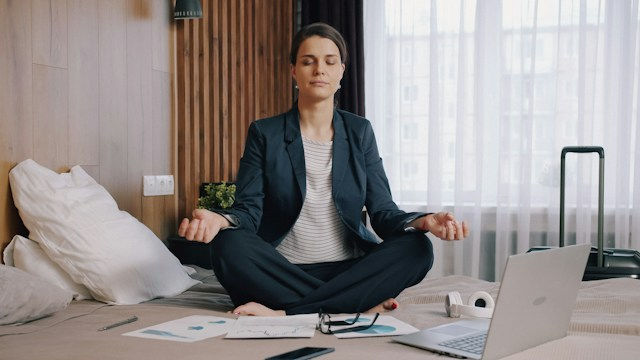
“I don't have time” is rarely the real problem
Here's what I see again and again with clients and members: when someone says, “I don't have time,” it's not an excuse. It's a genuine, lived reality. But it's also a symptom, not the root cause. Underneath almost every “I don't have time,” there's a missing system. Time is just where that missing system shows up first.
I've watched this shift happen over and over with ambitious, highly driven people, executives with genuinely full schedules and zero spare hours anywhere. What changed for them wasn't more time. It was focus. They stopped trying to squeeze in more and started understanding what we call their own Personal Wellbeing Blueprint: which pillar of their health actually needed attention. From there, energy increased, they felt more connected, and their health improved physically, mentally, and emotionally, without a single extra hour appearing anywhere.
What “I don't have time” actually means
In practice, “no time” looks like this: waking up already exhausted and rushing to make food for everyone else before making any for yourself. Being pulled into conversation before you've even oriented yourself to the day. Rushing from meeting to meeting, skipping bathroom breaks and breakfast, and running on adrenaline instead of fuel. Saying yes to one more thing because you don't yet feel comfortable saying no.
None of that is a discipline problem. It's the visible symptom of a missing system, and which system is missing depends entirely on the person. That's where your Personal Wellbeing Blueprint comes in: understanding exactly where the gap sits.
The 4 ways “no time” shows up
“I don't have time” means something completely different depending on which pillar of your Personal Wellbeing Blueprint is asking for attention.
If you feel run by your own calendar, with willpower and duct tape holding your day together, able to find anyone else's five minutes but never your own, having “no time” is the symptom of a missing system in how your environment is set up around you. What a system there actually looks like: food that's easy to access and actually fuels you. A calendar you run, instead of one that runs you – one that accounts for the kind of energy a day requires before it fills the slots. A home and work environment that makes things easier, and a circle of influence that lifts you rather than drains you. Build that, and you stop feeling like you're managing chaos. You feel spacious in your own life, able to adapt to whatever it throws at you next.
If you feel like you're pushing through everything, proud of needing very little to keep going and treating your own hunger and tiredness as inconveniences to override rather than signals to listen to, having “no time” is the symptom of a missing system for how your body is actually fuelled. What a system there actually looks like: knowing what food works for your specific body, and when. Accessing energy through daylight, movement or stillness, depending on what the moment calls for. Once that's in place, something shifts: you get to stay driven and ambitious and feel energised at the same time. You start running your life from a full tank instead of empty.
If your mind is still running the moment you close your laptop, replaying a conversation from three days ago, never fully anywhere because part of you is always somewhere else, having “no time” is the symptom of a missing system for how your mind actually resets. What a system actually looks like: you don't need an hour. You need one minute between tasks, a small reset that lets your mind integrate and process instead of endlessly crowding itself. By the end of the day, you recover faster, and you arrive in the moment faster too. You're actually present with the people you love, instead of still mentally at work while physically somewhere else.
If you're the first call anyone makes when things fall apart, always with room for one more person's problem, genuinely forgetting what your own “yes” sounds like when it isn't automatic, having “no time” is the symptom of a missing system that protects your own energy and needs. What a system actually looks like: boundaries that are actually spoken, not just felt. Knowing your own needs well enough to name them before you're too depleted to notice you have any left. Build that, and you stop running on what's left over. You get to be reliable and full.
Where time actually comes from
Here's the real shift: it's not about adding more time to your day. It's about using the time you already have differently.
Most of the moments we call “wasted”, rushing between meetings and moving from one task to the next, aren't actually empty. They're autopilot. There's a simple shift available in exactly those moments: becoming the observer instead of the experiencer. Looking through the same eyes, but through a different lens.
The moment you shift from experiencing a situation to observing it, you create a small gap, mentally and consciously. That gap is where everything happens. It's where awareness builds. Awareness builds understanding. Understanding builds the systems that make up your Personal Wellbeing Blueprint.
It's the same gap I wrote about in “You Don't Need a Better Plan. You Need Your Own Map.” The space between noticing and understanding is where the real answer always lives. You still only have 24 hours, the same as everyone else. But inside that gap, you can finally choose differently, consciously and in the moment, instead of running on autopilot toward the same depletion.
Where you go from here
You don't need more hours. You need to know exactly where to look. Take the free Wellbeing Independence Score, find out your Archetype and which pillar is actually asking for your attention, your starting point and the exact place your Personal Wellbeing Blueprint begins.
Follow me on Facebook, Instagram, and LinkedIn for more info!
Read more from Sarah Wittl
Sarah Wittl, Health & Wellbeing Transformation Coach
Sarah Wittl is a Health & Wellbeing Transformation Coach and founder of Sarah’s Wellbeing Hub. With over a decade of experience in executive coaching, neuroscience-based leadership, and physical training, she bridges personal and organisational wellbeing through her unique self-guided approach. Her work empowers individuals and teams to create lasting balance across body, mind, and emotions by focusing on sustainable habits and self-leadership. A former Australian National Karate Champion and lifelong martial artist, Sarah blends strength, compassion, and science to help others thrive from the inside out.